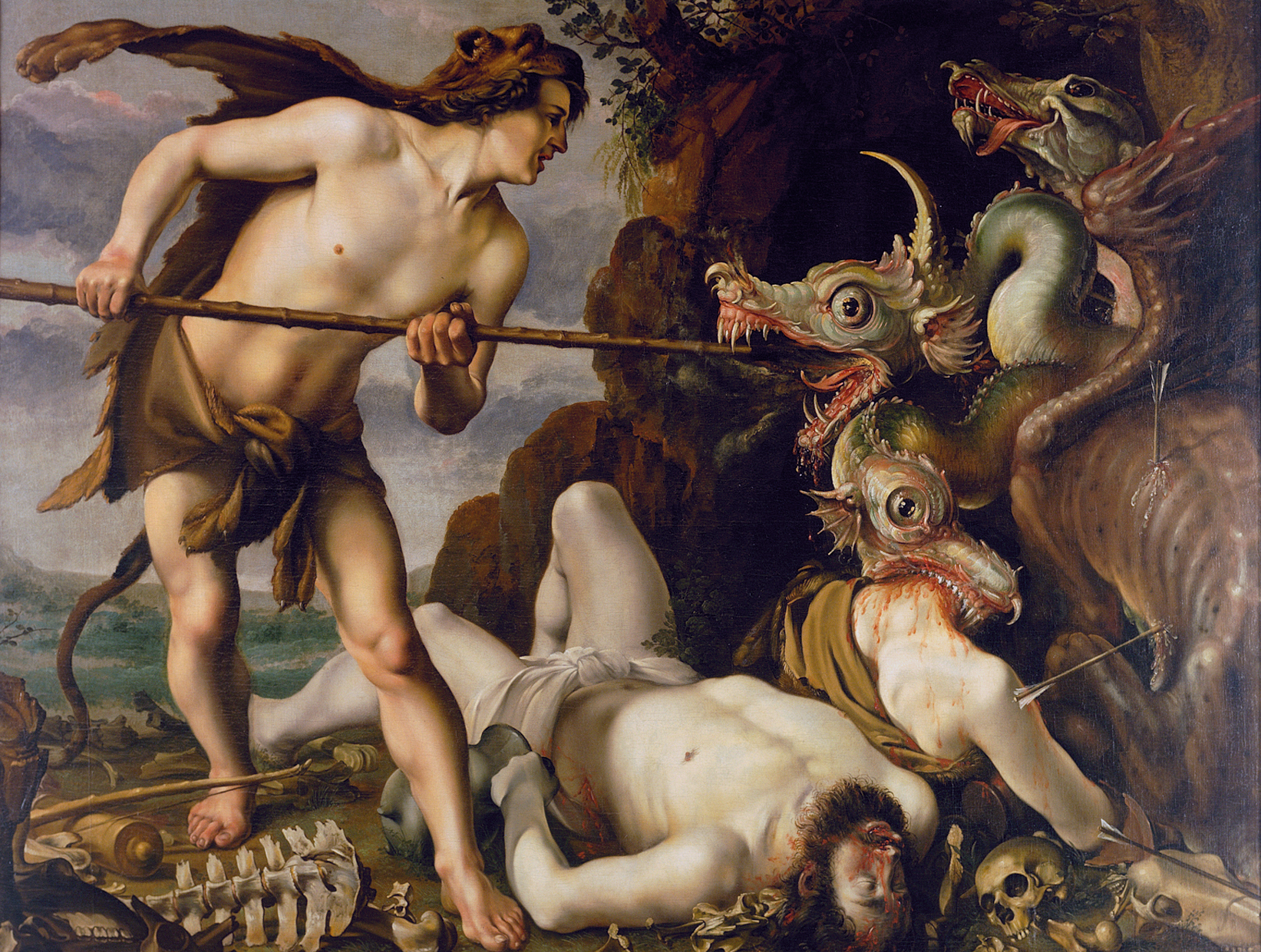
The ancient city of Thebes occupies a unique place in Greek mythology as a city repeatedly marked by tragedy, divine punishment, and the consequences of human pride. According to tradition, Thebes was founded by Cadmus, a Phoenician prince searching for his sister Europa after she had been carried away by Zeus. Following the guidance of the Oracle of Delphi, Cadmus killed a sacred dragon belonging to Ares and, on the advice of the goddess Athena, sowed the dragon's teeth into the earth. Armed warriors known as the Spartoi ("Sown Men") sprang from the ground. After fighting among themselves, the surviving Spartoi became the noble ancestors of Thebes' leading families.
Although Cadmus successfully founded the city, the killing of Ares' sacred dragon brought a lasting curse upon his descendants. Over the generations, this curse manifested itself through repeated disasters, betrayals, and family conflicts. One of the most famous episodes involved King Oedipus, who unknowingly fulfilled a prophecy by killing his father, Laius, and marrying his own mother, Jocasta. When the horrifying truth was revealed, Jocasta took her own life, while Oedipus blinded himself and went into exile.
The curse continued into the next generation when Oedipus' sons, Eteocles and Polyneices, fought one another for control of Thebes. Their rivalry culminated in the famous conflict known as the Seven Against Thebes, during which the brothers killed each other in single combat. Later, the city was attacked again by the Epigoni, the sons of the original seven champions, who finally succeeded in conquering Thebes. Through these successive tragedies, Thebes became a symbol of the destructive consequences of fate, pride, and family curses, illustrating the Greek belief that divine justice eventually reaches even the greatest cities.