Childhood in ancient Greece was not simply a period of preparation for adulthood. Children played, competed, imitated adults, and participated in family and religious life. Archaeological discoveries, literary references, vase paintings, and surviving ancient objects provide evidence that Greek children possessed a surprisingly diverse collection of toys and games.
Although childhood experiences differed according to gender, social status, location, and period, play was an important part of growing up. Toys could entertain children, help develop physical coordination, teach social behavior, or imitate the activities of adults.
Dolls and Figurines
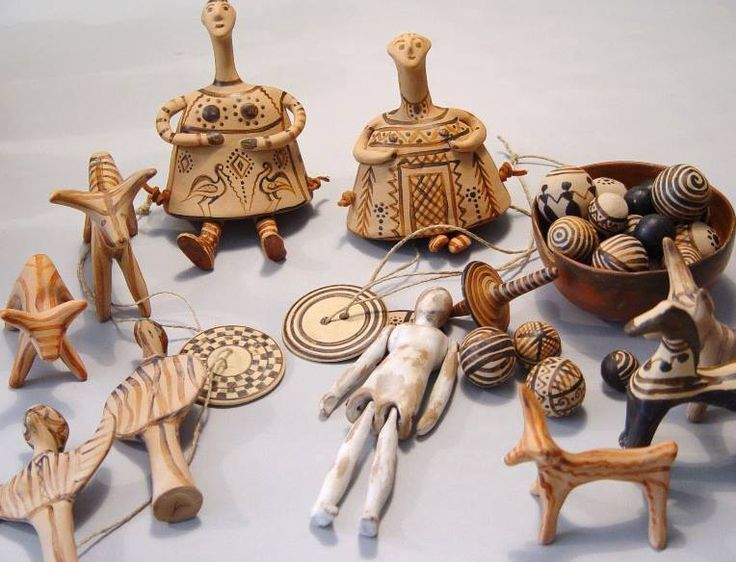
One of the most recognizable ancient Greek children's toys was the doll.
Greek dolls were commonly made from materials such as:
terracotta;
wood;
bone;
ivory;
and occasionally other materials.
Some terracotta dolls had movable arms and legs.
These articulated dolls could be dressed and manipulated, making them particularly interesting examples of ancient children's material culture.
Dolls and Girls' Childhood
Dolls appear to have had particular associations with girls.
This was partly because dolls could imitate adult roles associated with household life, clothing, marriage, and motherhood.
However, it would be too simplistic to assume that every doll was exclusively a girl's toy.
Children's play was often more flexible than rigid modern categories suggest.
Toy Animals
Children also played with miniature animals.
Archaeologists have discovered figurines representing:
horses;
dogs;
birds;
pigs;
cattle;
and other animals.
Some were simple figurines, while others may have been designed to move or be pulled.
Toy Horses and Chariots
Horses held enormous cultural importance in Greek society.
Children could imitate adult activities by playing with miniature horses, riders, and chariots.
Toy chariots demonstrate how children's games could reproduce aspects of warfare, transportation, athletics, and elite culture.
Balls
Ball games were another form of childhood entertainment.
Balls could be made from materials such as:
leather;
cloth;
wool;
or inflated animal materials.
Greek literature and visual art provide evidence that ball games existed for both children and young people.
Hoops and Physical Games
Children also participated in games requiring movement and coordination.
Games involving hoops, running, throwing, and catching helped develop physical skills.
This was consistent with the broader Greek emphasis on physical fitness.
Knucklebones
One particularly widespread game used knucklebones, often called astragaloi.
These were commonly made from the ankle bones of sheep or goats.
They could be:
thrown like dice;
used in games of chance;
or incorporated into skill-based games.
Adults also used them for gambling and divination.
Board Games
Ancient Greeks played various games involving boards, pieces, counters, or strategic movement.
The exact rules of many ancient games are uncertain.
Nevertheless, archaeological and literary evidence demonstrates that organized games were part of Greek recreational culture.
Spinning Tops
Spinning tops were another form of children's entertainment.
A child could spin the object and attempt to keep it rotating for as long as possible.
The game required coordination and practice.
Yo-Yo-Like Objects
Archaeological discoveries have also produced objects resembling simple versions of modern yo-yos.
These demonstrate that mechanical toys were not unknown in antiquity.
Kites?
Claims about ancient Greek kites occasionally appear in popular discussions, but the evidence is considerably weaker than for dolls, balls, knucklebones, and spinning toys.
This distinction is important when discussing ancient childhood.
Not every modern children's game can safely be projected backward into Greek history.
Play and Social Development
Games taught children important social skills.
Through play, children learned:
cooperation;
competition;
patience;
physical coordination;
rules;
strategy;
and social negotiation.
Religious Connections
Toys could also have religious significance.
When children reached important stages of life, they might dedicate childhood possessions to gods.
Girls approaching marriage, for example, could dedicate dolls and other childhood objects to Artemis.
This represented the transition from childhood toward adulthood.
Toys in Graves
Some toys have been discovered in ancient graves.
Their presence suggests that toys could have emotional and symbolic significance.
A child's favorite possession might accompany them into death.
Childhood and Social Class
Wealth influenced the types of toys available.
Children from wealthy families could have elaborate terracotta or imported objects.
Poorer children could use:
homemade dolls;
sticks;
stones;
scraps of cloth;
or simple natural materials.
The difference illustrates an important principle of archaeology: the objects that survive are not necessarily representative of everything children actually used.
Conclusion
Ancient Greek Childhood Toys and Games reveal a world in which children learned through imitation, competition, creativity, and physical activity.
Dolls, animals, balls, knucklebones, spinning toys, and miniature vehicles provided entertainment while also reflecting the larger society around children.
Play was therefore more than amusement. It was one of the ways Greek children learned how to understand their world.