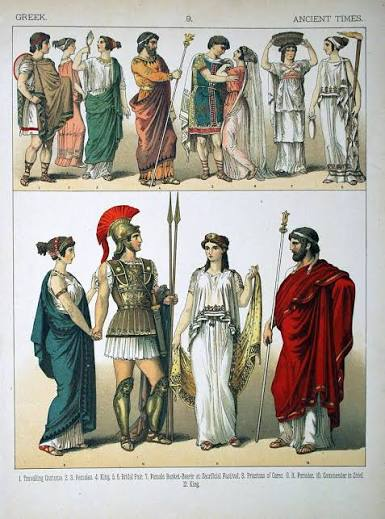
Clothing in ancient Greece was influenced by climate, social status, gender, occupation, wealth, and local traditions.
Although Athenians and Spartans shared many basic Greek garments, their societies developed noticeably different cultural attitudes toward clothing.
Athens became associated with urban life, trade, artistic culture, and elaborate civic institutions, while Sparta emphasized military discipline, physical endurance, and communal identity.
These differences affected how clothing was understood and used.
Basic Greek Garments
Both Athenians and Spartans used garments such as:
the chiton;
the peplos;
the himation;
cloaks;
sandals;
and other simple footwear.
Greek clothing generally relied on rectangular pieces of fabric that could be folded, wrapped, pinned, and belted.
The Chiton
The chiton was a basic garment made from fabric and worn by both men and women.
It could be:
short or long;
plain or decorated;
belted or loose.
The exact appearance depended on period, region, sex, age, and social context.
The Himation
The himation was a large outer garment.
It could be wrapped around the body in different ways.
A wealthy person's himation might use high-quality wool and decorative borders.
Women's Clothing
Women commonly wore garments such as the peplos and chiton.
In Athens, respectable women were often represented as wearing long garments that covered much of the body.
However, artistic representation does not always provide a straightforward picture of everyday clothing.
Athenian Clothing Culture
Athens was a major commercial and artistic center.
Textiles and dyes circulated through extensive trade networks.
Wealthier Athenians could therefore obtain higher-quality fabrics and decorative materials.
Clothing could communicate:
wealth;
age;
occupation;
civic identity;
and social position.
Spartan Clothing
Spartan clothing was influenced by the city's emphasis on simplicity and physical training.
Spartan men were expected to develop endurance rather than demonstrate luxury.
Military clothing and equipment therefore became especially important.
Spartan Women
Spartan women are particularly interesting.
They were often represented as wearing relatively practical clothing and participating in physical exercise.
Compared with Athenian women, Spartan women had greater social and economic independence in several respects.
Their clothing was therefore sometimes described by ancient observers as less restrictive.
The Spartan Red Cloak
The famous Spartan military cloak, commonly associated with red fabric, became an iconic part of Spartan imagery.
The color has sometimes been connected with military identity and the visual distinction of Spartan warriors.
However, popular claims about its exact practical or symbolic purpose should be treated carefully because ancient evidence is limited.
Clothing and Physical Activity
Spartan society placed exceptional emphasis on physical training.
Clothing needed to accommodate movement.
This was especially relevant for:
athletics;
military training;
running;
wrestling;
and other exercises.
Clothing and Gender
The contrast between Athens and Sparta is particularly interesting because clothing reflected different expectations of gender.
Athens generally emphasized women's domestic roles.
Sparta provided women with greater opportunities for physical training and property management.
Jewelry
Athenian and Spartan women could both wear jewelry.
Items included:
earrings;
necklaces;
bracelets;
rings;
and decorative pins.
However, excessive luxury could conflict with ideals of simplicity in certain contexts.
Conclusion
Clothing Styles in Athens vs. Sparta demonstrates that garments were not merely practical objects.
They expressed cultural values.
Athens developed a clothing culture connected with urban wealth, social distinction, and artistic traditions, while Sparta's reputation for austerity and military discipline encouraged a different approach.
The same basic Greek garments could therefore communicate very different social meanings depending on where and how they were worn.