The Diolkos was one of the most remarkable transportation systems of ancient Greece.
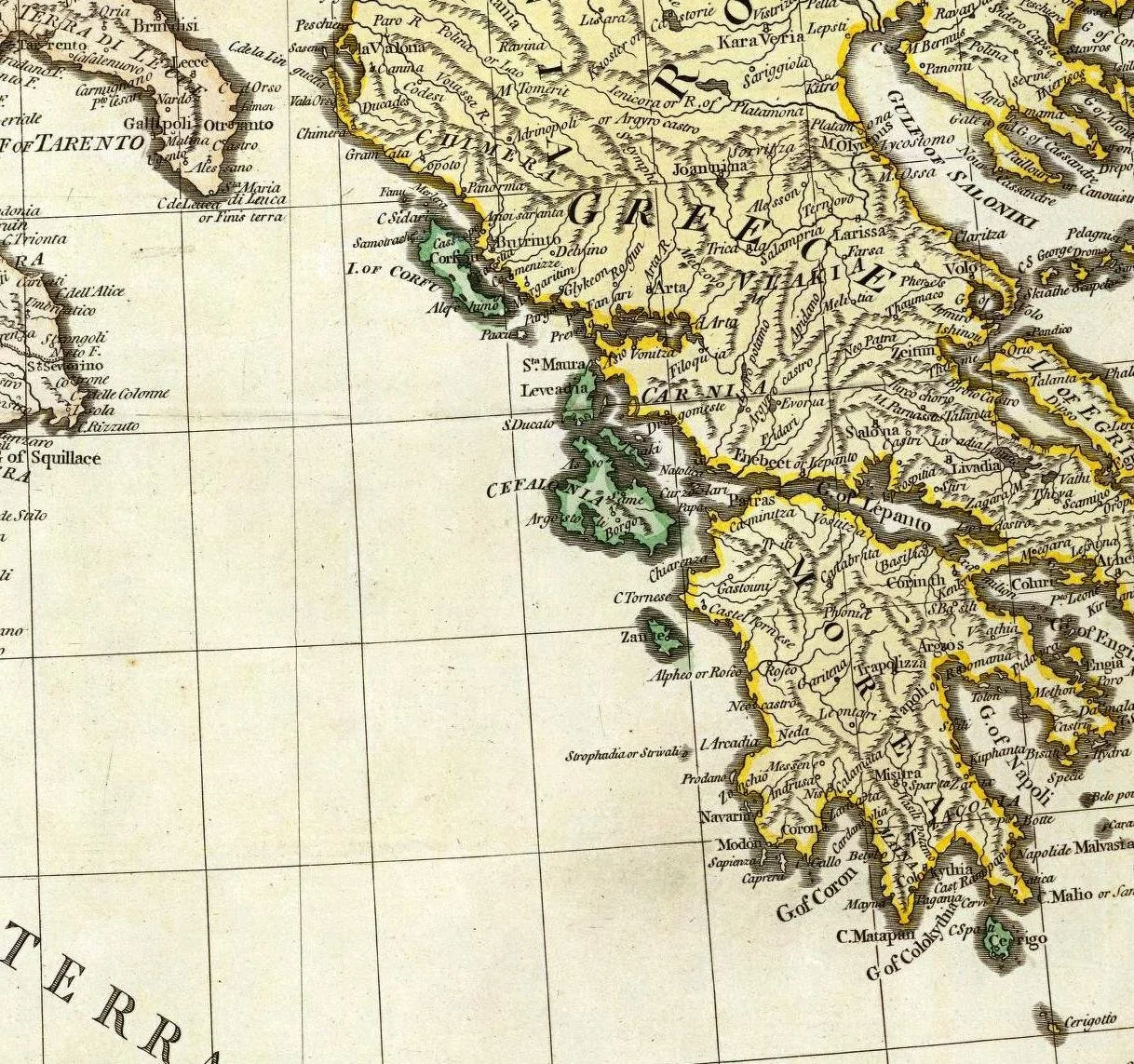
Located across the Isthmus of Corinth, it provided a means of moving goods and potentially vessels or ship cargo between the Gulf of Corinth and the Saronic Gulf.
Although it is sometimes described as a “canal,” the Diolkos was actually a paved overland trackway, making the distinction important when discussing its engineering.
The Problem of the Isthmus
The Peloponnese is connected to mainland Greece by the narrow Isthmus of Corinth.
Ships traveling from one side of the Greek mainland to the other would otherwise have to sail around the Peloponnese.
The southern route could be dangerous because of strong winds, currents, and difficult coastal waters.
The Diolkos Solution
Instead of constructing a waterway, ancient engineers created a land transportation system.
The Diolkos allowed cargo to be transported across the Isthmus.
Under some circumstances, ships or portions of ships may also have been moved along the route.
Construction
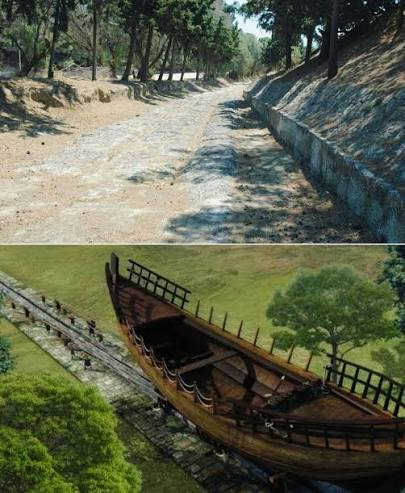
The trackway was paved with large stone blocks.
Its design was sufficiently robust to support heavy loads.
Parallel grooves or structural features helped organize movement.
How Ships Could Be Moved
The precise operating system remains debated.
Researchers have proposed that ships or cargo could be placed on wheeled platforms and hauled by teams of workers or animals.
The process would have required:
ropes;
wooden supports;
rollers or wheels;
manpower;
and careful coordination.
Economic Importance
The Diolkos reduced the need for ships to undertake the dangerous voyage around the Peloponnese.
It therefore had the potential to save:
time;
fuel;
labor;
and risk.
Corinth's Commercial Power
The route contributed to Corinth's strategic position.
The city already possessed access to two major maritime zones.
The Diolkos enhanced its ability to control movement between them.
Ancient Engineering
The project demonstrates several sophisticated engineering concepts.
Builders needed to understand:
load distribution;
road gradients;
traction;
stone paving;
transportation logistics;
and mechanical advantage.
Was It a “Canal”?
No.
Calling the Diolkos a canal is misleading.
A canal is a navigable artificial waterway.
The Diolkos was a land-based transport route.
The later construction of the modern Corinth Canal solved the same broad geographical problem using an entirely different engineering principle: cutting a navigable waterway through the Isthmus.
The Modern Corinth Canal
The Corinth Canal opened in the nineteenth century.
Unlike the ancient Diolkos, it allows ships to pass directly through water.
The contrast between the two projects demonstrates the evolution of transportation engineering across more than two millennia.
Archaeological Remains
Sections of the ancient Diolkos have been identified archaeologically.
The surviving stonework allows researchers to reconstruct aspects of the route's construction and use.
Historical Significance
The Diolkos is particularly important because it shows that ancient Greek engineering was not limited to temples and monumental architecture.
Engineers also developed practical infrastructure to solve major transportation problems.
Conclusion
The Engineering Marvel of the Diolkos Canal reveals the extraordinary practicality of ancient Greek engineering.
Although it was not technically a canal, the Diolkos solved one of the most difficult transportation problems of the Corinthian Isthmus through a sophisticated paved overland system.
Its existence demonstrates how ancient engineers combined geography, materials, manpower, and mechanical principles to improve maritime commerce long before modern engines, railways, or canal technology.