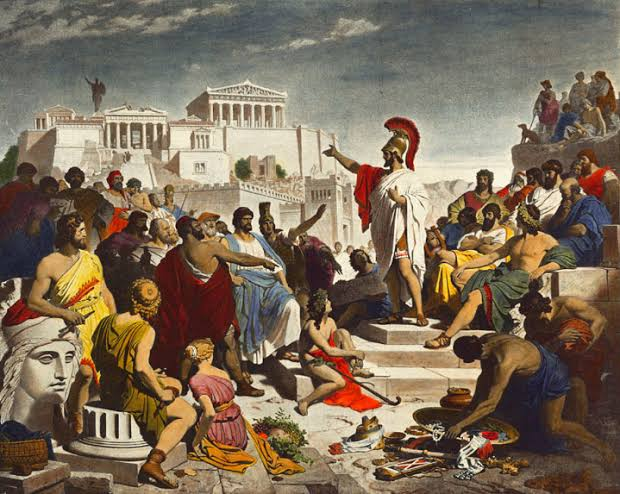
Public speaking was one of the most important political skills in ancient Greece, particularly in democratic Athens.
Political decisions were frequently made through public debate, assemblies, councils, courts, and other institutions where citizens had to persuade one another.
A politician therefore needed more than wealth or military experience.
He needed the ability to:
construct arguments;
respond to opponents;
appeal to emotions;
present evidence;
and speak confidently before large audiences.
Public speaking became so important that rhetoric eventually developed into a major field of Greek education and intellectual study.
Democracy and the Assembly
Athenian democracy relied heavily on the ekklesia, or citizen assembly.
Eligible male citizens could attend and participate in political decision-making.
The assembly dealt with matters including:
war;
alliances;
laws;
finances;
and public policy.
Because decisions depended on persuasion and voting, speeches could have enormous consequences.
Who Could Speak?
Athenian democracy was highly participatory but not universal.
Women, enslaved people, and resident foreigners were excluded from citizenship.
Political participation was primarily available to adult male citizens.
This limitation is essential when discussing Greek democracy.
The Power of Persuasion
A speaker had to convince listeners that his proposal was:
beneficial;
practical;
just;
and consistent with civic interests.
Arguments could appeal to:
logic;
emotion;
tradition;
religion;
fear;
patriotism;
or economic interests.
Rhetoric
The Greeks developed sophisticated theories of rhetoric.
Aristotle later identified three major persuasive strategies:
Ethos — establishing credibility.
Pathos — influencing emotions.
Logos — using reasoning and argument.
These concepts remain fundamental to public speaking today.
The Courts
Public speaking was also essential in Athenian courts.
There were no modern professional prosecutors and defense attorneys in the same sense as contemporary legal systems.
Citizens often had to represent themselves.
A person involved in litigation therefore needed to construct a persuasive speech.
Professional speechwriters known as logographers could assist individuals in preparing their arguments.
Political Speeches as Historical Sources
Some ancient speeches survive in written form.
Works attributed to speakers such as:
Demosthenes;
Aeschines;
Lysias;
and Isocrates
provide insight into political and social debates.
However, these speeches should not automatically be treated as objective historical records.
They were designed to persuade.
A speaker might exaggerate, omit information, or portray an opponent negatively.
Demosthenes
Demosthenes became one of the most famous Athenian orators.
He opposed the expansion of Macedonian power under Philip II.
His speeches, including the famous Philippics, attempted to persuade Athenians that Macedonian expansion represented a serious threat.
His career demonstrates how rhetoric could influence public debate concerning war and foreign policy.
Political Emotions
Ancient political speeches often appealed strongly to emotion.
Speakers could evoke:
fear of invasion;
pride in Athens;
anger toward political opponents;
sympathy for citizens;
or anxiety about social disorder.
This emotional dimension was not considered incompatible with rational political argument.
It was part of persuasion.
Memory and Delivery
An effective speaker needed to control:
voice;
timing;
gestures;
facial expression;
and memory.
Before widespread written political communication, the ability to remember long speeches was particularly valuable.
Rhetorical education trained students to organize arguments into memorable structures.
Education in Rhetoric
Elite Greek education increasingly included rhetorical training.
Students studied:
grammar;
literature;
argumentation;
philosophy;
and speech composition.
Sophists became particularly famous for teaching persuasive skills.
Their reputation was controversial because philosophers such as Plato criticized some sophists for prioritizing persuasion over truth.
Public Speaking and Social Status
Successful orators could become influential political figures.
Their ability to speak effectively could translate into:
political leadership;
prestige;
influence;
and access to decision-making.
This made rhetoric a form of political power.
The Dangers of Persuasion
The Greeks were also aware of the dangers of powerful speech.
A persuasive speaker could convince a crowd to support:
unnecessary wars;
unjust policies;
political punishments;
or reckless decisions.
The power of rhetoric therefore produced a philosophical question:
Should political decisions depend on persuasion or truth?
This question appears repeatedly in Greek philosophy.
Conclusion
Public speaking was central to ancient Greek political life because politics depended heavily on participation and persuasion.
In democratic Athens, citizens debated decisions in assemblies and courts, while political leaders used rhetoric to shape public opinion.
The Greek study of rhetoric eventually became one of the foundations of Western education.
The legacy remains visible today in:
parliamentary debate;
courtroom argument;
political campaigns;
public lectures;
and persuasive communication.