• Home page/Blog
    • Ancient Greece
    • Archaeology
    • Mythology
    • Architecture
    • Artefact
    • Inventions
    • Tourism
    • News
    • Science
    • General
    • Weird
    • Recipes
    • Blog
  • About
  • Contact
Menu

GHD

  • Home page/Blog
  • History
    • Ancient Greece
    • Archaeology
    • Mythology
  • Art
    • Architecture
    • Artefact
    • Inventions
  • Travel
    • Tourism
  • Other
    • News
    • Science
    • General
    • Weird
    • Recipes
    • Blog
  • About
  • Contact
No results found
kleroterion-video.jpg

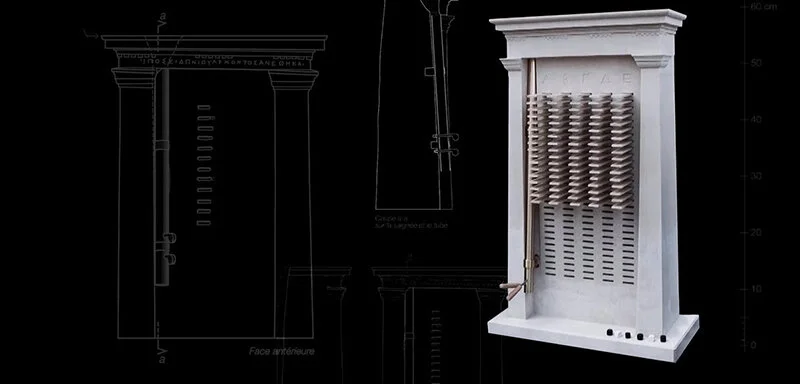
Kleroterion Device: In ancient Greek democracy, a Lottery system was devised to select citizens for public duty (video)

November 15, 2020

Is voting crucial in a democracy? Not necessarily. In Athens, a randomizing device called a kleroterion was used to select citizens to most public duties.

The kleroterion was a slab of stone incised with rows of slots and with an attached tube. Citizens' tokens—pinakia—were placed randomly in the slots so that every member of each of the tribes of Athens had their tokens placed in the same column.

There was a pipe attached to the stone which could then be fed dice that were coloured differently (assumed to be black and white) and could be released individually by a mechanism that has not survived to posterity (but is speculated to be by two nails; one used to block the open end and another to separate the next die to fall from the rest of the dice above it).

When a die was released, a complete row of tokens (so, one citizen from each of the tribes of Athens) was either selected if the die was coloured one colour, or discarded if it was the alternate colour. This process continued until the requisite number of citizens was selected.

For the first time, a team of archaeologists created a functional kleroterion they can now use to test their hypotheses.

Watch the video for more about the kleroterion device
← Psilovrachos. A Greek village with breathtaking views and historic secretsDrone Magnificently Captures the Mythical "Dragon lake" of Greece →
Featured
image_2026-05-06_233702963.png
May 6, 2026
The Contributions of Archimedes to Science
May 6, 2026
May 6, 2026
image_2026-05-06_233627067.png
May 6, 2026
The Role of Logic in Ancient Greek Thought
May 6, 2026
May 6, 2026
image_2026-05-06_233013105.png
May 6, 2026
Aristotle’s Influence on Medieval Europe
May 6, 2026
May 6, 2026
image_2026-05-06_232929601.png
May 6, 2026
How Plato’s Academy Shaped Western Thought
May 6, 2026
May 6, 2026
image_2026-05-06_232843492.png
May 6, 2026
Pythagoras: More Than Just a Mathematician
May 6, 2026
May 6, 2026
image_2026-05-06_232801249.png
May 6, 2026
The Milesian School: The First Greek Philosophers
May 6, 2026
May 6, 2026
image_2026-05-06_232630063.png
May 6, 2026
Greek Philosophy and Science
May 6, 2026
May 6, 2026
image_2026-05-04_222417927.png
May 6, 2026
The Importance of Fortifications in Ancient Greece
May 6, 2026
May 6, 2026
SEE MORE

Powered by ©GreeceHighDefinition / Privacy Policy