The Battle of Himera: A Clash of Greeks and Carthaginians
Introduction
The Battle of Himera was one of the most significant conflicts in early Greek history outside mainland Greece. Fought in 480 BCE in Sicily, it pitted Greek settlers against the expanding power of Carthage and is often compared—symbolically, though not directly—to the Persian Wars happening in the east at the same time.
Background of the Conflict
Greek colonists had established cities across Sicily, including Himera, which became a key point of tension with Carthaginian civilization.
Causes of the Battle:
Carthage sought to expand influence in Sicily
Greek city-states resisted foreign control
Local Sicilian alliances were divided
Power struggle over trade routes and territory
Himera became the focal point of this confrontation.
The Armies Involved
Greek Forces:
Allied Sicilian Greek city-states
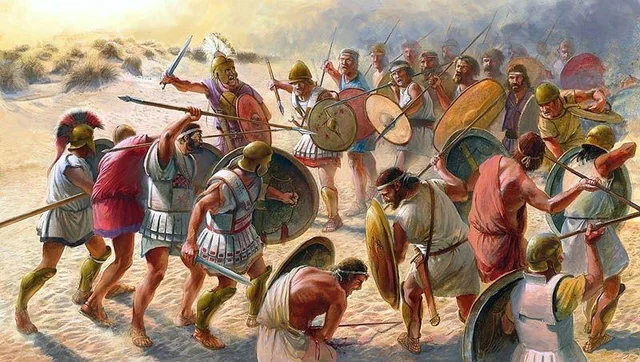
Hoplite infantry formations
Strong defensive positioning
Supported by cavalry and light troops
Carthaginian Forces:
Large mixed army including mercenaries
North African infantry and cavalry
War elephants (in later accounts, though debated historically for this battle)
Experienced naval power supporting land operations
Course of the Battle
Early Phase:
Carthaginians besieged or pressured Himera
Greeks held defensive positions
Reinforcements arrived for Greek side
Turning Point:
Greek forces launched coordinated counterattacks
Carthaginian supply lines were disrupted
Greek cavalry and hoplites exploited enemy disorder
Collapse:
Carthaginian army was overwhelmed
Retreat turned into a rout
Large-scale casualties followed
Leadership and Strategy
Greek Leadership:
Hieron of Syracuse played a key role in organizing resistance
Unified Greek strategy proved decisive
Carthaginian Command:
Hamilcar (Carthaginian general) reportedly died during the battle or siege
Coordination issues among diverse forces weakened effectiveness
Outcome of the Battle
Decisive Greek victory
Heavy Carthaginian losses
Temporary halt to Carthaginian expansion in Sicily
Strengthening of Greek Sicilian cities like Syracuse
Historical Significance
For the Greeks:
Reinforced confidence of western Greek colonies
Strengthened Sicilian Greek identity
Demonstrated effectiveness of hoplite warfare outside mainland Greece
For Carthage:
Major military setback
Continued but more cautious involvement in Sicily
Long-term rivalry with Greek cities persisted
Cultural and Symbolic Importance
Later Greek writers often linked Himera with the Persian Wars:
Said to have occurred on the same day as the Battle of Salamis (tradition, not confirmed)
Symbolized Greek resistance against foreign powers
Became part of heroic Greek military tradition
Conclusion
The Battle of Himera was a defining moment in the struggle between Greek settlers and Carthaginian expansion in Sicily. The Greek victory secured the independence of key Sicilian cities and reinforced the strength of hoplite warfare. Although not ending the conflict permanently, it marked an important early chapter in the long rivalry between Greek and Carthaginian civilizations in the western Mediterranean.