Long before mathematics was treated as a dry textbook exercise of formulas and variables, it was viewed as a deeply mystical, spiritual pathway to understanding the fabric of reality. At the heart of this transition was Pythagoras of Samos (c. 570–495 BCE) and his secretive, communal cult of followers known as the Pythagoreans.
Operating in Croton (southern Italy), this group effectively bridged the gap between primitive, practical arithmetic and the formal, deductive science of mathematics we recognize today.
1. The Core Philosophy: "All is Number"
To the Pythagoreans, numbers were not abstract symbols created by humans to count sheep; they were the literal, living building blocks of the universe. They believed that everything in the cosmos—from the orbits of the stars to human concepts like justice and marriage—could be expressed through ratios and integers.
The Tetractys: The most sacred symbol of the Pythagoreans was the Tetractys. It was a triangular figure composed of ten points arranged in four rows (1, 2, 3, and 4).
Cosmic Meaning: To the cult, this simple arrangement represented the organization of space: the first row (one point) signified the point; the second (two points) signified a line; the third (three points) signified a plane; and the fourth (four points) signified a solid object. Swearing an oath by the Tetractys was the ultimate vow for a member of the society.
2. Music and the Geometry of Sound
One of the Pythagoreans' most brilliant and lasting scientific breakthroughs was discovering the mathematical foundation of western music.
According to legend, Pythagoras passed a blacksmith's shop and noticed that the hammers struck the anvils with different, harmonious pitches. Through experimentation with stringed instruments (monochords), he realized that musical intervals correspond directly to simple mathematical ratios of string length:
The Octave: Created by a string ratio of $2:1$. Halving the length of a vibrating string perfectly doubles its frequency, raising the pitch by an octave.
The Perfect Fifth: Created by a string ratio of $3:2$.
The Perfect Fourth: Created by a string ratio of $4:3$.
This discovery blew the minds of the early Pythagoreans. If something as emotional and ethereal as music was governed by clean, simple ratios, they reasoned, then the entire universe must be a grand musical composition—a concept they called the "Music of the Spheres."
3. The Pythagorean Theorem: Geometric Rigor
While Babylonians, Chinese, and Egyptian builders had used the practical application of the right-angle triangle rule for centuries to survey land, the Pythagoreans were among the first to seek an abstract, universally applicable proof.
The theorem states that in a right-angled triangle, the square of the hypotenuse ($c$) is equal to the sum of the squares of the other two sides ($a$ and $b$):
$$a^2 + b^2 = c^2$$
Rather than just accepting that a 3-4-5 triangle made a perfect right angle, the Pythagoreans demonstrated visually and logically that the actual geometric area of the large square built off the longest side was perfectly equal to the combined areas of the two smaller squares. This shift from "functional rule of thumb" to "logical proof" laid the groundwork for Euclid centuries later.
4. The Crisis of the Irrational: $\sqrt{2}$
The absolute supremacy of integers and clean ratios eventually led to the cult's greatest intellectual crisis.
A Pythagorean named Hippasus of Metapontum was examining a simple right triangle where the two shorter sides both had a length of exactly $1$. According to their own theorem:
When Hippasus tried to calculate $\sqrt{2}$ as a ratio of two whole numbers, he realized it was mathematically impossible. He had discovered irrational numbers—decimals that go on forever without repeating or settling into a clean fraction.
The Scandal: This discovery directly shattered the core religious doctrine that "All is Number" (implying all things could be measured cleanly by whole integers).
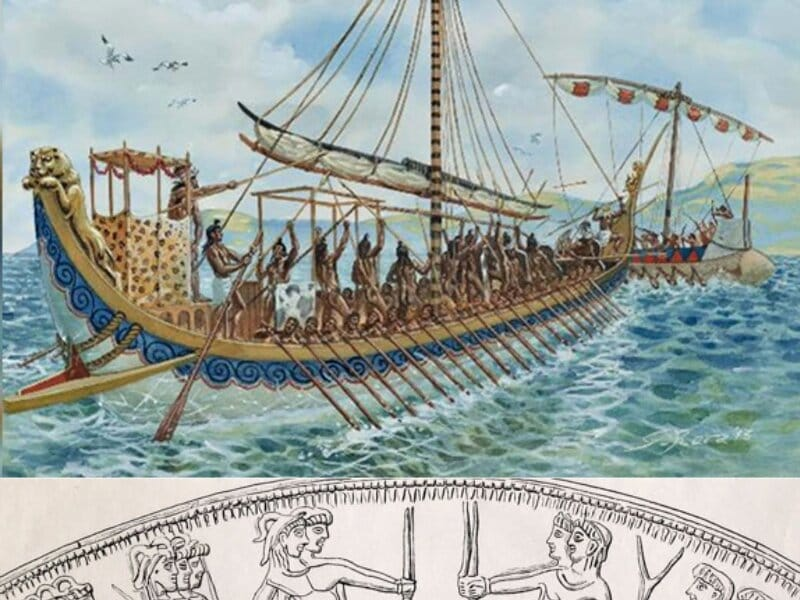
According to ancient gossip, the Pythagoreans were so horrified by this threat to their divine worldview that they took Hippasus out to sea on a boat and threw him overboard, swearing the remaining members to absolute secrecy about the existence of the irrational.
5. Summary of Mathematical Transitions
Before the Pythagoreans: Mathematics was purely practical, used by ancient accountants and builders for taxes, architecture, and measuring grain fields.
After the Pythagoreans: Mathematics became an abstract, philosophical system studied for its own sake to uncover hidden, immutable truths about nature.
The Pythagoreans ultimately dissolved as a political and religious force, but their intellectual imprint was massive. Plato was deeply influenced by Neo-Pythagorean thought, adopting their belief that the physical world is merely a flawed shadow of perfect, geometric truths.