The study of magnetism in ancient Greece represents one of humankind's earliest attempts to transition from a mythological worldview to an empirical, scientific one. Long before the formulation of electromagnetic theory, Greek thinkers were fascinated by the mysterious, invisible forces exerted by certain rocks.
By analyzing these phenomena, they laid the intellectual groundwork for early physics, introducing concepts of natural law, invisible attraction, and the atomic structure of matter.
1. The Discovery: The Stone from Magnesia
The history of magnetism begins in a region of ancient Greece called Magnesia (located in Thessaly). Around the 6th century BCE, shepherds and miners noticed that their iron-treated boots and walking sticks would violently cling to certain dark, heavy stones.
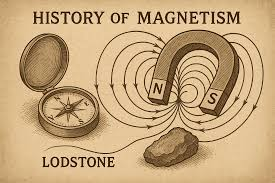
These naturally magnetized pieces of iron ore ($Fe_3O_4$) became known as lodestones, or simply ho Magnetes lithos—"the stone from Magnesia"—the linguistic origin of our modern word magnetism.
2. Thales of Miletus: The Spark of Animism
The earliest recorded philosophical inquiry into these stones comes from Thales of Miletus (c. 624–545 BCE), widely regarded as the first Greek philosopher.
Thales was determined to explain the universe without relying on Zeus, Poseidon, or the traditional pantheon. However, when faced with the lodestone, he encountered a profound paradox: an inanimate, cold rock possessed the ability to move another object without any physical contact.
The Living Rock: Because the prevailing thought of his era associated the ability to cause motion exclusively with life and consciousness, Thales famously concluded that "the lodestone has a soul (psyche), because it moves iron."
While this sounds mystical today, Thales's statement was actually a radical leap toward early physics. By attributing the force to the stone's own inherent nature rather than a capricious whim of the gods, he established the baseline rule of physics: objects operate under intrinsic, discoverable properties.
3. Empedocles and Effluences: The First Field Theory
As Greek thought matured, philosophers sought mechanical, physical explanations for magnetic attraction that did not rely on Thales’s concept of a stone soul.
In the 5th century BCE, Empedocles proposed a theory based on invisible emissions, which acts as a primitive precursor to the modern concept of a magnetic field.
The Effluences: Empedocles argued that all physical objects constantly emit invisible streams of microscopic particles called "effluences."
The Mechanism: He theorized that the surface of iron contains specific, microscopic pores that perfectly match the shape of the effluences streaming out of a lodestone.
The Attraction: As the lodestone's particles stream into the iron's pores, they expel the air trapped inside. This creates a localized vacuum. The surrounding air then forcefully pushes the iron toward the lodestone to fill the void, creating the illusion of a pulling force.
4. Democritus and Epicurus: The Atomic View
The Atomists, led by Democritus (c. 460–370 BCE) and later championed by the Epicureans, refined this mechanical view by applying it to their theory of an indivisible, material universe.
The Atomists argued that the lodestone emits a highly dense stream of specialized, smooth atoms. Because these atoms move at incredible speeds into the void, they strike the air molecules between the magnet and the iron, scattering them away.
The atoms of the iron itself are uniquely hooked or chained. When the vacuum forms between the two objects, the hooked iron atoms are drawn forward into the empty space, dragging the entire piece of iron along with them. For the Atomists, magnetism was not a spiritual mystery, but a violent, microscopic game of billiards.
5. Plato and the Magnetized Chain
In his dialogue Ion, the philosopher Plato (c. 428–348) used the lodestone not to explain physical mechanics, but as a metaphor for divine, artistic inspiration. In doing so, he accurately described the phenomenon of magnetic induction—how a magnet can transfer its power to non-magnetic objects.
Plato observed that if you touch a lodestone to an iron ring, that ring becomes temporarily magnetized. You can then hang a second iron ring from the first, a third from the second, and so on, creating a long, suspended chain of rings all held together by the original stone's power.
Plato used this to describe how a Muse inspires a poet, who then inspires an actor, who ultimately inspires an audience. Mechanically, however, this observation showed that the Greeks recognized that magnetic force was a transmissible property that could alter the physical state of surrounding matter.
6. The Limitations of Greek Magnetism
While the Greeks excelled at theorizing the philosophical and physical cause of magnetism, their progress halted due to a lack of experimentation:
No Compass: The Greeks never realized that if you suspend a magnetic needle freely, it will always align itself with Earth's geomagnetic poles. The invention of the mariner’s compass would instead emerge independently in ancient China centuries later.
The Static Confusion: Greek physicists frequently conflated magnetism with static electricity. They noticed that amber (elektron), when rubbed vigorously with animal fur, would attract light objects like feathers or straw. Because both amber and lodestones exerted an invisible pull, early physics treated them as variants of the exact same natural force.
Ultimately, the Greek study of the lodestone was a crucial catalyst for early science. By forcing philosophers to grapple with an invisible, non-contact force, magnetism smashed the primitive notion that the universe was made up only of things humans could see and touch, steering western thought toward the abstract, mathematical laws of nature.