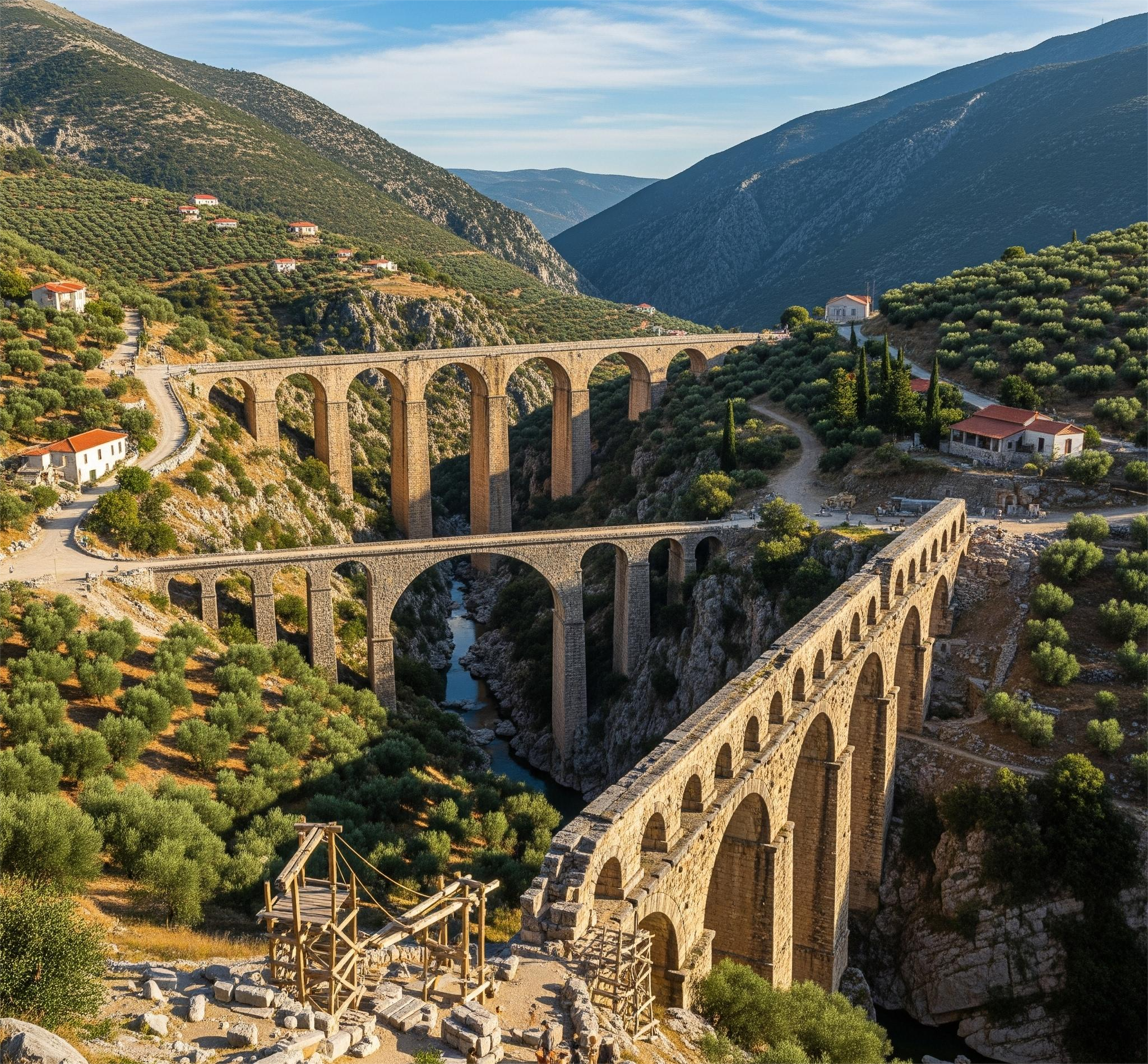
From spanning rivers to connecting island coasts, bridges in Greece reflect a long legacy of architectural ingenuity, precision, and adaptation to rugged landscapes. While Greece is better known for its temples and theaters, ancient Greek engineers also excelled in infrastructure—building durable and functional bridges that withstood both time and terrain.
Let’s take a closer look at some notable Greek bridges, their construction techniques, and how they reveal the technological capabilities of ancient Greek civilization.
Engineering in the Ancient World
Unlike the Romans, who are famous for their large-scale arched bridges and aqueducts, ancient Greeks favored simpler and often corbel-based constructions. Bridges were mostly utilitarian, made to serve local needs, especially in agricultural areas and sacred landscapes. They were often built with local stone, arranged without mortar, relying on the precision of stone cutting and balance.
Greek engineers were well aware of load distribution, pressure points, and environmental factors—even if their structures weren’t as visually monumental as Roman ones, they were highly effective.
Notable Ancient Greek Bridges
1. The Arkadiko Bridge (Mycenaean Period, c. 1300 BCE)
Argolis, Peloponnese
Considered one of the oldest surviving arch bridges in the world still in use.
Built from limestone boulders without mortar, using a corbel arch technique—stones stacked in horizontal layers gradually overlapping until the two sides met.
Originally part of a military road connecting Tiryns and Epidauros.
Width: ~2.5 meters (wide enough for chariots!).
This bridge showcases early Greek innovation in civil engineering long before Roman influence. Its survival today is a testament to Mycenaean craftsmanship.
2. The Kazarma Bridge (Also Mycenaean)
Near Mycenae
Similar construction to Arkadiko, likely part of the same ancient highway.
Features the same corbel arch and drystone masonry, and built to accommodate wheeled transport.
These bridges reveal that the Mycenaeans had an organized road system, possibly the earliest in Europe, complete with durable bridge crossings.
3. The Eleutherna Bridge (Hellenistic Period)
Crete
A stone arch bridge, unlike the Mycenaean corbel types.
Features a true arch, suggesting evolution and influence from other cultures (possibly Near Eastern or early Roman techniques).
Represents a transitional point in Greek bridge engineering from corbel to curved arches.
Key Construction Techniques
Corbel Arch: Layers of stone progressively jut inward, creating a passage with a triangular or curved top.
Dry Stone Masonry: Stones placed without mortar, relying on precise cuts and gravity for strength.
Use of Local Materials: Builders used stones available from nearby quarries, reducing transportation and adapting to terrain.
Inclined Approaches: Many bridges were designed with sloping paths to ease entry and manage elevation changes.
These methods demonstrate not only engineering knowledge, but also a keen understanding of geography, weathering, and longevity.
From Ancient to Modern
Greece’s tradition of bridge-building didn’t end with antiquity. Modern Greece is home to the Rio-Antirrio Bridge, one of the longest multi-span cable-stayed bridges in the world, completed in 2004. This colossal structure connects the Peloponnese with mainland Greece, proving that Greece’s bridge-building legacy spans thousands of years, evolving from corbel arches to cutting-edge suspension.
Why Greek Bridges Matter
Though often overshadowed by more famous monuments, Greek bridges reveal a different kind of brilliance—one grounded in practicality, resilience, and subtle beauty. They speak to a civilization that valued connection—between cities, people, and sacred spaces—and had the skill to make it happen.
Whether carved from stone in a Mycenaean gorge or stretched across a modern strait, Greek bridges are silent storytellers of innovation, endurance, and unity.