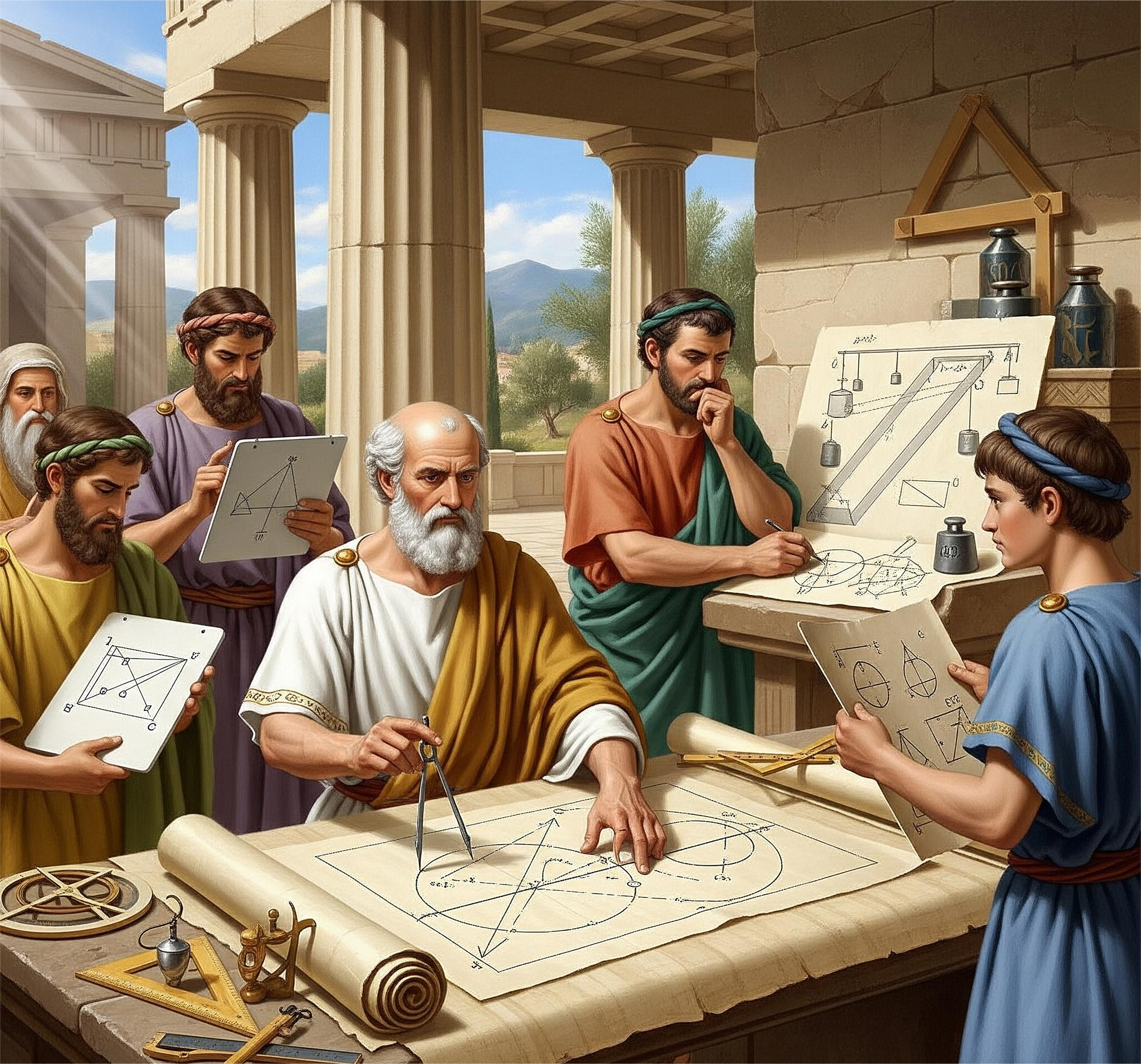
The legacy of Greek mathematics is etched into the very structure of Western civilization. Nowhere is this more evident than in geometry, a field the ancient Greeks elevated from a tool for land surveying into a rigorous, abstract science. From Euclid’s elegant postulates to Archimedes’ ingenious formulas, Greek geometric theories were not just theoretical marvels—they had profound practical applications in architecture, astronomy, engineering, and everyday life.
Foundations of Greek Geometry
Geometry (from the Greek “geo” = earth, “metron” = measure) began as a practical art for measuring land but evolved into a deeply logical system.
Thales of Miletus (c. 624–546 BCE)
Among the first to apply deductive reasoning to geometry.
Known for Thales’ Theorem: In a circle, a triangle drawn from the ends of a diameter is always a right triangle.
Used geometry to calculate the height of pyramids by measuring shadows.
Pythagoras (c. 570–495 BCE)
Introduced the idea of mathematics as a path to understanding the cosmos.
Most famous for the Pythagorean Theorem:
a² + b² = c² in right-angled triangles.Applied in construction, navigation, and early trigonometry.
Euclid (c. 300 BCE)
Authored The Elements, the most influential textbook in history.
Introduced axiomatic geometry—building theorems step-by-step from a small set of definitions and postulates.
His logical system influenced Renaissance scientists, Enlightenment thinkers, and even modern programming.
Archimedes (c. 287–212 BCE)
Master of applied geometry.
Calculated areas, volumes, and centers of gravity with precision.
Designed machines using geometric principles—screws, levers, and catapults.
Practical Applications in Ancient Greece
Geometry wasn't just for philosophers; it was crucial for daily life and empire-building.
Architecture & Construction
Temples like the Parthenon were designed using geometric ratios for harmony and balance.
Golden ratio aesthetics (φ ≈ 1.618) were believed to reflect natural beauty.
Astronomy
Geometry helped map celestial movements.
Eudoxus and Hipparchus used geometric models to explain planetary motion—precursors to later heliocentric theories.
Land Surveying
Vital for defining property boundaries and redistributing land.
Used geometric tools like the dioptra (a type of ancient theodolite).
Navigation
Triangulation and angular measurements were used in sea travel.
Greeks calculated distances and routes using stars and geometric models.
Engineering & Mechanics
Archimedean principles were applied in siege engines and aqueduct systems.
Levers, pulleys, and wheels were all optimized using geometric logic.
Enduring Influence
Greek geometry provided a universal language of shape, proportion, and logic that transcended time.
Used by Roman engineers, Islamic scholars, and Renaissance artists.
Forms the basis of modern geometry, physics, architecture, and computer science.