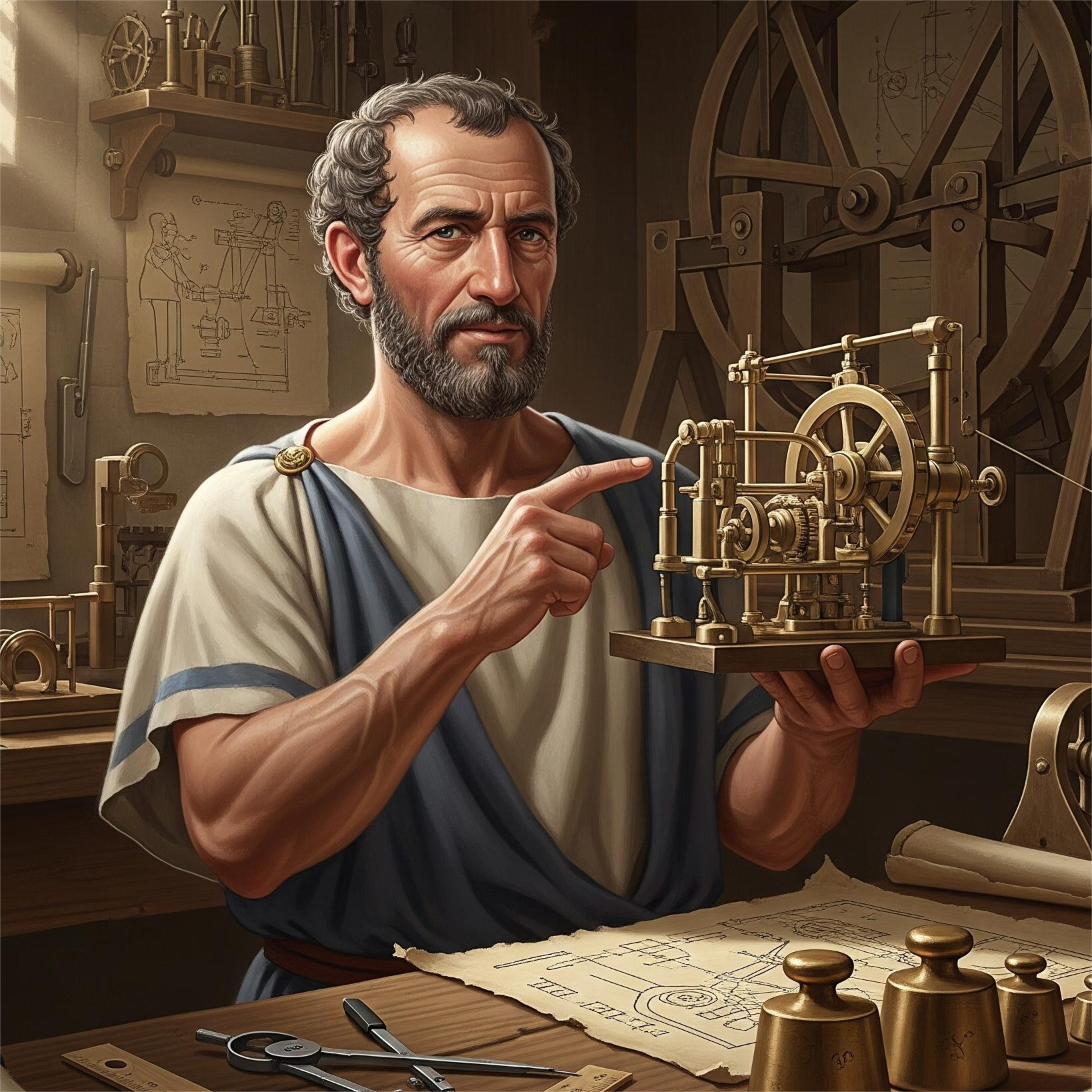
In the bustling city of Alexandria during the 1st century CE, a brilliant mind named Hero (or Heron) of Alexandria was redefining the boundaries of science and engineering. A mathematician, physicist, and inventor, Hero blended imagination with mechanical precision to create devices that dazzled his contemporaries—and still inspire awe today. From steam-powered engines to automated theaters, Hero’s creations are considered some of the earliest examples of robotics and mechanical engineering.
The Aeolipile: The First Steam Engine
Hero’s most famous invention is the aeolipile, often considered the first recorded steam engine in history.
How it worked: A hollow metal sphere was mounted on an axis and connected to a boiler. Steam entered the sphere and exited through two bent pipes, causing it to spin from the resulting thrust—much like a modern jet engine.
Purpose: While primarily a novelty or demonstration of principles, it showed a deep understanding of thermodynamics and pressure—long before the Industrial Revolution.
This device wasn’t used to power machines, but it showed that Greeks understood how to convert steam pressure into motion, centuries ahead of its practical application.
Automata: The Dawn of Mechanical Programming
Hero also created automata—mechanical devices that could move, act, or perform tasks on their own, powered by air, steam, weights, or springs.
Mechanical puppets: Used in miniature theaters to tell stories with timed movements.
Self-opening temple doors: Operated by hidden systems of pulleys, water, and fire.
Coin-operated machines: Like a holy water dispenser—when a coin was inserted, water flowed out briefly.
These automata were more than toys—they were early programmable machines, the ancestors of modern robotics.
Other Ingenious Devices
Hero’s imagination knew few limits. Some of his other inventions included:
Wind-powered organs: Early use of wind energy to produce music.
Syringes and force pumps: Practical tools for medicine and firefighting.
Catapults and military devices: Improvements in artillery design, applying precise geometric calculations.
Fountains and siphons: Using air pressure and vacuum principles to manipulate water flow.
Hero the Educator
Hero wasn’t just an inventor—he was a prolific teacher and author. His works became standard texts in engineering and math for centuries.
Key works include:
Pneumatica: Describes his automata and pneumatic devices.
Mechanica: Explores the principles of simple machines like pulleys and levers.
Metrica: Offers techniques for calculating area and volume—still studied today.
Dioptra: A treatise on surveying instruments used in construction and astronomy.
Influence and Legacy
Though Hero’s works were largely forgotten in Western Europe after the fall of Rome, they were preserved by Islamic scholars and later translated into Latin during the Renaissance, where they influenced thinkers like Leonardo da Vinci.
Today, Hero is celebrated as:
A pioneer of automation
A visionary in applied science
A symbol of ancient innovation that prefigured modern engineering