Few works in Western philosophy have sparked as much debate and inspiration as Plato’s Republic. Written around 375 BCE, this seminal dialogue envisions a society built on reason, harmony, and justice—an intellectual experiment as much as a political treatise. At its heart lies a bold question: What is justice, and what would a truly just society look like?
Plato’s Philosophical Framework
Plato presents his vision through a dialogue primarily between Socrates and several Athenian interlocutors. The goal is not only to define justice in the individual but to magnify the question onto the scale of a city-state (polis), making it easier to examine.
At the core of Plato’s thinking is the idea that justice is achieved when everyone performs the role to which they are best suited—a principle that shapes every aspect of his ideal state.
The Tripartite Society
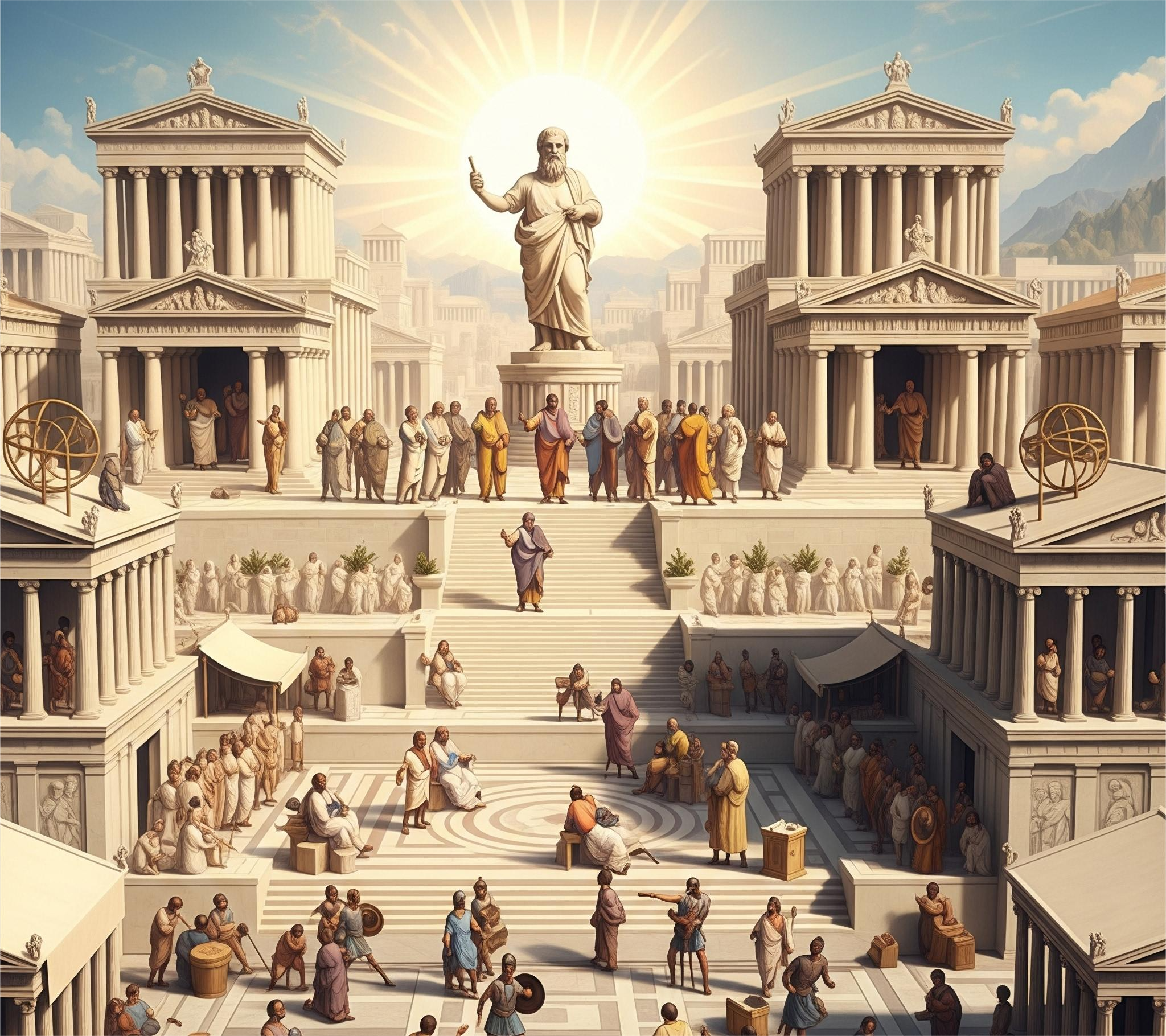
Plato proposes a rigidly structured society composed of three distinct classes:
Rulers (Philosopher-Kings)
Govern with wisdom and reason.
Chosen for their intellectual and moral superiority.
Guided by the Form of the Good, the ultimate truth and source of justice.
Auxiliaries (Warrior Class)
Defend the city and uphold the rulers’ decisions.
Governed by spirit and courage.
Trained to be loyal and selfless, acting as protectors rather than aggressors.
Producers (Farmers, Artisans, Merchants)
Provide for the material needs of the city.
Governed by their appetites and desires.
Must remain in their station and focus on their craft.
Plato’s ideal society functions like a well-tuned body: Reason (rulers) leads, spirit (auxiliaries) supports, and appetite (producers) obeys.
Justice as Social Harmony
In The Republic, justice is not fairness in the modern sense. Instead, Plato defines justice as each class performing its role without interfering with the others. This structure creates balance, unity, and order.
Injustice, conversely, arises when the natural hierarchy is disrupted—when, for example, desires overrule reason.
The Rule of the Philosopher-King
Plato argues that only philosopher-kings, those who have grasped the eternal truths through dialectic and contemplation of the Forms, are fit to rule. Their wisdom and lack of personal ambition make them uniquely qualified to govern justly.
This concept introduces a radical idea: the best ruler is not the one with power, wealth, or popularity—but the one with knowledge and virtue.
Education and the Allegory of the Cave
Plato devotes much of The Republic to education, especially for the guardian class. He famously uses the Allegory of the Cave to illustrate the philosopher’s journey:
Most people live chained in ignorance, mistaking shadows for reality.
The philosopher escapes the cave, sees the true world (the Forms), and returns to enlighten others.
However, the return is painful, and the philosopher risks ridicule or hostility from those still in the dark.
This allegory emphasizes the transformative power of education and the philosopher’s duty to serve the community, even at personal cost.
Radical Proposals and Criticisms
Plato’s ideal society includes some controversial features:
Censorship of poetry and music to control moral education.
Communal property and families among guardians to avoid conflicts of interest.
Rigorous eugenics and selective breeding for the guardian class.
These ideas have drawn criticism for being authoritarian or utopian, leading many to view the Republic as a philosophical model rather than a practical blueprint.
Legacy and Influence
Though never implemented, Plato’s vision influenced political thought for centuries:
Inspired Augustine, More’s Utopia, and Rousseau.
Laid the groundwork for debates on idealism vs. realism, meritocracy, and state control.
Continues to provoke questions about leadership, morality, and the common good.