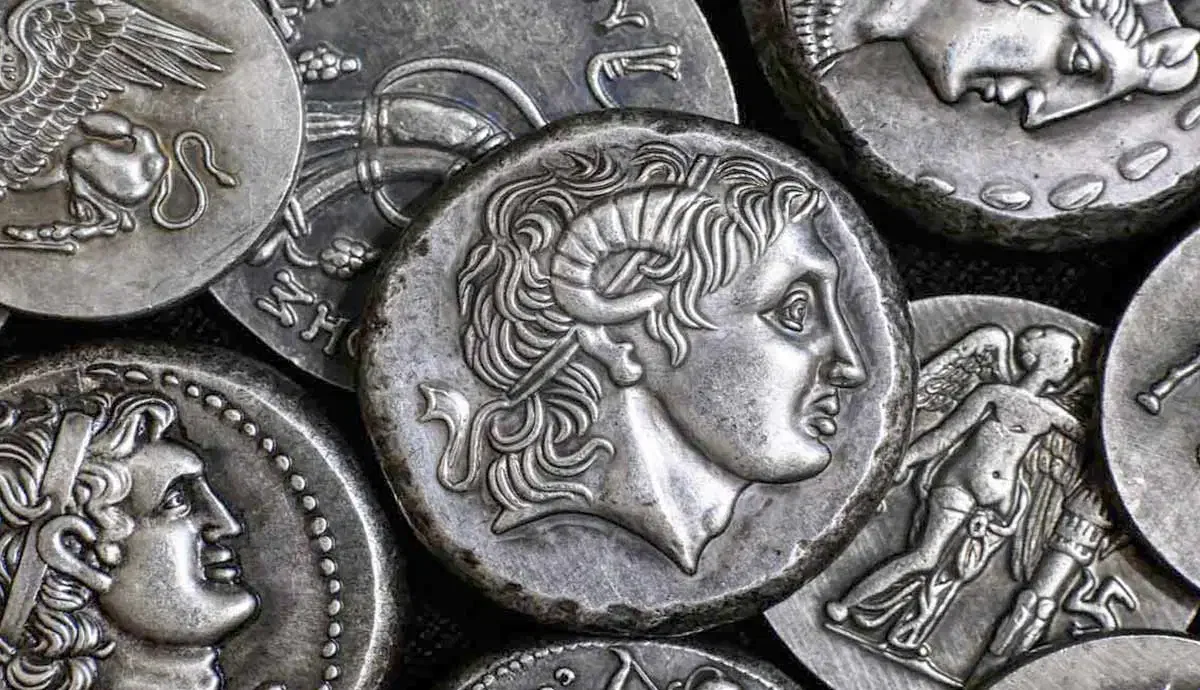
When you hold an ancient Greek coin, you're not just holding money—you're holding a miniature masterpiece, a political statement, and a window into the economy of a thriving civilization. Greek coinage wasn’t just a tool for trade; it was a powerful blend of art, propaganda, and financial innovation.
Origins: The Birth of Coinage
Greek coinage emerged in the 7th century BCE, likely in Lydia (modern-day Turkey), but it was the Greek city-states that refined and popularized the practice. By the 6th century BCE, cities like Aegina, Athens, and Corinth were minting their own coins, each with unique designs and inscriptions that reflected civic identity and pride.
Coins were made from precious metals—mainly silver, but also gold, bronze, and electrum—and often stamped with images representing gods, symbols, or local emblems.
Economic Function: Money with a Mission
Coins revolutionized the Greek economy by:
Standardizing Trade: Coins offered a consistent and recognizable value across regions, making local and long-distance trade much more efficient.
Facilitating Taxation and Wages: City-states paid soldiers, bureaucrats, and laborers in coin, creating a more organized system of governance.
Storing Wealth: Precious metal coins became a stable store of value for both the state and wealthy citizens.
Notably, Athens became an economic powerhouse in part due to its control of silver mines at Laurion, which financed the production of the iconic Athenian tetradrachm—a large silver coin used widely throughout the Mediterranean.
Designs: Beauty in the Details
Greek coins are celebrated for their high artistic quality. Each city-state commissioned skilled engravers to create designs that were both symbolic and beautiful.
Common themes included:
Gods and Goddesses: Athena on Athenian coins, Apollo on Rhodian currency, and Zeus or Hera elsewhere.
Animals and Emblems: The Athenian owl, the Corinthian Pegasus, the dolphin of Taras—all symbols of power, mythology, or local identity.
Portraiture: Later coins, especially during the Hellenistic period, began to feature rulers such as Alexander the Great—marking a shift toward personal political branding.
Despite their small size, many coins featured incredible detail, including lifelike depictions and fine inscriptions, showcasing the skill of Greek artisans.
Coins as Propaganda
Coins also served as political tools. By placing a ruler’s face, a god’s image, or a triumphant scene on coins, city-states and leaders could broadcast power, piety, and legitimacy.
For example, coins minted by Alexander the Great spread his image and symbolism across his vast empire, helping to unify diverse regions under a shared currency and ideology.
Legacy and Global Reach
Greek coinage influenced monetary systems far beyond its borders. Roman coins borrowed heavily from Greek designs and standards. Greek coins have been found from Spain to India, proof of their wide circulation and economic reach.
Today, these coins are treasured by historians and collectors not just for their historical value but for their role in shaping how we think about money, art, and identity.