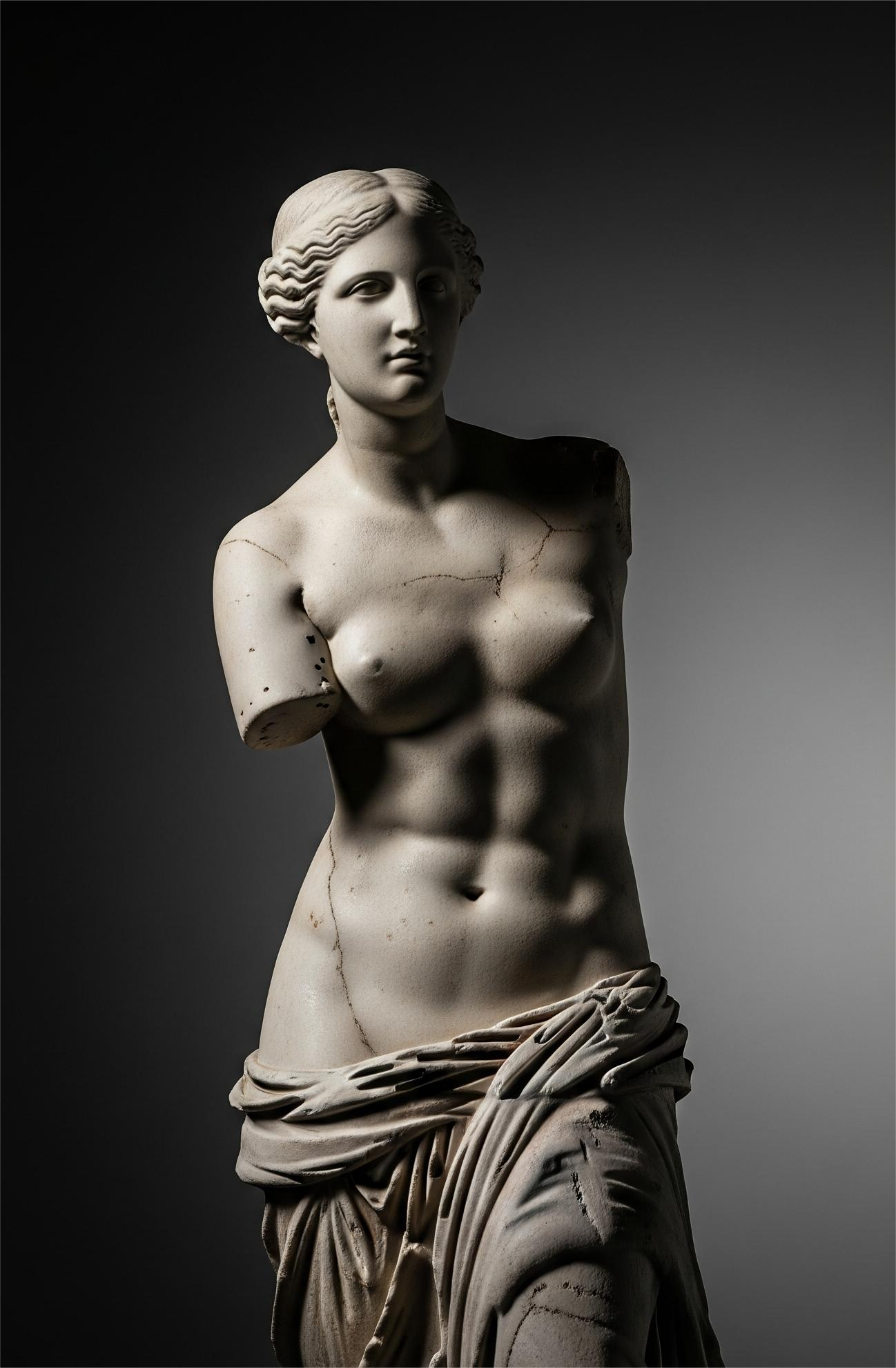
Few sculptures have captivated the world quite like the Venus de Milo. Towering in grace and mystery, this ancient statue is celebrated as one of the finest examples of classical beauty, despite—or perhaps because of—its most famous feature: her missing arms. But what makes the Venus de Milo an enduring icon of art history? And what do scholars believe about the secrets she once held?
Discovery and Origins
The statue was discovered in 1820 by a farmer on the Greek island of Melos (Milos) in the Cyclades. Soon after, it was acquired by French officials and transported to the Louvre Museum in Paris, where it remains a star attraction today.
The Venus de Milo stands at over 6 feet tall and is carved from Parian marble, renowned for its luminous quality. While initially attributed to the classical period, scholars now agree it was created in the late Hellenistic period, around 130–100 BCE. The work is often credited to Alexandros of Antioch, rather than the earlier sculptor Praxiteles as once thought.
Artistic Value and Style
The Venus de Milo is widely admired for its fusion of classical balance and Hellenistic sensuality. Her poised stance, gentle contrapposto (weight-shift), and serene expression reflect the ideals of Greek beauty—symmetry, calm, and proportion. Yet her slightly twisted torso and draped lower garment introduce dynamic movement and texture.
Despite her incomplete form, Venus exudes a powerful presence. Her idealized yet naturalistic body captures the Greek celebration of the human form, particularly feminine beauty and fertility.
The Missing Arms: Clues and Theories
The statue was found in pieces, and her arms were already missing. This gap has become a subject of fascination and debate for centuries. Early reports suggest fragments may have included a hand holding an apple—a nod to Aphrodite’s mythological victory in the Judgment of Paris. Other theories propose she might have held a shield, a mirror, or even leaned on a pillar or companion.
However, with no definitive evidence, the missing limbs have become part of her mystique—leaving viewers to imagine their own interpretations and deepening the statue's mythos.
Symbolism and Enduring Fame
Though originally identified as Aphrodite, the Greek goddess of love and beauty, the Venus de Milo was renamed in the Roman tradition (“Venus”) and quickly became a cultural phenomenon after arriving in France. In the 19th and 20th centuries, the statue came to represent timeless beauty and classical refinement—a perfect blend of antiquity and enigma.
Her fame grew in part due to her imperfection. The loss of her arms humanizes the goddess, drawing attention not just to her ideal form but also to the fragility of time and the incomplete nature of history.
Legacy in Art and Popular Culture
Today, the Venus de Milo is more than a sculpture—she's a global icon. Her image has been reproduced in countless paintings, parodies, fashion shoots, and even pop art. She continues to inspire artists and thinkers, not only as a symbol of aesthetic ideals but also as a reminder that mystery itself can be beautiful.