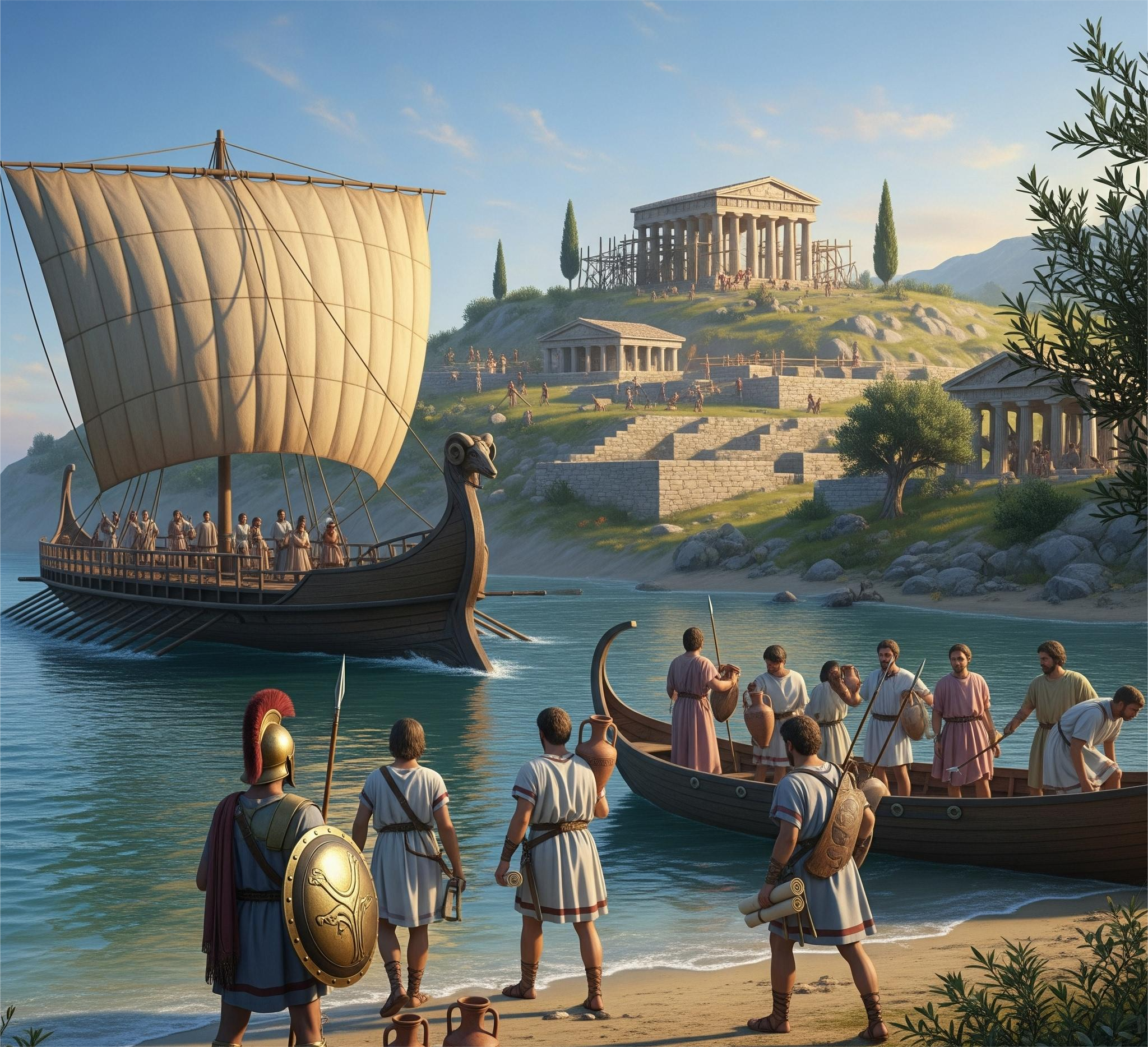
Between the 8th and 5th centuries BCE, the Greek world underwent a remarkable transformation—from a cluster of independent city-states (poleis) in the Aegean to a far-reaching network of colonies stretching from Spain to the Black Sea. Known as the period of Greek colonization, this movement wasn't just about settling new lands—it was about spreading Greek language, art, religion, and political ideas, while also interacting with and adapting to local cultures.
Why Did the Greeks Colonize?
Several key factors drove Greek expansion:
Overpopulation and limited arable land in the homeland.
Internal strife or political exile.
The desire for new trade routes and resources (e.g., metals, grain, timber).
Curiosity and a sense of adventure tied to myth and exploration.
Greek colonization wasn’t imperial in the modern sense. Each new colony (called an apoikia) was independent of its mother city, though cultural and religious ties often remained.
Mapping Greek Colonies: Major Regions of Expansion
1. Western Mediterranean
Southern Italy & Sicily (Magna Graecia): Cities like Tarentum (Taranto), Sybaris, Croton, and Syracuse became major Greek centers. Sicily in particular became a cultural melting pot.
Southern France: The city of Massalia (modern Marseille) was a vital Greek trading outpost.
Eastern Spain: Settlements like Emporion (Empúries) linked the Greeks with Iberian tribes.
2. Northern Aegean & Thrace
Greeks founded colonies such as Abdera and Maroneia, interacting with Thracian tribes and facilitating trade in grain and minerals.
3. Black Sea Region (Euxine Sea)
Cities like Byzantion (later Constantinople), Sinope, Trapezus, and Olbia were established to access fish, grain, and trade with the Scythians.
This region became a key supplier of wheat to Greece.
4. North Africa
Naukratis in Egypt functioned as a Greek trade enclave under the approval of Egyptian pharaohs.
Greek merchants also operated in Cyrene (modern Libya), blending Hellenic and local Berber culture.
5. Anatolia & the Eastern Aegean
Ionia, Aeolis, and Dorian coastal regions of Asia Minor were settled earlier but saw renewed cultural expansion during colonization.
Cities like Ephesus, Miletus, and Smyrna became intellectual and trade hubs.
Cultural Interactions with Indigenous Peoples
Greek settlers did not colonize uninhabited lands—they encountered and interacted with various local populations:
Trade and Intermarriage: Colonists often exchanged goods, ideas, and genes with native peoples, leading to hybrid communities.
Syncretism in Religion: Local gods were sometimes equated with Greek deities. For example, Zeus-Ammon in North Africa and Thracian horsemen gods blended with Greek pantheons.
Conflict and Coexistence: Some interactions were peaceful, while others involved displacement or war, especially when Greeks competed for resources or political dominance.
Legacy of Greek Colonization
Greek colonization left lasting marks:
Spread of the Greek language and alphabet, which influenced Latin and Cyrillic scripts.
Urban planning models like the grid-based Hippodamian plan became standard across colonies.
Greek colonies became centers of art, philosophy, and science—especially in Magna Graecia and Ionia.
Many colonies evolved into powerful cities in their own right, contributing to later Roman and Byzantine civilizations.
A World Connected by Greeks
Though separated by sea, the colonies remained part of a “Greek world” connected through trade, religion, festivals, and identity. Pan-Hellenic sanctuaries like Delphi and Olympia remained spiritual anchors for far-flung Greeks. Colonization created a shared Mediterranean culture, blending Hellenic and local elements that would endure long after the classical age.