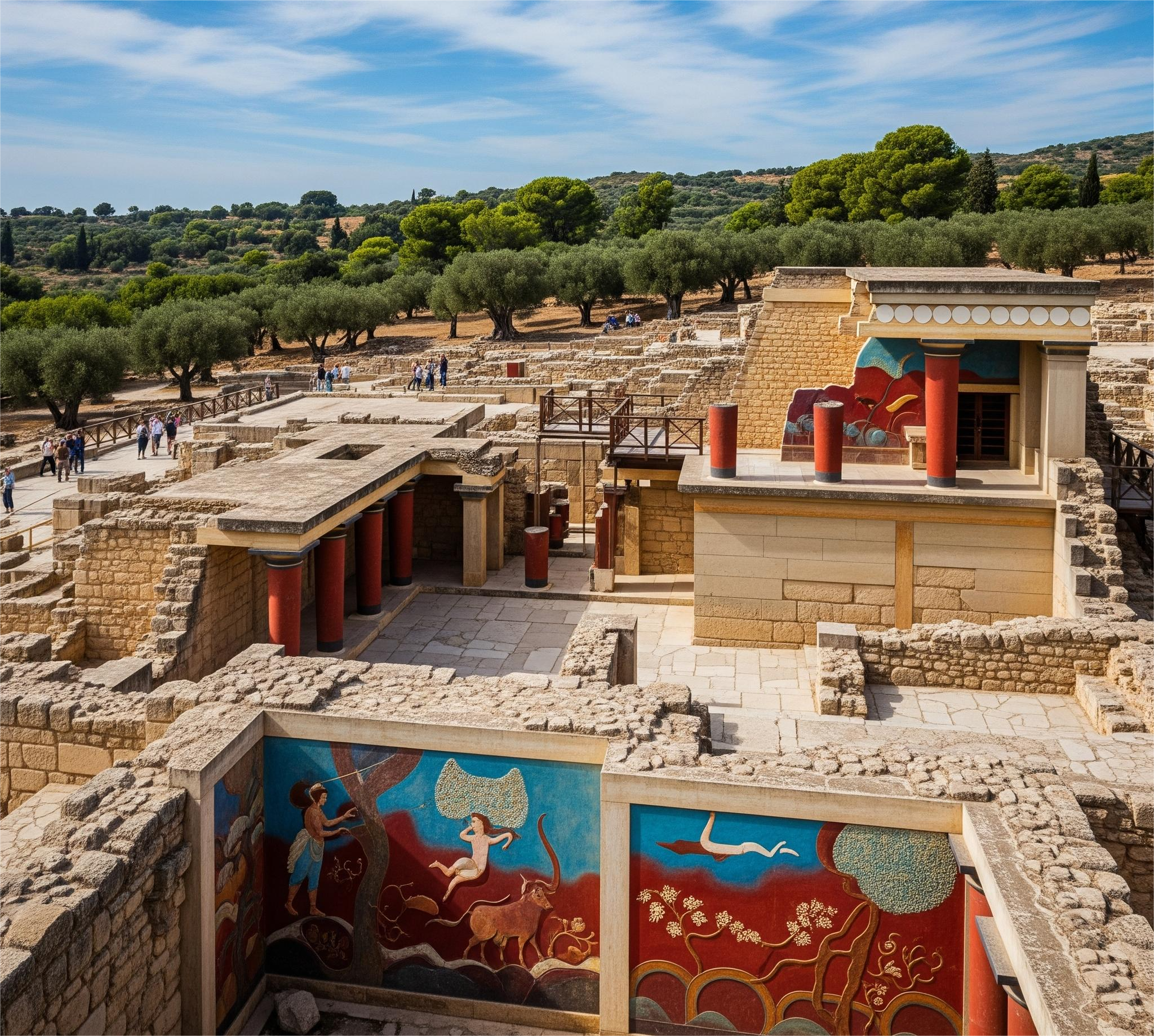
The Palace of Knossos, located near modern-day Heraklion on the island of Crete, stands as the largest and most intricate palace complex of the Minoan civilization, which flourished between 2000 and 1400 BCE. Excavated primarily by Sir Arthur Evans in the early 20th century, Knossos offers an unparalleled glimpse into a vibrant and advanced Bronze Age culture—marked by monumental architecture, artistic sophistication, and a social order that was remarkably complex for its time.
A Palace Like No Other
Unlike the stone fortresses of the Mycenaeans, Knossos was not a defensive structure. Instead, it was an open and sprawling complex, featuring:
Over 1,000 rooms connected by corridors and staircases.
Multi-story buildings, some rising up to four stories high.
Central courtyards used for public gatherings, ceremonies, or even sporting events.
Colorful frescoes, vibrant pottery, and intricately carved seals.
Its layout is so complex that some believe it inspired the myth of the Labyrinth and the Minotaur, with King Minos at its center.
Frescoes and Art: Life in Living Color
The art of Knossos is one of the palace’s most compelling legacies. The frescoes decorating its walls were not just decorative—they conveyed religious, societal, and cultural themes, including:
“The Prince of the Lilies” – possibly a priest or prince, depicted in elegant Minoan attire.
“Bull-Leaping Fresco” – showing a daring acrobatic ritual involving a charging bull, suggesting a religious or ceremonial sport.
Nature scenes, including dolphins, birds, and flora, reflecting the Minoans’ close relationship with their environment.
These images suggest a refined, peaceful society that valued aesthetics, ritual, and the natural world.
Plumbing, Storage, and Innovation
The palace demonstrated remarkable technological advancements, including:
Sophisticated plumbing systems, with flushing toilets and drainage networks.
Massive storage facilities (known as magazines) containing pithoi—large storage jars used for oil, grain, and wine—indicating centralized economic control.
Use of Linear A, a still-undeciphered script used for recordkeeping.
These features reflect a society that was administratively organized, economically prosperous, and technologically progressive.
Women, Religion, and Social Roles
Minoan religion appears to have been centered on goddess worship, possibly indicating a matrifocal or matrilineal society. Frescoes depict women prominently—participating in ceremonies, dressed in elaborate clothing, and occupying seemingly elevated roles in society.
Artifacts suggest that priestesses played major roles in religious rituals, which may have been held in palace shrines, courtyards, or sacred caves nearby.
A Hub of Trade and Cultural Exchange
Knossos was not isolated—it was the center of a powerful maritime trading empire. Minoan merchants traded with:
Egypt, from which they imported luxury goods and art styles.
The Levant and Anatolia, exchanging metals, textiles, and pottery.
Other Aegean islands and mainland Greece, influencing Mycenaean culture.
This web of trade fostered not only material wealth but cultural exchange, making Knossos a melting pot of Mediterranean ideas.
Collapse and Legacy
By around 1400 BCE, Knossos declined, possibly due to a combination of:
The Thera (Santorini) eruption, which may have disrupted the economy.
Invasion or assimilation by the Mycenaeans from mainland Greece.
Internal strife or administrative collapse.
Even in decline, its cultural influence persisted, and many Minoan artistic and religious elements were absorbed into Mycenaean traditions.