When picturing ancient Greek sports, most envision male athletes competing in the nude, cheered on by other men in arenas like Olympia. This image, though historically grounded, overlooks the nuanced and sometimes surprising roles women played in the athletic life of ancient Greece. While largely excluded from most public competitions, women were not entirely absent from the world of Greek sports—and in a few notable cases, they even broke through societal boundaries to make their mark.
Cultural Norms and Athletic Exclusion
In many Greek city-states, particularly Athens, women were expected to lead private, domestic lives. Public sports events, especially those involving nudity or physical competition, were considered inappropriate and indecent for women to attend—let alone participate in.
At the Olympic Games, for example, not only were women barred from competing, married women were forbidden from even watching under penalty of death (though the enforcement of this rule is debated). These restrictions reflected the deeply entrenched patriarchal norms of the time.
The Heraia: A Festival for Female Athletes
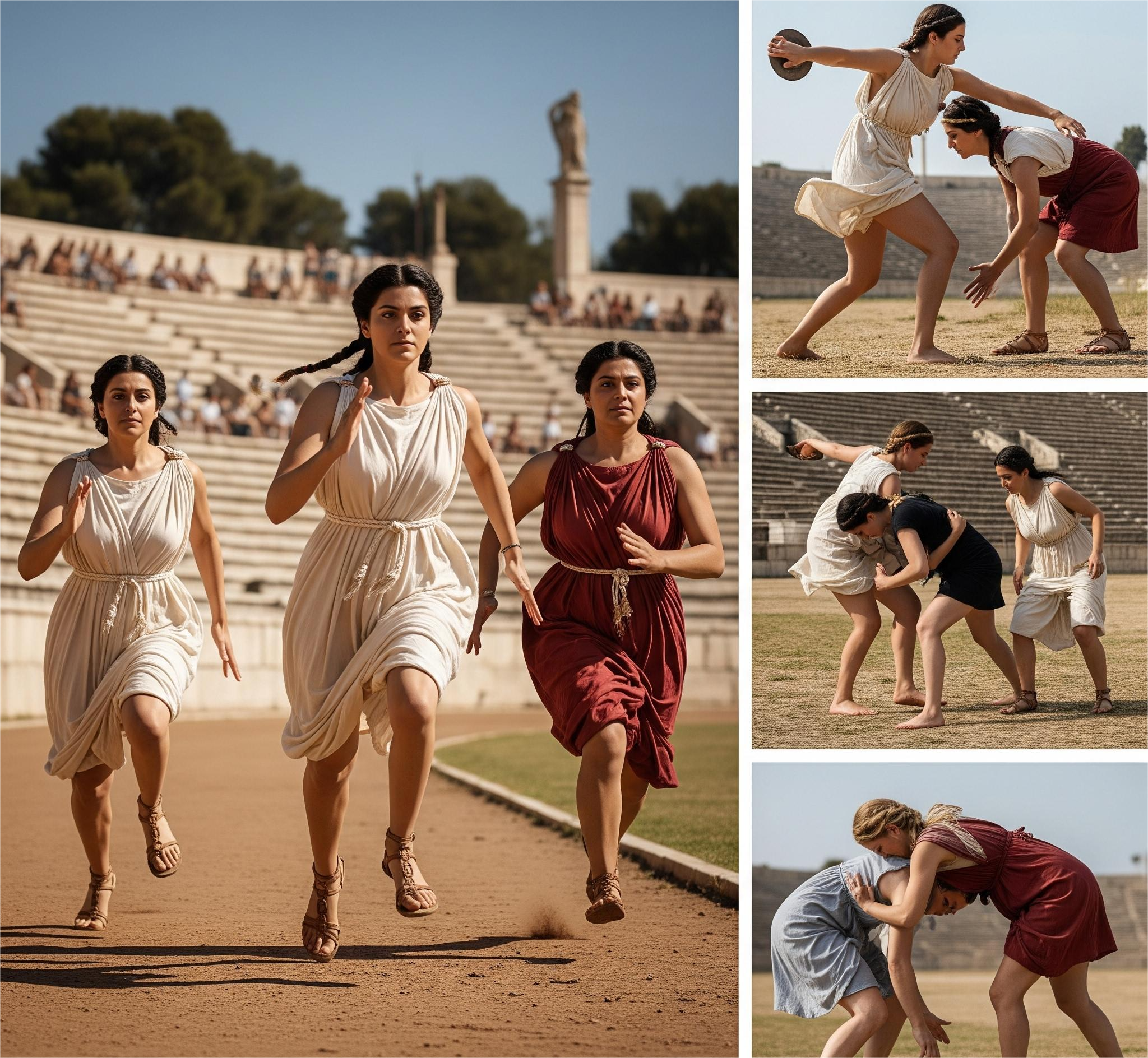
Despite these prohibitions, there were sports festivals for women, the most prominent being the Heraia, a footrace held in honor of the goddess Hera at Olympia. This all-female competition featured young, unmarried girls who ran races in a stadium wearing short tunics that left one shoulder bare. The Heraia may not have been as grand as the male Olympic Games, but it provided a rare and important outlet for female athleticism in the ancient world.
Winners received olive crowns, similar to their male counterparts, and could dedicate statues to Hera—a powerful public recognition of their accomplishment.
Sparta: A Different Athletic Culture
The Greek city-state of Sparta presents a compelling counterexample to Athenian norms. In Sparta, women trained in athletics alongside men, believing that strong mothers would bear strong warriors. Spartan girls engaged in running, wrestling, and even javelin throwing.
This athletic training was not only accepted but celebrated. Spartan women were known for their physical strength, confidence, and outspoken nature. While they didn’t compete in male athletic festivals, their own local competitions and training were central to Spartan culture.
Kyniska of Sparta: A Historic Breakthrough
Perhaps the most remarkable case of a woman breaking into the male-dominated world of Greek athletics is Kyniska, a Spartan princess and the first woman to win an Olympic event. Since chariot racing awarded victory to the owner of the horses—not the driver—Kyniska entered a team in her name and won the four-horse chariot race (tethrippon) in both 396 and 392 BCE.
Her victories were so unprecedented that a statue of her was erected at Olympia, inscribed with her own proud message:
“I, Kyniska, victorious with a chariot of swift-footed horses, have erected this statue. I declare myself the only woman in all Greece to have won this crown.”
Her win challenged gender boundaries and inspired other aristocratic women to follow suit.
Beyond the Arena: Female Physical Activity
Even in societies where women were excluded from formal competition, physical activity still played a role in their lives. In some places, especially in rural or religious settings, women participated in ritual dances, processions, and games associated with festivals.
In mythology, too, we see echoes of strong female athletes—Atalanta, for instance, was a legendary runner and huntress who only agreed to marry a man who could beat her in a footrace.