
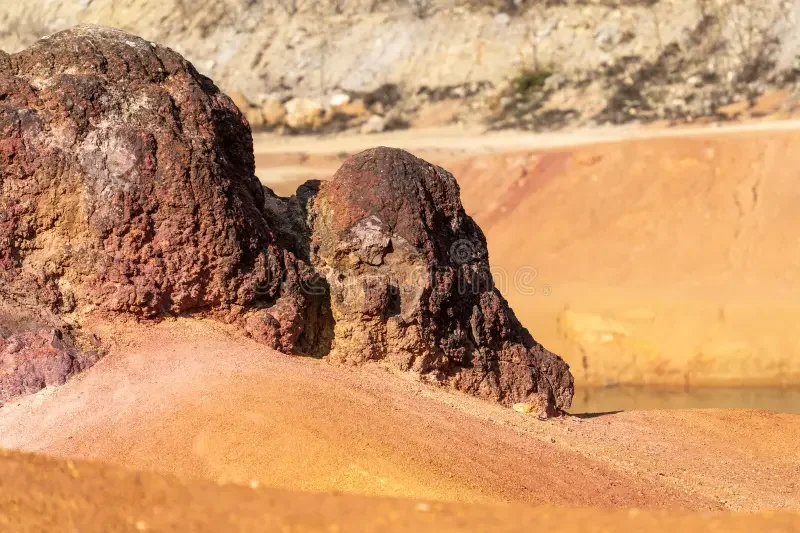
The geology of aluminum-rich rock, the history of mineral exploration, and the hidden resources of the Peloponnese.
Reading the Mountains Through Their Rocks
The Parnon mountain range extends through the southeastern Peloponnese, forming a landscape of ridges, valleys, forests, and settlements. Like other mountain regions in Greece, it reflects a long geological history involving the formation, movement, and alteration of different rock units.
Mineral resources are not always obvious from the surface. Some deposits occur within layers that are covered by soil or vegetation, while others appear only as subtle changes in rock color or texture. Geological mapping allows researchers to identify these differences and investigate whether they reflect ordinary variations in rock composition or potentially significant mineralization.
The title refers to forgotten bauxite formations in Parnon. Bauxite is the principal ore used in the production of aluminum, and Greece has documented bauxite resources, particularly in other parts of the country. However, the presence of bauxite in the Parnon Range should not be assumed without geological evidence specific to the area.
A credible investigation would examine the range's mapped geology, identify any documented aluminum-rich deposits, and distinguish verified occurrences from speculative claims about hidden resources.
How Bauxite Forms
Bauxite is not a single mineral but a rock composed of aluminum-rich minerals, commonly including forms of aluminum hydroxide and associated iron oxides, clay minerals, and other components. It generally forms through intense weathering, which removes more soluble elements from suitable source materials and leaves a concentration of aluminum-rich residues.
The conditions required for bauxite formation depend on several factors. The original rock must contain appropriate minerals, while climate, drainage, topography, and the duration of weathering influence the chemical changes that occur. In some geological settings, bauxite accumulates in depressions or develops in association with particular carbonate rock formations.
Because these processes vary, bauxite deposits can differ considerably in composition, thickness, and quality. A red or brown rock is not automatically bauxite, since iron oxides and other materials can create similar colors.
Geologists identify potential deposits through field mapping, sampling, and laboratory analysis. Chemical testing can determine the concentration of aluminum and the presence of impurities, while mineralogical analysis helps establish the rock's composition. The geological setting is also essential for explaining how the deposit formed.
Greece's Documented Bauxite Resources
Greece has a significant history of bauxite exploration and extraction. Its known deposits have been important to the country's mineral industry and the wider European supply chain for aluminum. The geology of the documented mining districts provides a useful framework for understanding how bauxite occurs within Greek rock formations.
However, national mineral resources cannot be distributed across every mountain range simply because the geology appears superficially similar. Deposits depend on specific geological conditions, and the presence of bauxite in one region does not establish that it occurs in another.
For Parnon, researchers would need to consult geological maps, mineral-resource inventories, published studies, and relevant exploration records. These sources could establish whether bauxite has been identified, whether historical exploration occurred, and whether any known occurrences have been evaluated.
The word forgotten also requires clarification. A deposit may be poorly documented in public sources, abandoned after exploration, considered uneconomic, or simply misidentified in informal accounts. Each situation has a different explanation and should not be described as a hidden discovery without evidence.
Geological Mapping and Modern Exploration
Modern mineral exploration combines field observations with analytical and geophysical methods. Geological maps show the distribution of rock units and structural features, while sampling helps determine the composition of particular layers. Remote sensing may reveal surface patterns associated with different rock types, although these patterns must be confirmed through fieldwork.
Geographic information systems can integrate geological maps, topography, historical mining records, and environmental information. Such tools allow researchers to identify areas that warrant closer investigation and compare known deposits with regions that have received less attention.
Laboratory analysis remains essential. Chemical composition can indicate whether a material contains sufficient aluminum to be considered bauxite, while mineralogical analysis helps determine the nature of the ore and its impurities. Economic evaluation requires further information about deposit size, accessibility, processing requirements, and environmental constraints.
An area identified as geologically promising is not the same as a confirmed mineral deposit. Exploration results may remain uncertain, and some prospects never develop into commercial mines.
Mining, Communities, and Environmental History
Mineral extraction can influence settlement patterns, employment, transportation, and the local economy. Mining also creates environmental challenges, including the disturbance of land, the production of waste rock, changes in drainage, and potential effects on nearby ecosystems.
A study of Parnon's mineral history could examine whether mining or exploration influenced particular settlements and how local communities used the surrounding landscape. Historical maps and archival records may reveal abandoned workings, transport routes, or former industrial activity.
If bauxite deposits were confirmed, researchers would also need to investigate the environmental conditions associated with them. The presence of a mineral resource does not automatically make extraction economically or environmentally desirable. Decisions depend on the deposit's quality, the cost of development, ecological constraints, and applicable regulations.
The subject of forgotten bauxite formations in Parnon therefore offers a useful opportunity to examine how geological resources are identified and evaluated. The article's strongest foundation is the documented geology of the range, with any claims about hidden bauxite deposits clearly tied to reliable mapping and analytical evidence.







