
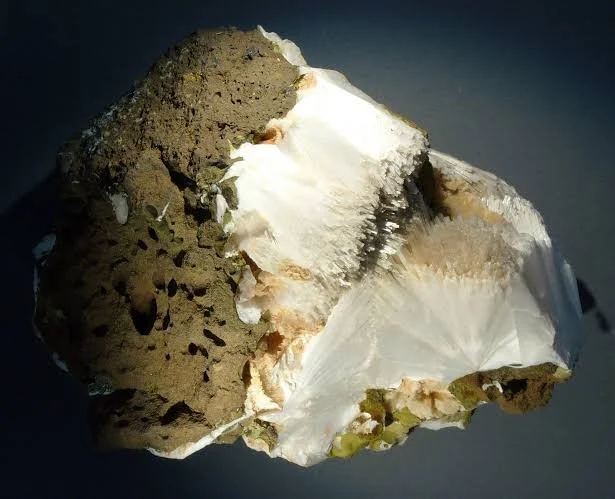
Volcanic geology, mineral-rich fluids, and the hidden chemistry of the Aegean islands.
The Geology Beneath Ikaria
Ikaria is an island in the eastern Aegean known for its rugged terrain, mountainous landscapes, and thermal springs. Its geological history reflects complex processes that have shaped the broader Aegean region, where tectonic movement, metamorphism, and the circulation of hot fluids have influenced the formation of rocks and mineral deposits.
The island's thermal waters are particularly relevant to investigations of subsurface geology. Hot water moving through rock can transport dissolved substances, alter minerals, and produce chemical changes as it cools or reacts with surrounding materials. These processes provide clues about the history of groundwater systems and the rocks through which they move.
The title's reference to zeolite crystals from Ikaria's volcanic core raises a specific mineralogical claim that needs verification. Zeolites are a real and diverse group of minerals, but the existence of a particular subterranean deposit on Ikaria should be established through geological mapping and mineralogical research. The island's thermal activity alone does not prove that a zeolite-bearing volcanic core exists.
A scientifically grounded investigation would examine the island's documented geology, the origin of its thermal waters, and the conditions under which zeolite minerals form.
What Are Zeolites?
Zeolites are a group of minerals characterized by porous crystal structures composed primarily of silicon, aluminum, and oxygen, with water and other ions occupying spaces within the framework. Their internal structure allows certain molecules and ions to move through interconnected channels, giving some zeolites useful properties in industrial and environmental applications.
Natural zeolites commonly form when volcanic glass or other suitable materials react with water over time. Depending on the chemistry, temperature, pressure, and composition of the surrounding rock, different zeolite minerals may develop. Some deposits form through the alteration of volcanic ash, while others arise through fluid-rock interactions in particular geological settings.
The mineral group is diverse. Individual zeolites have different structures, compositions, and physical properties, so identifying a specimen requires more than recognizing a general resemblance to a crystal. Laboratory methods such as X-ray diffraction can help determine the mineral's crystal structure, while chemical analysis provides information about its composition.
Natural zeolites have attracted scientific interest because of their ability to exchange certain ions and interact with water and gases. They have been investigated for applications involving water treatment, agriculture, industrial separation processes, and other uses, although their suitability depends on the particular mineral and the conditions of use.
These properties make zeolites an interesting subject for an article about hidden minerals, but claims about a specific Ikaria deposit require direct evidence.
Thermal Waters and Fluid-Rock Interactions
Thermal springs occur when groundwater circulates through the subsurface and returns to the surface at an elevated temperature. The heat may reflect the regional geothermal gradient, deeper circulation pathways, or local geological conditions. The chemistry of the water depends on the rocks it encounters and the length of time it remains underground.
As water moves through fractures and porous materials, it can dissolve some minerals and promote the formation of others. These interactions can alter the surrounding rock, producing zones with different mineral compositions and textures.
In certain environments, hydrothermal alteration can contribute to the formation of zeolites or other secondary minerals. However, the presence of thermal springs does not automatically imply that zeolites are forming. Researchers must establish the mineralogical composition of the host rocks and the conditions under which the alteration occurred.
For Ikaria, geological fieldwork could investigate exposed rock units, structural features, spring chemistry, and any documented mineral occurrences. Samples would need to be collected and analyzed appropriately before a particular zeolite species or deposit could be confirmed.
Investigating a Subterranean Mineral Deposit
The study of underground mineral deposits often begins with geological mapping and the identification of suitable host rocks. Researchers examine the relationships between rock layers, fractures, alteration zones, and fluid pathways. Surface observations can then guide further investigation, although not every subsurface feature can be inferred reliably from what is visible above ground.
Geophysical methods may help identify variations in subsurface properties. Depending on the geological setting, these methods can provide information about rock boundaries, fractures, or zones containing fluids. Their results must be interpreted alongside geological evidence rather than treated as direct mineral identification.
Laboratory analysis is essential when determining whether a sample contains zeolites. X-ray diffraction can identify crystalline phases, while microscopy and chemical analysis can reveal textures and composition. The resulting information can help distinguish a genuine mineral occurrence from material that merely resembles one.
Researchers must also distinguish between a mineral occurrence and an economically significant deposit. A few zeolite crystals do not establish that a large, accessible resource exists, and the presence of a useful mineral does not automatically justify extraction.
The Environmental Importance of Zeolite Research
Natural zeolites have attracted interest in environmental research because some varieties can interact with dissolved ions and other substances. Their porous structures can make them useful in particular filtration and adsorption applications, although performance varies considerably among minerals and treatment conditions.
In a geothermal setting, understanding mineral formation can also contribute to knowledge about groundwater movement and water chemistry. Minerals precipitating from fluids may record aspects of the conditions under which the water circulated, while altered rocks can preserve evidence of earlier geological processes.
Such information can help researchers reconstruct the evolution of a hydrothermal system. It may also contribute to environmental monitoring where thermal waters are important to local ecosystems or communities.
An article about subterranean zeolites on Ikaria should therefore combine mineralogy, geothermal research, and environmental science. The island's thermal waters provide a compelling setting for exploring subsurface chemistry, while reliable geological evidence must establish whether the specific zeolite deposits described in the title are actually present.







