
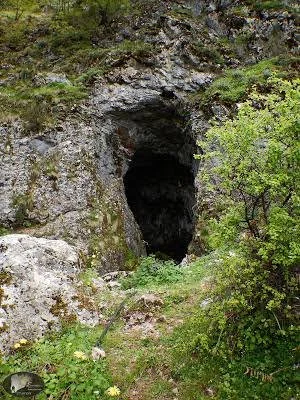
Iron-rich minerals, subterranean geology, and the search for hidden mineralized pathways.
The Mountains and Their Mineral History
The Othrys mountain range lies in central Greece and forms part of a broader geological landscape shaped by tectonic movement, sedimentation, metamorphism, and the development of mineral deposits. Mountain regions can preserve complex relationships between rock layers and mineralized zones, making them valuable subjects for geological investigation.
Iron-bearing minerals occur in many geological environments. Some form through sedimentary processes, while others develop through the alteration of earlier rocks or the circulation of mineral-rich fluids. Their distribution can provide information about the chemical conditions that existed when the deposits formed.
Hematite is an iron oxide mineral known for its reddish-brown to metallic appearance. It can occur as massive material, fine-grained coatings, crystalline specimens, or layers within other rocks. Its color and abundance have made it important in geological studies and in the history of pigments and iron resources.
The title's reference to underground hematite rivers suggests flowing pathways of iron-rich material beneath the Othrys Mountains. Hematite itself does not ordinarily flow like water, and a specific subterranean hematite system would require geological evidence. The more scientifically grounded investigation concerns iron-rich fluids, mineral veins, and the geological processes that can concentrate hematite underground.
How Hematite Forms
Hematite can develop under a range of geological conditions. It may form when iron-bearing materials react with oxygen, when mineral-rich fluids deposit iron oxides in fractures, or when earlier minerals undergo chemical alteration.
The mineral's color varies with grain size, impurities, and the conditions under which it formed. Fine particles can produce strong red pigments, while larger crystalline specimens may display a metallic sheen. Hematite can also occur as coatings on rock surfaces or as part of layered iron-rich deposits.
Geologists study hematite by examining its texture, mineral associations, and relationship to surrounding rocks. Chemical analysis can establish its composition, while microscopy and other methods help distinguish it from related iron oxides and iron-bearing minerals.
The geological setting is essential because similar-looking deposits may have formed through different processes. A red stain on a rock surface might result from the oxidation of iron-bearing minerals without representing a substantial hematite deposit.
Underground Fluids and Mineralized Fractures
Fluids moving through fractures can transport dissolved elements and alter the surrounding rock. When temperature, pressure, acidity, or chemical conditions change, some substances may precipitate, forming mineral coatings, veins, or replacement zones.
Iron can be transported in groundwater under suitable chemical conditions. When the water encounters a different environment, iron may oxidize and precipitate as iron oxides or related minerals. The resulting deposits can follow fractures, fill cavities, or form irregular concentrations within the host rock.
These processes can create striking geological patterns. A fracture coated with red or dark mineral material may appear as a line running through the rock, while a larger mineralized zone may extend along a structural boundary.
However, a mineralized fracture is not a river, and its presence does not prove that a large underground deposit exists. Researchers must establish the material's composition, continuity, and geological origin before describing the feature accurately.
For Othrys, an investigation would begin with published geological maps and mineral-resource studies, followed by field observations of any documented iron-bearing formations. The exact location and characteristics of a claimed hematite deposit would need to be verified.
Iron Resources and Human History
Iron-bearing materials have played an important role in human technology. Iron production allowed communities to manufacture tools, agricultural implements, weapons, and other objects, although the availability of usable ore did not automatically mean that a region developed a large iron industry.
The archaeological study of iron production examines furnaces, slag, ore fragments, charcoal, and metal objects. These materials can reveal how ore was processed, which technologies were used, and how metalworking connected with wider economic networks.
A mineral deposit may have been known to local communities without being exploited on a large scale. Extraction depends on accessibility, the quality of the ore, the availability of fuel, transportation, labor, and the technology available at a particular time.
An investigation of the Othrys region could examine whether iron-bearing deposits influenced historical settlement or industry. Such claims would need archaeological, geological, or documentary support rather than relying solely on the presence of iron minerals.
Modern Methods for Mapping Subsurface Deposits
Geologists use several techniques to investigate mineralized zones beneath the surface. Geological mapping establishes the distribution of rock types and structures, while geophysical surveys can identify differences in properties such as magnetism, electrical resistivity, or density.
Iron-rich minerals may produce measurable magnetic or other physical responses, although the usefulness of each method depends on the deposit and surrounding geology. Geophysical anomalies must be interpreted alongside field observations and sampling because they can have several possible causes.
Drilling may provide direct evidence about subsurface materials, but it is generally used when there is a clear scientific or exploration purpose and appropriate authorization. Samples obtained from different depths can reveal whether a mineralized zone continues below the surface and how its composition changes.
The phrase underground hematite rivers is best treated as a metaphor for hidden iron-rich pathways until geological evidence establishes what actually exists. A compelling article can explain the real processes that create iron oxide deposits, investigate the documented geology of Othrys, and show how modern methods distinguish a striking surface feature from a substantial mineral resource.







