
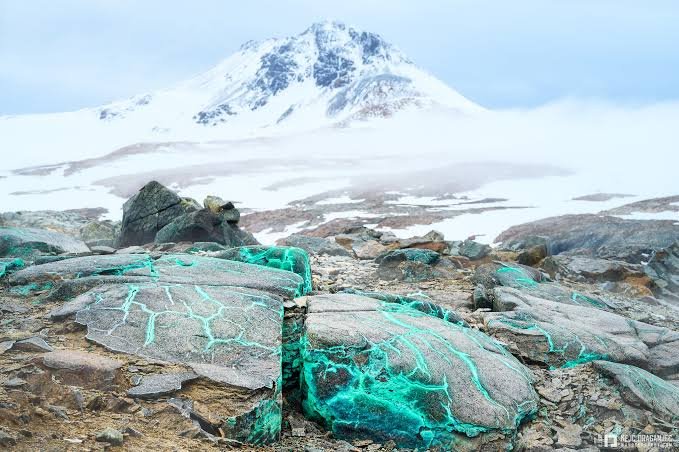
Copper minerals, mountain geology, and the search for evidence beneath northern Greece's rugged terrain.
A Green Mineral with a Long History
Malachite is one of the most recognizable copper minerals. Its vivid green colors, often arranged in concentric bands or irregular patterns, have made it popular in decorative objects, pigments, and jewelry for thousands of years.
The possibility of hidden malachite veins in the Varnous Massif invites an exploration of mineral formation in northern Greece. However, the presence of a specific malachite deposit in this mountain region must be confirmed through geological mapping and mineralogical records rather than inferred from the area's rugged appearance.
How Malachite Forms
Malachite is a copper carbonate hydroxide mineral. It commonly develops near the surface of copper-bearing deposits, where oxygenated water reacts with copper minerals and carbonate-bearing conditions encourage secondary mineral formation.
Its characteristic green color comes from its copper content. Malachite may occur as crusts, fibrous aggregates, botryoidal masses, or coatings along fractures. In some deposits, it appears alongside other secondary copper minerals, including azurite.
Unlike a primary copper ore formed deep within a geological system, malachite is generally associated with near-surface alteration. Its occurrence can therefore reveal how groundwater and weathering have transformed an older mineral deposit.
Understanding the Varnous Massif
The Varnous mountain region lies in northern Greece near the border with North Macedonia. Its landscape includes mountainous terrain, forested slopes, and geological formations shaped by long-term tectonic and erosional processes.
The existence of copper mineralization in a wider region would not automatically establish malachite veins at a particular mountain site. Geologists must identify the relevant host rocks, structural features, and chemical conditions before determining whether a deposit is likely.
Field surveys typically begin with geological maps and surface observations. Researchers examine rock outcrops, fractures, alteration zones, and mineral stains before collecting samples for laboratory analysis.
Finding and Identifying Copper Minerals
Green coloration in rock is not sufficient evidence of malachite. Other minerals, weathering products, and even biological growth can produce green surfaces. Reliable identification may require microscopy, chemical analysis, X-ray diffraction, or Raman spectroscopy.
If malachite were discovered in the Varnous Massif, researchers would investigate its relationship to surrounding rocks and any underlying copper mineralization. They would also assess the scale and continuity of the occurrence before describing it as a vein or deposit.
A mineral specimen and an economically significant ore body are not the same thing. The latter requires evidence about quantity, grade, accessibility, and environmental constraints.
Conservation and Responsible Exploration
Mountain environments may contain sensitive habitats, protected areas, and landscapes with important ecological value. Mineral exploration should therefore respect access restrictions and avoid unnecessary disturbance.
Malachite also deserves careful handling because copper-bearing mineral dust should not be inhaled or ingested. Specimens should be collected only where legally permitted.
The prospect of green copper minerals in Varnous is an appealing subject for geological investigation. Its scientific importance, however, depends on verified samples, transparent documentation, and an accurate understanding of the region's mineral resources.







