
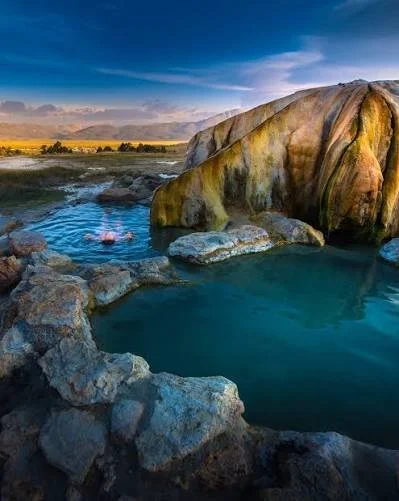
Mineral-rich waters, limestone landscapes, and the geology of natural terraces.
Water That Builds Stone
Travertine is a sedimentary rock that forms when dissolved minerals precipitate from water, often around springs and other environments where groundwater reaches the surface. Over time, repeated deposition can create ledges, crusts, pools, and terraces that transform the shape of a landscape.
The process can appear almost architectural. Water flows over a surface, leaves behind mineral deposits, and gradually creates raised edges or irregular steps. As conditions change, some areas accumulate material more rapidly than others, producing patterns that resemble walls, basins, or miniature cascades.
The title refers to hidden travertine terraces associated with hot springs in the Nestos region of northeastern Greece. The existence, location, and extent of such terraces would need to be confirmed through geological and hydrological sources. The broader scientific subject is well established, but a specific formation should not be described as a verified discovery without supporting evidence.
The Nestos River basin provides a useful setting for examining how water interacts with rock, how mineral deposits develop, and how geological processes create features that can later become subjects of local interest or folklore.
How Travertine Forms
Groundwater can dissolve minerals as it moves through rock. When the water reaches the surface, changes in temperature, pressure, acidity, or carbon dioxide concentration may cause some dissolved material to precipitate. In many travertine-forming environments, calcium carbonate is the principal component.
Carbon dioxide plays an important role in the chemistry of carbonate-rich water. Groundwater containing dissolved carbon dioxide can dissolve limestone, carrying calcium and bicarbonate in solution. When the water emerges and loses carbon dioxide to the atmosphere, calcium carbonate may precipitate and accumulate on nearby surfaces.
Warm water can influence the rate of these processes, but travertine does not require a hot spring to form. Some deposits develop around cool springs, rivers, or other water sources where the chemical conditions are suitable.
The resulting formations vary considerably. Some are porous and irregular, while others develop more clearly defined terraces or ledges. Microorganisms, vegetation, water flow, and changes in chemistry can all influence the final structure.
Geologists distinguish travertine from other carbonate deposits through their texture, mineral composition, geological setting, and formation history. A pale, layered rock near a spring should not automatically be identified as travertine without appropriate examination.
The Nestos River and Its Surrounding Landscape
The Nestos, known as the Mesta in Bulgarian, flows through a region shaped by mountains, valleys, forests, and agricultural landscapes before reaching the Aegean. Its basin supports a variety of ecosystems, and the river has influenced human settlement, land use, and transportation throughout its history.
Investigating mineral terraces in this region would require identifying the relevant water source and establishing its geological characteristics. Researchers would examine local rock types, groundwater pathways, temperature measurements, water chemistry, and the presence of carbonate deposits.
Hydrological research could establish whether a spring is naturally warm, whether its flow changes seasonally, and what dissolved minerals it carries. Geological mapping would help determine whether the surrounding rocks could supply the materials needed for travertine formation.
It is important to distinguish between a hot spring, a mineral spring, and a travertine-forming spring. These categories overlap in some places but are not interchangeable. Warm water does not necessarily deposit travertine, and travertine can form without elevated temperatures.
A site-specific investigation should therefore begin with published geological information and verified field observations rather than assuming that a hidden thermal terrace exists because the region contains river gorges and mineral springs.
Terraces as Records of Environmental Change
Travertine deposits can preserve information about the conditions under which they formed. Their layers may reflect changes in water flow, mineral concentration, temperature, vegetation, or other environmental factors. Some deposits can be dated using appropriate scientific methods, allowing researchers to investigate how the spring environment changed over time.
The interpretation of these layers requires care. A terrace may contain interruptions, erosion surfaces, or deposits formed under different conditions. Researchers must consider the local geology and the possibility that several processes contributed to the final structure.
Geochemical analysis can provide information about the water and environmental conditions involved in mineral deposition. Microscopic examination may reveal textures associated with biological activity, while mapping can show how deposits relate to the spring and surrounding terrain.
These methods can turn a visually striking formation into a record of environmental history. However, a terrace cannot automatically be interpreted as evidence of ancient human activity or a historical bathing site. Such claims would require archaeological evidence in addition to geological analysis.
Conservation and the Vulnerability of Mineral Springs
Travertine formations may be sensitive to changes in water flow, pollution, physical disturbance, and other environmental pressures. Once the conditions responsible for deposition change, the formation process may slow or stop. Existing terraces can also be damaged by erosion or direct contact.
Water abstraction, land development, and alterations to drainage can affect springs and groundwater systems. The impact depends on the site's specific geology and hydrology, making careful monitoring important where valuable formations are present.
Researchers and conservation authorities can document sensitive sites through mapping, photography, water-quality monitoring, and repeated measurements. Such records can establish whether the formation is growing, deteriorating, or changing in response to environmental conditions.
A long-form article about the Nestos hot-spring terraces can combine geology, hydrology, environmental history, and conservation. Its strongest focus is the way mineral-rich water gradually builds a landscape, while verified local evidence determines whether a particular hidden terrace exists and what makes it scientifically significant.







