
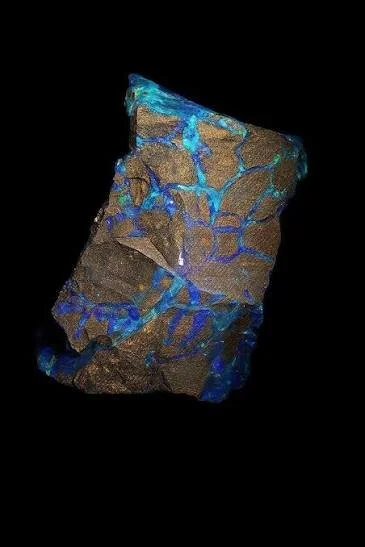
The mining history of Serifos, the geology of the Aegean, and the search for unusual mineral deposits.
An Island Shaped by Mining
Serifos, one of the Cycladic islands in the Aegean Sea, has a significant history of mineral extraction. Its mining landscape includes remnants of industrial activity, infrastructure associated with ore transport, and sites connected to the people who worked in the mines. These remains provide evidence of the relationship between geology, labor, and the economic development of an island community.
Mining settlements can appear ghostly after industrial activity ends. Buildings deteriorate, transport equipment falls into disuse, and pathways once used by workers become quiet. The abandoned landscape can inspire stories about lost wealth and hidden resources, particularly when mineral deposits remain visible in exposed rock.
The title's reference to rare opal veins introduces a specific geological claim that requires verification. The presence of mining history on Serifos does not establish that commercially significant opal veins exist there. The island's known mineralization, geological maps, and mineralogical studies would need to be examined before any such deposit could be described as a discovery.
A compelling article can investigate the real mining landscape and explain how geologists determine whether an unusual mineral occurrence is genuine, how it formed, and whether it has any economic significance.
What Makes Opal Different From Other Minerals?
Opal is a hydrated form of silica that differs from many crystalline gemstones because it lacks the regular long-range crystal structure characteristic of minerals such as quartz. Its appearance can range from translucent or milky material to specimens displaying striking flashes of color.
Precious opal can exhibit a play of color caused by the interaction of light with regularly arranged microscopic silica structures. Other forms of opal may lack this optical effect but still display attractive colors or patterns. The appearance of a specimen depends on its internal structure, water content, impurities, and the conditions under which it formed.
Opal can develop in different geological environments, including settings where silica-rich water deposits material in cavities or fractures. However, the presence of silica-rich rock alone does not guarantee that opal will form. Temperature, water chemistry, host-rock properties, and geological history all influence the resulting material.
Geologists identify minerals using a combination of physical properties and analytical techniques. Color alone is insufficient, because several minerals and altered rock materials can resemble one another. Laboratory analysis may be required to distinguish opal from quartz, chalcedony, or other silica-rich substances.
Any claim about rare opal veins on Serifos would therefore require actual samples, reliable geological documentation, and an assessment of the material's properties.
The Geological History of Serifos
The geology of Serifos reflects complex processes that affected the Aegean region over long periods. The island contains metamorphic rocks and mineralized zones associated with geological events that influenced the distribution of iron-bearing materials and other minerals.
Hydrothermal processes can move dissolved substances through fractures in rock. As fluids cool or react with surrounding materials, minerals may precipitate, producing veins, replacements, or concentrations within the host rock. The composition of the fluids and the conditions under which they circulate determine which minerals form.
Understanding these processes requires more than observing a colorful rock surface. Geologists examine the relationships between mineral deposits and surrounding rock units, investigate structural features such as faults and fractures, and compare samples from different locations. Laboratory techniques may help identify mineral composition and establish the conditions under which the material formed.
For Serifos, a useful investigation would begin with published geological maps and mineralogical research. It could examine the island's documented iron deposits and associated mineralization, then determine whether opal has been reported in reliable sources.
If no credible evidence for opal veins is found, the article should not describe the deposit as real. Instead, the question can become a case study in how geological claims are verified and why an abandoned mine's appearance can lead to speculation about hidden minerals.
The Industrial Archaeology of Abandoned Mines
Mining sites preserve evidence of more than geology. They also reveal how workers extracted, processed, and transported materials. Buildings, loading facilities, rail infrastructure, machinery, and waste deposits can help reconstruct the organization of an industrial operation.
Serifos is especially important because its mining history is closely connected to labor and social change. Industrial activity affected employment, settlement, working conditions, and the island's relationship with external markets. The remains of mines can therefore be studied as archaeological evidence of modern industrial life.
Industrial archaeology examines how technology and infrastructure were used, maintained, and eventually abandoned. Researchers can map surviving structures, identify machinery, study historical photographs, and compare the physical remains with company records and other documents.
The landscape also raises questions about environmental impact. Mining can alter terrain, expose rock, create waste deposits, and influence local water systems. The long-term effects depend on the materials extracted and the methods used, making site-specific investigation essential.
These questions provide a strong foundation for an article even if no rare gemstone discovery can be confirmed. The abandoned mines themselves represent a substantial historical subject.
How a Mineral Discovery Would Be Verified
A claim about a rare mineral deposit requires several forms of evidence. First, the material must be identified correctly. Second, its geological context must be documented so researchers can establish how it occurs within the surrounding rocks. Third, the extent and quality of the deposit must be evaluated before claims about rarity or commercial importance can be justified.
Field sampling and laboratory analysis are central to this process. Mineralogical testing can determine composition and structure, while geological mapping can establish whether specimens come from an isolated occurrence or a larger mineralized zone.
Researchers must also distinguish between an unusual specimen and an economically significant deposit. A small piece of opal discovered in an area does not necessarily indicate the presence of a continuous vein, and a mineral occurrence does not automatically justify commercial extraction.
An article about supposed opal veins on Serifos could therefore explore the island's authentic mining history, explain how opal forms, and investigate the evidence for any reported occurrence. This keeps the mystery engaging while allowing geological research, rather than speculation, to determine what the rocks actually contain.







