
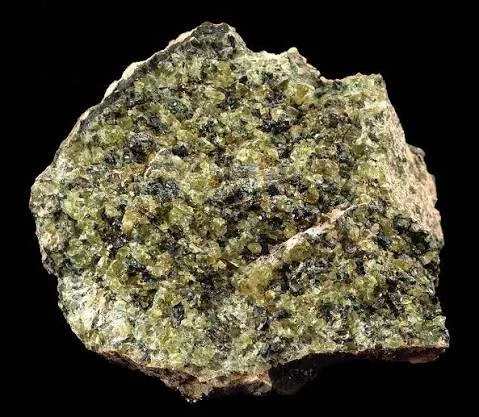
Mantle-derived minerals, altered oceanic rocks, and the geological origins of green gemstones.
The Green Gemstone Hidden in Earth's Rocks
Peridot is the gem-quality variety of olivine, a mineral group commonly associated with magnesium-rich and iron-bearing rocks. Its characteristic green color makes it recognizable in jewelry, but the mineral's geological importance extends far beyond its appearance.
Olivine is a major component of Earth's upper mantle, where high temperatures and pressures influence the composition of rocks deep beneath the surface. When mantle-derived materials are brought closer to the surface through geological processes, olivine may occur in rocks that provide clues about the planet's interior.
Serpentinite is a rock formed when water reacts with certain ultramafic rocks, changing their mineral composition through a process known as serpentinization. Because serpentinite can develop from rocks that originally contained olivine, the association between serpentinite and peridotite is geologically important.
The title refers to rare peridot deposits in Aegean serpentinite rocks. Such an association is scientifically plausible in a broad geological sense, but the existence of gem-quality peridot deposits at a specific Aegean location would require mineralogical confirmation. Serpentinite alone does not establish the presence of commercially valuable gemstones.
Olivine, Peridot, and the Earth's Mantle
Olivine is a silicate mineral with a crystal structure that incorporates magnesium and iron in varying proportions. Magnesium-rich varieties tend to have lighter green colors, while greater iron content can influence the mineral's appearance and physical properties.
Peridot is the name used for olivine when it possesses suitable color, clarity, and quality for use as a gemstone. Not all olivine is suitable for jewelry, and many specimens occur as small grains within rock rather than as transparent crystals.
The mineral is particularly important in geology because olivine is abundant in many mantle-derived rocks. Its composition can provide information about the conditions under which a rock formed and the processes it experienced during its movement through the Earth's crust.
Geologists study olivine through thin-section microscopy, chemical analysis, and other mineralogical methods. These techniques can help establish its composition, identify alteration, and compare samples from different geological settings.
What Serpentinite Reveals About Ancient Oceans
Serpentinite forms when water reacts with ultramafic rocks, often producing minerals belonging to the serpentine group. The process can occur in oceanic crust and in mantle rocks exposed along tectonic boundaries. It can alter the physical and chemical properties of the original material.
Serpentinite is significant in the study of plate tectonics because it can preserve evidence of water-rock interactions in environments associated with oceanic crust and the Earth's mantle. In some geological settings, serpentinized rocks form part of ancient oceanic lithosphere that was later incorporated into mountain belts.
The Aegean region has a complex tectonic history involving the movement and interaction of crustal blocks, the evolution of ocean basins, and the development of mountain systems. Ultramafic rocks and serpentinite occurrences can provide evidence of these processes.
However, serpentinite is not itself proof that peridot gemstones occur nearby. Olivine may have been altered during serpentinization, and its survival depends on the conditions of alteration. The presence of suitable crystals must be confirmed through field and laboratory investigation.
How Geologists Search for Peridot
The search for peridot begins with geological mapping and the identification of rock types capable of containing olivine. Researchers examine exposed outcrops, mineral textures, and the relationships between different rock units. Samples are then collected and analyzed to establish the presence and composition of olivine.
Laboratory analysis can distinguish olivine from other green minerals that may resemble it. Microscopy and chemical testing can reveal the mineral's composition and the extent of alteration. If transparent crystals are present, gemological examination is needed to assess whether they have suitable color, clarity, and durability for gemstone use.
The distribution of olivine also matters. Small grains scattered throughout a rock are different from a concentration of crystals that can be extracted economically. Researchers must assess the size, quality, continuity, and accessibility of any potential deposit before describing it as a gemstone resource.
An unusual green mineral discovered in an Aegean rock formation should therefore not automatically be labeled peridot. Correct identification requires appropriate testing, and claims about rarity or commercial importance require additional evidence.
The Value of Geological Fieldwork
Geological fieldwork provides a direct way to connect mineral samples with their surrounding environment. Researchers record the location and structure of an outcrop, identify the host rock, and examine the relationships between mineral grains and geological features such as fractures or alteration zones.
Field observations can be combined with remote sensing and geographic information systems to map the distribution of rock units. Laboratory results then help establish whether the observed materials match the expected mineralogy.
The investigation may also reveal how geological processes affected the original rock. A sample containing olivine may preserve evidence of partial alteration, while surrounding minerals may indicate the conditions under which water interacted with the rock.
These details are scientifically valuable even if no gem-quality peridot is found. They can improve understanding of the Aegean's tectonic history and the processes that transform mantle-derived materials into the rocks exposed at the surface.
An article about rare peridot in Aegean serpentinite can therefore combine gemstone science, mineralogy, and plate tectonics. Its central mystery is how green crystals form and survive within a changing geological environment, while verified sampling determines whether a particular deposit exists.







