
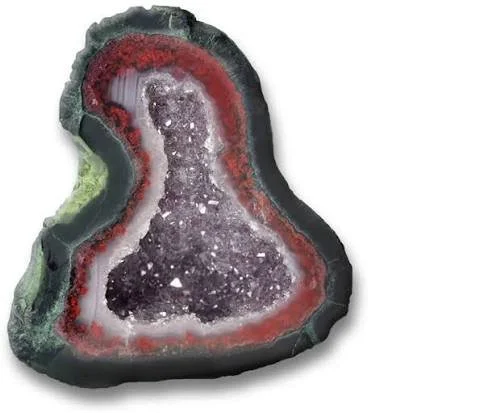
Hollow mineral formations, silica deposition, and the geological story of the Cyclades.
The Mystery Inside a Stone
Some of the most interesting geological specimens appear ordinary from the outside. A rounded rock may conceal a cavity lined with crystals, concentric bands, or layers of mineral growth. When such a cavity develops within rock and later fills partly or completely with minerals, it can form a geode.
Agate geodes are particularly attractive because their interiors may display delicate bands of chalcedony and quartz. The idea of hidden geodes beneath the cliffs of Antiparos creates an appealing image of a secret mineral landscape, but a specific local occurrence requires evidence from geological surveys or documented specimens.
How Geodes and Agate Develop
Geodes often begin as cavities in volcanic or sedimentary rocks. Mineral-rich fluids enter the empty space and deposit silica or other minerals over time. Depending on the chemistry and conditions, crystals may grow inward from the walls, sometimes leaving a central void.
Agate is a banded variety of chalcedony. Its layers can differ in color, opacity, and texture because of changes in fluid chemistry, impurities, or the conditions under which silica was deposited.
Not every hollow rock is a geode, and not every silica-filled cavity contains agate. Some cavities are lined with quartz crystals, while others contain calcite or different minerals.
The geology of the host rock is crucial. Geodes are often associated with particular volcanic or sedimentary environments, and their presence cannot be predicted simply because a region has cliffs or underground cavities.
The Geological Setting of Antiparos
Antiparos is a Cycladic island known for its coastal scenery and cave system. Its landscape reflects the geological history of the Aegean, including sedimentary processes, tectonic activity, and the development of exposed rock formations.
The presence of a cave or cliff does not establish that geodes occur beneath it. A limestone cave, for example, develops primarily through dissolution, whereas many geodes originate in cavities associated with different geological processes.
To investigate the proposed geodes, geologists would first map the local bedrock and identify any formations capable of hosting silica-rich cavities. They would then document mineral occurrences and determine whether they are natural features rather than fragments transported from elsewhere.
Finding Evidence Without Damaging the Landscape
Researchers can use geological mapping, surface surveys, and carefully selected samples to evaluate a suspected mineral occurrence. Where underground spaces are involved, safety assessments are essential because unstable rock, narrow passages, and loose cliff material can pose serious hazards.
Antiparos also has geological and natural features that deserve protection. Uncontrolled collecting or excavation can damage fragile formations and archaeological or paleontological material.
If agate geodes were confirmed, researchers could examine their banding, mineral composition, and formation conditions. Such work might reveal information about the fluids that moved through the rock and the history of the surrounding geological environment.
Separating a Geological Possibility from a Discovery
A geode can be scientifically valuable even if it is small or commercially insignificant. Its internal structure may preserve a record of mineral growth, fluid movement, and changing chemical conditions.
However, describing a deposit as extensive, underground, or rare requires evidence beyond a single attractive specimen. Researchers need reliable locations, verified mineral identification, and enough observations to understand the occurrence.
The proposed geodes beneath Antiparos remain a subject for investigation rather than an established discovery. Their story begins with the same principles that guide all mineral research: identify the host rock, document the evidence, and allow the geology to determine the conclusion.







