Introduction and Historical Background
The study of geometric patterns in ancient burial textiles offers an important perspective on the technological abilities, artistic traditions, social organization, and funerary beliefs of prehistoric and historical communities. In the region of Kilkis, in Central Macedonia, archaeological evidence from ancient cemeteries provides opportunities to investigate the relationship between clothing, personal adornment, burial rituals, and social identity.
Kilkis occupies a historically significant geographical position between the Axios River valley, the plains of Central Macedonia, and the southern Balkan interior. Its location encouraged interactions among communities through agriculture, migration, exchange, and cultural contact. These interactions influenced local pottery styles, metalworking traditions, burial practices, and textile production.
Archaeological investigations at Palio Gynaikokastro have documented an Early Iron Age cemetery dating approximately to 1100–1000 BCE. The cemetery contained numerous cremation burials, pottery vessels, bronze ornaments, and iron weapons. The pottery featured incised, grooved, and painted decoration, demonstrating the importance of geometric and repetitive ornamental traditions in the region. However, these findings should not be confused with the discovery of a particular collection of geometric burial textiles. The textile evidence requires separate archaeological verification.
Textile Production and Raw Materials
Ancient textile production generally involved several stages, beginning with the collection and preparation of raw materials. In the broader Aegean and Balkan regions, commonly used textile materials included:
Wool: Obtained from domesticated sheep and processed through cleaning, sorting, spinning, and weaving.
Flax: A plant-based fiber used to produce relatively fine and lightweight fabrics.
Other bast fibers: Plant fibers obtained from stems and processed into threads suitable for weaving.
Animal-derived materials: Depending on regional resources, other animal fibers could also have been utilized.
The transformation of raw fibers into finished textiles required specialized knowledge. Fibers were cleaned, separated, twisted into yarn, and arranged into threads. Spindle whorls and loom weights, when recovered from archaeological contexts, can help establish the presence of spinning and weaving activities.
The warp-and-weft system formed the foundation of woven textile production. Warp threads were arranged longitudinally, while weft threads passed horizontally through them. By modifying the arrangement, tension, color, and thickness of these threads, textile producers could create different textures and decorative patterns.
Geometric Decoration and Design Principles
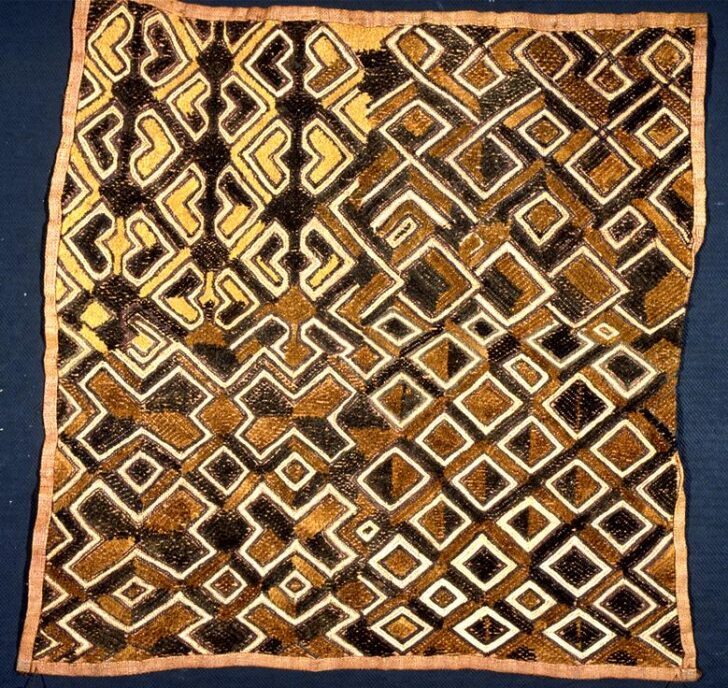
Geometric textile decoration is characterized by the repetition and arrangement of basic visual elements. These include:
Horizontal and vertical lines.
Parallel bands.
Zigzag patterns.
Triangular compositions.
Diamond-shaped motifs.
Checkerboard arrangements.
Repeated symmetrical forms.
Such designs were not necessarily decorative alone. In ancient societies, patterns could communicate group identity, cultural affiliation, social position, and aesthetic preferences.
Geometric designs could be created through variations in thread color, weaving structure, embroidery, supplementary weft techniques, or applied decorative bands. The precise technique cannot be established without surviving textile samples or sufficiently detailed archaeological documentation.
Textiles in Funerary Practices
Textiles played several possible roles in ancient burial customs. They could serve as garments, body coverings, shrouds, wrappings, or decorative elements associated with funerary objects.
The condition of burial textiles is particularly important. Organic fibers deteriorate rapidly when exposed to moisture, microorganisms, oxygen, and fluctuating soil conditions. Consequently, the absence of preserved textiles does not necessarily mean that textiles were absent from the original burial ceremony.
In some archaeological settings, mineralization can preserve impressions of fabrics against metal objects. Corrosion products may retain traces of the original textile structure, allowing researchers to identify weave patterns and fiber arrangements even when the original organic material has disappeared.
The investigation of such remains requires microscopy and scientific analysis rather than visual interpretation alone.
Social and Cultural Significance
The presence of textiles in burial contexts can provide evidence about the social organization of ancient communities. Differences in garment quality, decorative complexity, and the quantity of textile-related objects may indicate differences in economic resources and access to specialized production.
Textiles may also have represented inherited cultural traditions. Similar patterns across neighboring settlements could reflect shared technical knowledge, commercial exchange, intermarriage, or the movement of craftspeople.
Nevertheless, geometric patterns should not automatically be interpreted as ethnic symbols. A repeated motif may have been adopted by different communities without carrying an identical cultural meaning.
Archaeological Research and Scientific Methods
A comprehensive study of Kilkis burial textiles would benefit from several analytical approaches:
Optical microscopy for identifying fiber structures.
Scanning electron microscopy for examining surface morphology.
High-performance liquid chromatography for identifying certain organic dyes.
Radiocarbon dating when suitable organic samples survive.
Digital imaging for recording textile impressions.
Microscopic analysis of corrosion layers on associated metal objects.
Comparative studies of Greek funerary textiles have demonstrated the potential of these methods. Research on textiles recovered from the Lefkandi pyre-burial context, for example, identified different woven structures, decorative bands, and traces of dyes. This is a useful methodological comparison, although it does not establish the existence of the same textile assemblage at Kilkis.
Conclusion
Geometric textile traditions provide a valuable framework for understanding ancient Macedonian material culture. Although specific geometric burial textiles from Kilkis require further verification, the region's archaeological cemeteries establish a strong context for investigating funerary ornamentation, craft production, and social identity.
Future research should prioritize the identification of textile impressions, organic fragments, and microscopic traces associated with excavated graves. Such investigations could contribute to a more complete reconstruction of ancient clothing practices and the symbolic role of woven materials in funerary ceremonies.