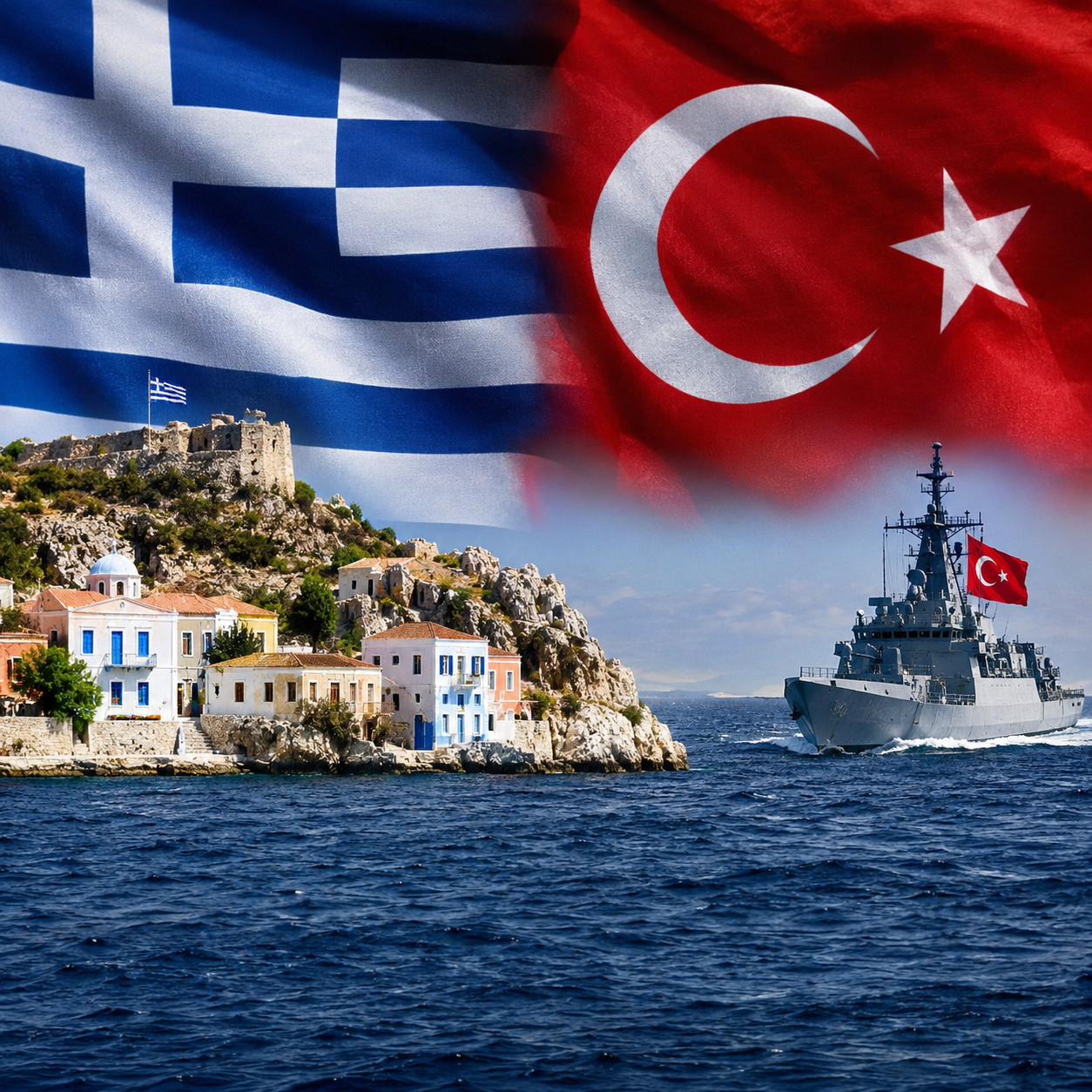
Fresh controversial statements from Turkey have reignited tensions with Greece, with a senior Turkish maritime law official questioning Greek sovereignty over Aegean islands and raising longstanding disputes over territorial waters, demilitarization and the status of hundreds of small islands and islets.
Mustafa Başkara, head of Turkey’s National Research Center for the Law of the Sea (DEHUKAM), an institution affiliated with Ankara University, has made a series of statements challenging Greece’s position on several sensitive issues in the Aegean and Eastern Mediterranean.
Among the most contentious claims was his suggestion that Greece could potentially face questions over its sovereignty of certain islands because of their military presence.
Başkara referred to the 1923 Treaty of Lausanne and the 1947 Treaty of Paris, arguing that Greek sovereignty over certain islands was linked to demilitarization obligations. He also cited a Turkish letter submitted to the United Nations in September 2021, suggesting that Ankara considers the continued military presence on the islands a basis for questioning their legal status.
Greece firmly rejects this interpretation, maintaining that its sovereignty over the islands is established by international treaties and cannot be challenged on the grounds presented by Turkey.
The Turkish official also renewed Ankara’s opposition to Greece extending its territorial waters to 12 nautical miles in the Aegean Sea.
According to Başkara, such an expansion would place more than 70% of the Aegean under Greek territorial waters, a development he described as unacceptable for Turkey. He argued that it would restrict Turkey’s rights and affect international navigation.
However, the right of coastal states to establish territorial waters extending up to 12 nautical miles is recognized under the United Nations Convention on the Law of the Sea. The expansion would also not automatically eliminate the rights of foreign vessels to navigate through relevant waters under applicable international law.
Another particularly sensitive issue raised by Başkara concerns approximately 500 islands, rocks and islets in the Aegean. He claimed that their sovereignty should be discussed between Greece and Turkey, arguing that some geographical formations are not explicitly identified in international treaties.
The remarks effectively revive Ankara’s longstanding position regarding certain geographical formations in the Aegean, an issue that has remained a source of tension between the two NATO allies.
Başkara also criticized Greece’s maritime spatial planning, describing it as an instrument of what he considers excessive maritime claims. Particular attention was directed toward Kastellorizo (Megisti), the easternmost Greek island complex, which occupies a strategically important position in the Eastern Mediterranean.
He argued that Greece assigns excessive maritime influence to Kastellorizo, claiming that this interpretation conflicts with Turkey’s interests in the region. Ankara has consistently promoted a different approach to maritime boundaries and continental shelf rights in the Eastern Mediterranean.
The latest statements highlight how the Greek-Turkish dispute extends beyond disagreements over the continental shelf and Exclusive Economic Zones (EEZs). Issues involving territorial sovereignty, the military status of Greek islands, territorial waters and maritime spatial planning are increasingly prominent in the broader geopolitical debate.
Athens continues to reject Turkish challenges to Greek territorial sovereignty, while the two countries maintain fundamentally different legal and diplomatic positions on several key issues.
The renewed rhetoric underscores the continuing sensitivity of the Aegean question and the challenges facing efforts to maintain stable relations between Greece and Turkey.