
Introduction
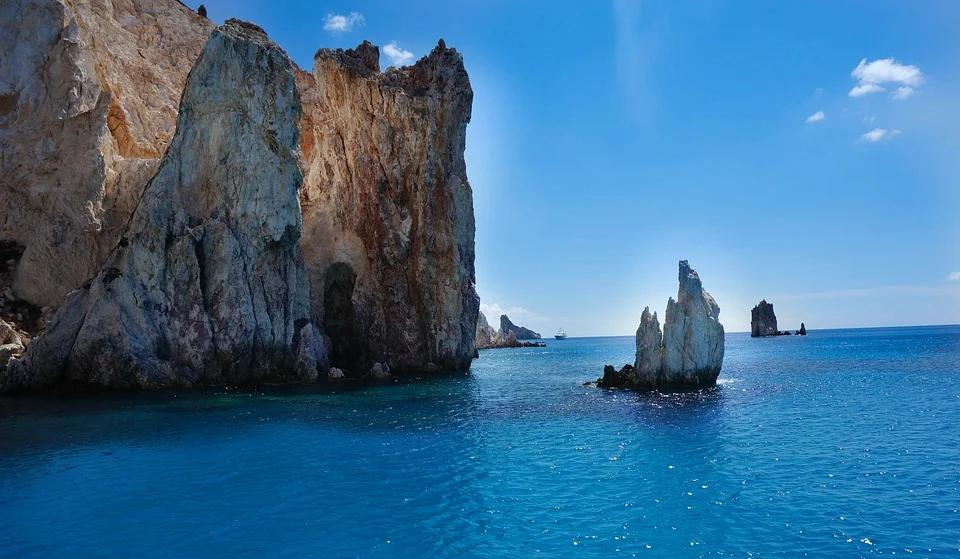
Polyegos is an island in the Cyclades region of Greece, situated near Milos and known for its distinctive coastal landscapes and geological features.
The idea of basalt pillars off the Polyegos islets presents an interesting topic in volcanic geology and coastal geomorphology.
Basalt is an igneous rock produced when relatively low-viscosity lava cools and solidifies. Under certain conditions, cooling produces fractures that form columnar structures.
The specific basalt pillars described in the title are not confirmed here. Their investigation would require identifying the rock type and examining the formation of the structures.
Basalt Formation
Basalt forms from magma or lava with relatively low silica content compared with many other volcanic rocks.
When lava reaches the surface, it cools and solidifies.
The cooling process influences:
Crystal size.
Texture.
Mineral composition.
Fracture development.
Rock structure.
Rapid cooling may produce fine-grained basalt, while slower cooling may allow larger crystals to form.
Columnar Jointing
Columnar jointing is a geological structure created when rock contracts during cooling.
As a lava flow or other suitable rock body cools, contraction stresses develop. Fractures may form and extend through the rock.
These fractures can create polygonal columns, commonly with several sides.
The columns may appear vertical, inclined, curved, or irregular depending on the geometry of the cooling surface and the rock body.
Columnar jointing is not exclusive to basalt, although basalt is a common example.
Coastal Exposure and Erosion
Coastal volcanic structures are affected by waves, wind, saltwater, and mechanical weathering.
Erosion may expose columnar structures and create cliffs, arches, cavities, or isolated rock formations.
The direction and intensity of erosion depend on:
Rock composition.
Fracture patterns.
Wave energy.
Sea level.
Sediment movement.
Exposure to weather.
The resulting coastal landscape may change over long periods.
Geological Investigation
Researchers examining basalt pillars near Polyegos could use:
Geological mapping.
Rock sampling.
Petrographic analysis.
Mineral identification.
Structural measurements.
Coastal erosion assessment.
Underwater survey.
The distinction between basalt, andesite, volcanic breccia, and other volcanic rocks is important because visual appearance alone may not be sufficient.
Landscape Significance
Columnar volcanic formations can provide information about lava emplacement and cooling.
The geometry of the columns may reveal the direction of heat loss and the relationship between the rock body and surrounding surfaces.
Coastal exposure may also provide opportunities to study how volcanic structures respond to marine erosion.
Conclusion
Basalt pillars represent a valuable geological record of volcanic cooling and fracture development.
If basaltic columnar structures were confirmed off Polyegos, they could provide insight into volcanic rock formation, coastal erosion, and the geological evolution of the Cyclades.







