
Introduction
Moonstone is a variety of feldspar known for its characteristic optical effect called adularescence. When light interacts with microscopic internal structures, the mineral can display a soft, floating glow that appears to move across its surface.
Moonstone is commonly associated with feldspar-rich igneous and metamorphic rocks. Its appearance in beach sediments would therefore raise an interesting geological question: how could feldspar crystals from inland or offshore source rocks become concentrated along a coastline?
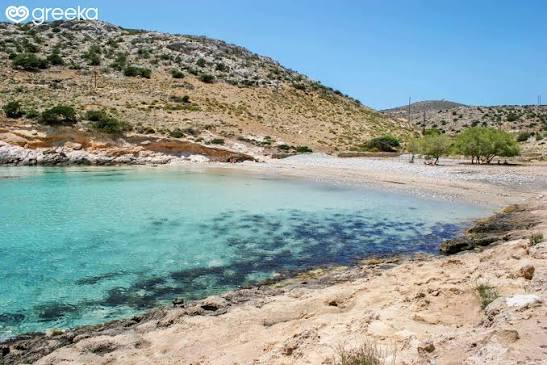
Schinoussa, a small island in the Cyclades, offers a useful setting for examining coastal sediment transport, mineral weathering, and the concentration of resistant grains by waves.
Feldspar Formation and Optical Properties
Moonstone is typically associated with orthoclase or related feldspar compositions. Its optical effect results from internal microscopic intergrowths that scatter light.
The quality of the effect depends on crystal structure, internal layering, transparency, and the orientation of the stone. Not every feldspar grain displaying a pale sheen is necessarily gem-quality moonstone.
In geological environments, feldspar can occur in granitic and other silica-rich igneous rocks. It may also be present in metamorphic formations derived from feldspar-bearing protoliths.
How Beach Concentrations Could Develop
The movement of sand along a shoreline can sort minerals according to density, grain size, shape, and resistance to weathering.
Wave action repeatedly removes and redeposits sediment. Lighter or finer grains may be carried farther, while certain heavier or more durable grains become concentrated in particular beach zones.
If feldspar-bearing source rocks occur on or near Schinoussa, weathering could release feldspar grains that eventually reach the coast. Offshore sediment sources are another possibility, although their contribution would require investigation.
The term vein should be used carefully. A vein is a mineral-filled fracture within rock, whereas a beach concentration is a sedimentary accumulation. Moonstone grains found loose in sand would not constitute a geological vein.
Field and Laboratory Methods
A study would begin with sediment sampling along different parts of the coastline. Samples should be collected at multiple grain-size intervals and at different positions relative to the shoreline.
Laboratory work could include:
Grain-size analysis.
Heavy-mineral separation.
Petrographic identification.
X-ray diffraction.
Raman spectroscopy.
Optical examination under controlled lighting.
Geochemical comparison with potential source rocks.
These methods would establish whether the grains are feldspar, whether they display genuine adularescence, and where they may have originated.
Coastal and Environmental Considerations
Beach mineral concentrations are part of dynamic coastal systems. Removing material may affect sediment balance, particularly on small islands where beaches are limited in area.
Research should prioritise non-destructive observation and small, authorised samples. Any commercial extraction proposal would require environmental assessment and legal review.
Conclusion
Moonstone-like grains on Schinoussa beaches would provide an interesting opportunity to connect mineralogy with coastal processes. Their presence would need to be confirmed through optical and mineralogical testing, while their distribution could help reveal how waves and weathering move feldspar-bearing sediments across island shorelines.







