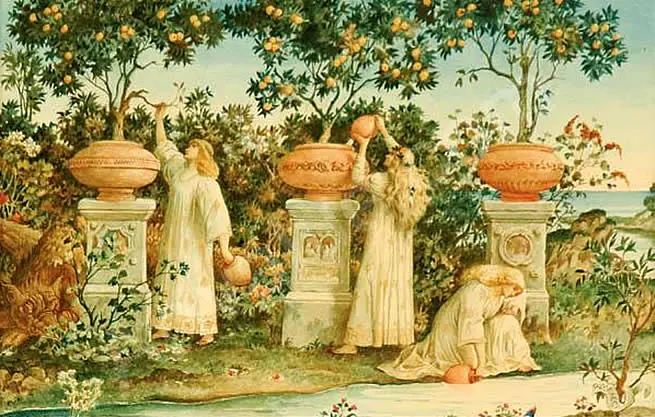
In the far western reaches of the ancient world, near the edge of the encircling ocean and the shadow of the Atlas Mountains, lay the Garden of the Hesperides. This sacred grove belonged to Hera and served as the divine orchard of the gods, home to the legendary Golden Apples.
The Garden and its Guardians
The Hesperides were the "Nymphs of the Evening" or "Daughters of the Sunset." While their parentage varies in myth—sometimes cited as the daughters of Nyx (Night) or the Titan Atlas—their duty was singular: to tend the trees that grew the golden fruit. These apples were originally a wedding gift from Gaia (Mother Earth) to Hera upon her marriage to Zeus.
Because the nymphs were occasionally prone to plucking the apples for themselves, Hera placed an additional, more terrifying guardian in the garden: Ladon. Ladon was a hundred-headed dragon that never slept, capable of speaking in a multitude of different voices and perpetually coiled around the trunk of the central tree.
The Eleventh Labor of Heracles
The Golden Apples are most famous for their role in the labors of Heracles (Hercules). Tasked by King Eurystheus to steal the fruit, Heracles faced a trial that required as much cunning as it did strength.
Seeking the Location: The garden's location was a closely guarded secret. Heracles first had to wrestle the shape-shifting sea god Nereus to force him to reveal the path to the western edge of the world.
The Burden of Atlas: Upon reaching the garden, Heracles encountered the Titan Atlas, who was condemned to hold the heavens upon his shoulders. Heracles offered to take the weight of the sky if Atlas would enter the garden and retrieve the apples (as a Titan and father to the Hesperides, Atlas could bypass Ladon).
The Deception: Atlas agreed, but upon returning with the fruit, he enjoyed his freedom too much to take the sky back. Heracles, feigning agreement, asked Atlas to hold the heavens for just a moment longer so he could adjust a pad on his shoulders. When Atlas took the weight, Heracles snatched the apples and made his escape.
Symbolic Meaning
The Golden Apples represented immortality and the unattainable treasures of the divine realm. Unlike the Apple of Discord, which brought chaos, the Apples of the Hesperides represented the ultimate prize of a hero’s journey—the transition from mortal struggle to divine rest.
After Heracles delivered the apples to Eurystheus, they were eventually returned to the garden by Athena, as it was considered improper for such divine artifacts to remain in the world of men.