The Story of Sisyphus: The Man Condemned to Eternal Labor
In Greek mythology, Sisyphus is the quintessential figure of futility and defiance. As the founder and first king of Ephyra (later known as Corinth), he was renowned for his cunning and intellect—qualities that ultimately led to his downfall when he attempted to outwit the gods themselves.
1. The Transgressions of a King
Sisyphus was not a tragic hero in the traditional sense; he was a "trickster" king who valued human wit over divine authority. His descent into eternal punishment was the result of several major offenses:
Betraying Zeus: Sisyphus witnessed Zeus abducting the nymph Aegina. When her father, the river god Asopus, came searching for her, Sisyphus offered to reveal her location in exchange for a perennial freshwater spring for his city. This act of "snitching" on the King of the Gods was seen as an unforgivable hubris.
The Enchainment of Death: Enraged by the betrayal, Zeus sent Thanatos (Death) to chain Sisyphus in Tartarus. However, Sisyphus slyly asked Thanatos to demonstrate how the shackles worked. When Thanatos put them on himself, Sisyphus locked them, effectively stopping death in the world. For a time, no one could die—even those decapitated or mortally wounded in battle—until Ares, frustrated that war had lost its meaning, intervened to free Death.
The Final Trick: Before being dragged back to the underworld, Sisyphus told his wife to leave his body unburied and perform no funeral rites. Once in Hades, he complained to Persephone that his wife was disrespecting him. He was granted permission to return to the world of the living for one day to "punish" her. Once free, he refused to return, living to a ripe old age before finally being reclaimed by the gods.
2. The Eternal Punishment
For his "superior" cleverness and repeated escapes from the inevitable, the gods devised a punishment that was perfectly tailored to his character: a task that required immense effort but yielded zero progress.
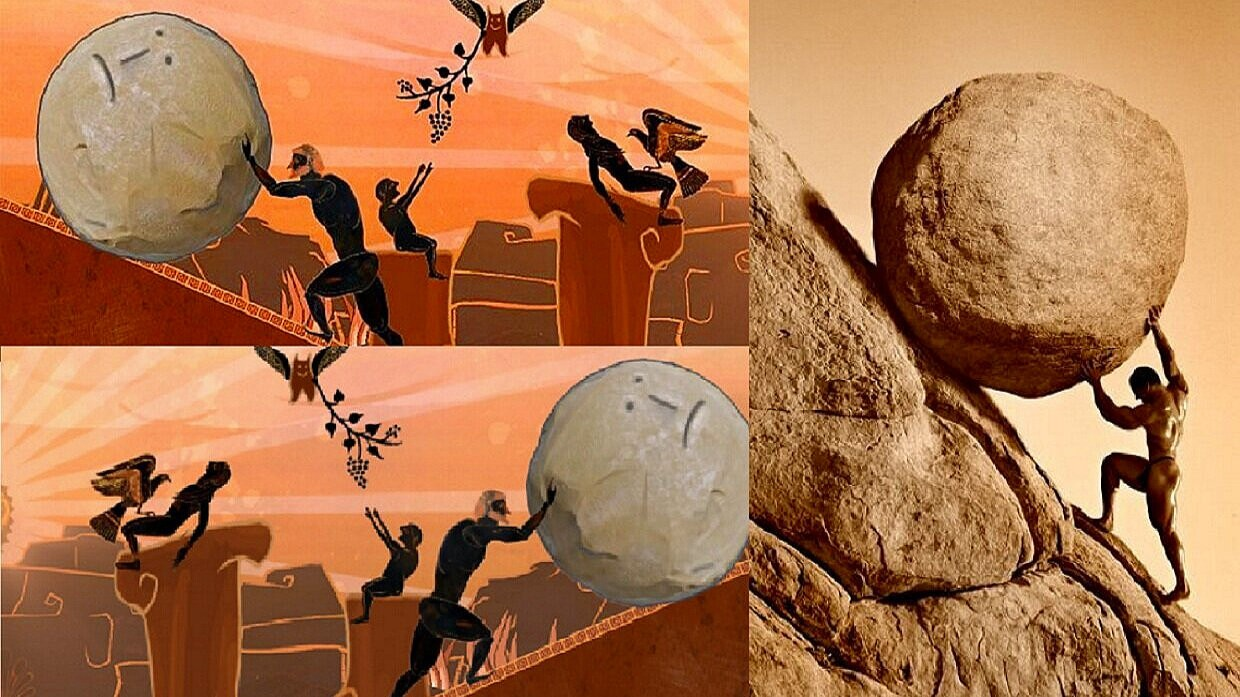
The Labor: Sisyphus was condemned to roll a massive boulder up a steep hill in Tartarus.
The Twist: Just as he reached the very peak, the weight of the stone would become too much to bear, or a divine force would intervene, causing the boulder to roll all the way back to the bottom.
The Cycle: Sisyphus would then have to descend the hill to begin the labor all over again, repeating the process for all eternity.
3. Philosophical Legacy: The Myth of Sisyphus
While the ancient Greeks saw the story as a warning against pride, the 20th-century philosopher Albert Camus reinterpreted the myth in his famous essay, The Myth of Sisyphus.
The Absurd: Camus used Sisyphus as the ultimate "Absurd Hero." He argued that our lives are often filled with repetitive, seemingly meaningless tasks, much like rolling the boulder.
Conscious Defiance: Camus suggested that Sisyphus is most interesting when he is walking back down the hill to fetch his rock. In that moment of pause, he is conscious of his fate. By accepting the struggle and continuing anyway, he becomes superior to his destiny.
The Conclusion: Camus famously concluded, "The struggle itself toward the heights is enough to fill a man's heart. One must imagine Sisyphus happy."
Sisyphus remains a powerful symbol of the human condition—the drive to persist even when the goal seems unreachable.