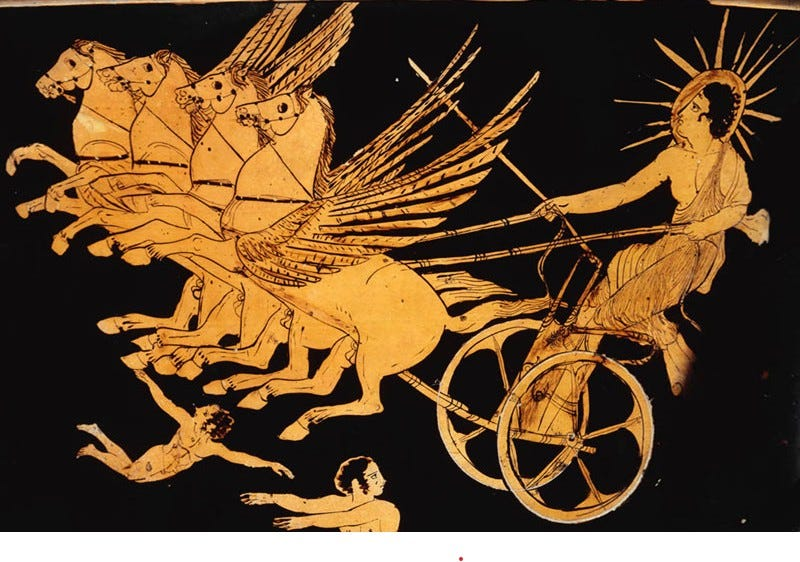
The Myth of Helios: The Sun God’s Journey Across the Sky
In Greek mythology, the passage of day and night was not a celestial accident but a heroic daily labor. Helios, the personification of the Sun (and son of the Titans Hyperion and Theia), was responsible for driving the solar chariot across the heavens, bringing light to both gods and mortals.
1. The Golden Chariot and the Four Steeds
Every morning, Helios rose from the ocean-stream Okeanos in the East. He emerged from a golden palace, signaled by his sister Eos (the Dawn), who opened the gates of heaven.
The Vessel: His chariot was forged by the god-smith Hephaestus out of gleaming gold and precious gems to withstand the intense heat of the sun.
The Horses: The chariot was pulled by four fire-breathing stallions: Pyrios, Aeos, Aethon, and Phlegon. Their names translate to meanings associated with fire, light, and burning.
The Radiance: Helios wore a radiant crown (the aureola) with twelve rays, representing the months or the hours of the day, which emitted a light so bright it was blinding to the human eye.
2. The Daily Path: East to West
The journey of Helios was a fixed, perilous route across the "bronze firmament" of the sky.
Ascension: He climbed to the highest point of heaven (midday), from where he was said to be "all-seeing." Because of this, Helios was often called upon as a witness to oaths and secret crimes.
Descent: In the evening, he descended into the West, where he bathed his weary horses in the cool waters of the outer ocean.
The Return Journey: To return to the East for the next sunrise, Helios didn't fly back through the dark. Instead, he floated around the northern edge of the world in a giant golden cup or vessel created by Hephaestus, carrying his chariot and horses back to his starting point while the world slept.
3. The Tragedy of Phaethon
The most famous myth involving the sun chariot is the story of Helios' son, Phaethon. Seeking to prove his divine parentage, Phaethon asked his father for one wish: to drive the sun chariot for a single day.
The Disaster: Despite Helios' warnings, Phaethon could not control the fiery steeds. He flew too high, freezing the earth, and then too low, scorching the African continent into a desert and darkening the skin of its inhabitants.
The End: To prevent the total destruction of the world, Zeus was forced to strike the chariot with a thunderbolt. Phaethon fell to his death into the river Eridanus, and Helios, struck by grief, refused to drive the chariot for a day, leaving the world in darkness.
4. Helios vs. Apollo
A common misconception is that Helios and Apollo are the same god.
Helios is the Titan of the Sun—the literal physical orb and the charioteer.
Apollo is an Olympian who, in later Roman and Hellenistic periods, became associated with light, prophecy, and music. Over time, their identities merged in popular Roman culture (as Sol), but in classical Greek myth, they remained distinct entities with different genealogies.
Helios serves as a reminder of the ancient Greek view of the cosmos: a world where nature was alive, rhythmic, and maintained by the constant vigilance of the gods.