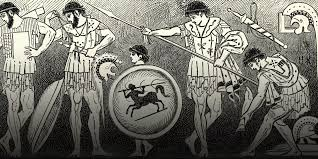
Introduction: The Spartan Paradox
To examine how the Spartans trained their Helot warriors is to unearth one of the most volatile paradoxes of the ancient world. The Helots were a Greek population—primarily from Messenia and Laconia—subjugated by Sparta and reduced to state-owned chattel slaves. They outnumbered the elite Spartan citizen-class (Homoioi) by an estimated ratio of at least seven to one.
To maintain control over this massive, hostile workforce, the Spartan state relied on structural terror. Every year, the Spartan magistrates declared ritual war on the Helots, allowing the Krypteia (the Spartan secret police composed of elite youths) to hunt and murder any Helot deemed too strong, too intelligent, or too politically dangerous.
Yet, as Sparta’s perpetual wars dragged on through the 5th and 4th centuries BC, the city faced a terminal demographic crisis: the citizen population was shrinking rapidly, while its military commitments were expanding globally. Out of sheer necessity, Sparta was forced to do the unthinkable—induct thousands of their enslaved Helots into the military, arm them, and train them to fight. This required a highly calculated, deeply precarious training methodology designed to transform slaves into lethal frontline soldiers without giving them the tools or confidence to overthrow their masters.
1. The Separation of Martial Skill: Agoge vs. Utility
The foundational rule of Spartan society was the strict segregation of military training. Spartan citizens underwent the Agoge—a brutal, 13-year institutionalized training matrix focused entirely on phalanx geometry, martial violence, and absolute psychological conditioning. Helots were strictly banned from the Agoge.
Instead, the initial training of Helot warriors focused on asymmetric utility rather than elite, hand-to-hand combat systems.
The Light-Armored Skirmisher (Psiloi): Long before Helots were ever handed a heavy shield or spear, they were trained as psiloi—unarmored light infantry. They were drilled in the mechanics of the sling, the javelin, and the bow. These weapons required agility and distance rather than the dense, crushing weight of the phalanx.
The Foraging and Camp Infrastructure: Helots were trained extensively in military camp logistics. On the march, they were drilled in rapidly fortifying camp perimeters, constructing trenches, pitching tents, and managing horses. This physical conditioning built immense stamina and spatial discipline, which translated directly to battlefield endurance.
2. The Step-by-Step Escalation of Armament
When Sparta’s manpower shortages peaked during the Peloponnesian War, the state initiated formal programs to transition Helots from camp servants into heavy infantry hoplites. This training was managed with extreme caution through a progressive system of trust.
[ Light Skirmishing Drill ] ──► [ Defensive Shield Practice ] ──► [ Phalanx Synchronicity ] ──► [ Full Armored Induction ]
The Shield-Bearing Drills: Early phases of training focused entirely on defense. Helots were drilled in how to handle the heavy, circular bronze-faced shield (aspis). By prioritizing shield work over spear training, Spartan handlers ensured that the Helots mastered the art of protecting the line before they were given the offensive capability to easily turn weapons on their masters.
The Integration of the Sarissa/Spear: Once a unit of Helots demonstrated absolute obedience under pressure, they were issued standard eight-foot thrusting spears (dory). They were then drilled in the core mechanic of the phalanx: locking shields and keeping step to the rhythm of double-flutes.
3. Psychological Subjugation as Tactical Conditioning
Spartan military handlers recognized that a slave-soldier could not fight effectively if they were completely broken by terror, yet they could not be allowed to feel like equals. Training, therefore, relied on an intense regime of psychological conditioning that blended humiliation with tactical purpose.
The Forced Intoxication Ritual: Plutarch records that Spartans would regularly force Helots to drink large quantities of un-watered, pure wine until they were completely inebriated, then parade them through the communal dining halls (syssitia). To the young Spartans, this was a moral lesson on temperance; to the Helots, it was a systematic drill in public degradation designed to strip away their sense of individual dignity, enforcing the psychological reality that their bodies belonged entirely to the state.
The Caricature of War: During training exercises, Helots were forced to sing absurd, demeaning songs and perform ridiculous dances while forbidden from engaging in the noble, traditional war dances of the Spartan citizen class. This ensured that even while building physical muscle and coordination, the Helot's mind was continuously conditioned to accept an inferior, subservient identity.
4. The Branded Units: The Neodamodeis and Brasidians
To optimize the military utility of these trained slave-warriors while keeping them distinct from the citizen elite, the Spartan state organized them into highly specific, professional military units.
The Brasidians: In 424 BC, the visionary Spartan general Brasidas recruited 700 Helots, armed them as heavy hoplites, and marched them north to strike at Athenian colonies in Thrace. These men underwent intense, high-speed tactical drilling on the march, learning to fight in rough, non-traditional terrain. They fought with such fierce distinction that they earned a permanent collective name: the Brasideioi.
The Neodamodeis Class: Upon returning from successful campaigns, Helots who proved their bravery were granted a new, legally manufactured social status: Neodamodeis (literally, "New Citizens"). They were formally emancipated from chattel slavery and granted personal freedom. However, they were not granted political voting rights or integrated into Spartan society; instead, they were settled as a permanent, segregated border garrison along the volatile frontiers of Laconia, functioning as a buffer class to protect the state.
5. The Fatal Insecurity: The Purge of the 2,000
The ultimate testament to the terrifying efficacy of Helot military training—and the dark paranoia it induced in the Spartan elite—is preserved in a chilling account by the historian Thucydides.
During the Peloponnesian War, terrified that the heavily trained, combat-veteran Helots might exploit the city's military distractions to launch a domestic revolution, the Spartan government issued a public proclamation:
They announced that any Helot who believed he had performed the most valiant deeds for Sparta on recent campaigns should step forward to be evaluated, promising them immediate, total legal freedom.
Two thousand of the absolute strongest, most highly trained, and decorated Helot warriors stepped forward. The Spartans placed garlands on their heads and marched them around the temples of the gods in a grand religious celebration of their liberation.
Then, within days, all 2,000 men vanished without a trace.
Thucydides recorded that the Spartan state secretly assassinated every single one of them in a coordinated, overnight purge. The Spartans had trained them so well, and built them into such formidable kinetic weapons, that their very excellence became an intolerable threat to the survival of the Spartan elite, proving that in the hyper-militarized world of Laconia, a slave's greatest battlefield triumph was often his direct ticket to execution.