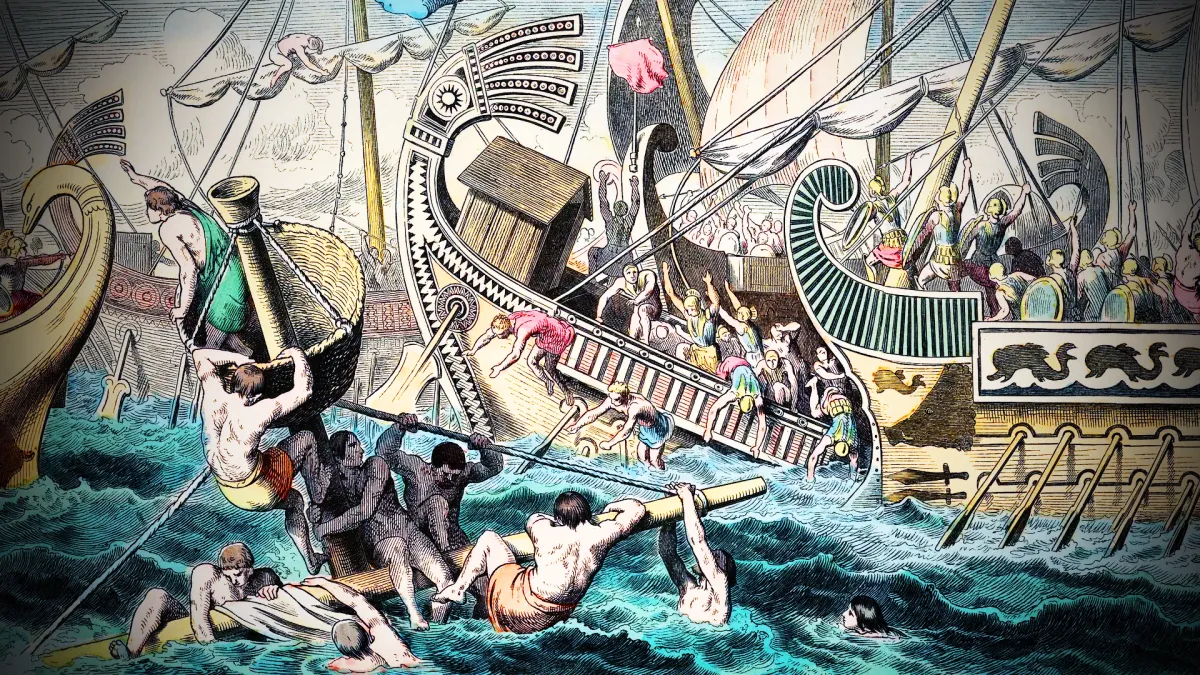
Introduction: The Wooden Walls of Freedom
In 480 BC, as the massive imperial army of Xerxes marched relentlessly toward Athens, the desperate citizens turned to the Oracle of Delphi for guidance. The Oracle responded with a cryptic decree: "The wooden wall shall not fall, but help you and your children." While some traditionalists argued this referred to a thorn hedge around the Acropolis, the statesman Themistocles correctly recognized its true meaning: Athens’ survival rested entirely on the wooden hulls of its triremes.
For ancient Greece, naval warfare was not a chaotic collision of boats; it was a highly intellectual chess match played across shifting tides. The narrow, rocky waters of the Aegean Sea served as an asymmetric arena where raw numbers consistently bowed to superior naval geometry, hydrodynamics, and tactical cunning. By mastering specialized maneuvering systems, exploiting coastal geography, and out-thinking their opponents through psychological deception, Greek commanders turned the trireme into a precise missile, proving that maritime strategy was the ultimate safeguard of classical civilization.
1. The Weaponized Hull: The Anatomy of the Trireme
To understand Greek naval strategy, one must first view the trireme (trieres) not as a cargo transport, but as a high-velocity, human-powered projectile.
The Bronze-Sheathed Ram (Embolos): The primary weapon of the trireme was a massive, three-bladed bronze ram projecting from the waterline of the bow. Its sole purpose was to puncture the wooden hulls of enemy ships, causing them to flood instantly and become waterlogged or sink.
The Rowers' Matrix: The ship was powered by 170 rowers arranged in a strict, hyper-dense three-tier configuration: the thranitai on the top row, the zygitai in the middle, and the thalamitai at the very bottom, just inches above the waterline. This layout packed maximum muscle into a remarkably narrow, lightweight wooden frame.
The Structural Trade-off: To maximize speed and maneuverability, triremes were built without heavy protective decks or ballast. They were incredibly light, narrow, and shallow. This meant they were highly fragile in open, rough seas and lacked storage space for food and water, forcing fleets to land along the coast every single night to sleep and eat, turning coastal real estate into a vital strategic asset.
2. Tactical Maneuvering: The Geometry of the Ram
Greek naval strategy focused entirely on avoiding the enemy’s bow—where their ram was strongest—and striking the vulnerable side or rear of their hull. Commanders relied on two standardized, high-speed tactical maneuvers to fracture enemy formations.
The Diekplous (The Shearing Break-Through)
  [Enemy Fleet Line]   o   o   o   o   o
                           ^
  [Greek Trireme]          │ (Speeds through the gap, shears oars,
                           │  and wheels around to ram the rear)
The diekplous ("sailing through") was an offensive maneuver requiring elite rowing synchronicity. A Greek trireme would charge at a dead sprint directly into a gap between two enemy ships. At the absolute last fraction of a second, the Greek helmsman would command his rowers to instantly pull their oars completely inside the hull. The Greek ship would slide past, its bronze-shod flanks snapping and shattering the extended wooden oars of the enemy vessel, leaving it completely paralyzed on the water. The Greek ship would then swiftly wheel around in a tight arc to ram the defenseless enemy from behind.
The Periplus (The Outflanking Wheel)
If the enemy line was packed too tightly to execute a diekplous, commanders utilized the periplus ("sailing around"). The swiftest triremes on the extreme wings of the fleet would sprint out wide into open water, outflanking the enemy line. Once past the flank, they would wheel inward dynamically, crashing into the exposed, blind sides of the enemy vessels in a series of cascading flank attacks.
3. Defensive Formations: The Kyklos (The Shield Ring)
When a fleet was outnumbered, faced less-experienced crews, or was protecting vulnerable transport ships, commanders abandoned aggressive maneuvering in favor of a fortress-like defensive formation known as the kyklos (circle).
The ships were arranged in a perfect, outward-facing circle, with their lethal bronze rams pointing toward the approaching enemy like the spikes of a sea urchin. The vulnerable sterns and rudder oars were tucked safely inside the interior of the circle.
Inside the center of the ring, the commander held a small, elite reserve squadron of highly maneuverable ships. If an enemy ship attempted to approach the circle or probe for a weak spot, the reserve ships would instantly dart out through the gaps to ram the attacker, neutralizing their speed advantage.
4. The Topographical Masterstroke: The Battle of Salamis (480 BC)
The ultimate validation of Greek naval strategy occurred at the Battle of Salamis, where Themistocles orchestrated a defensive masterpiece that saved Greece from Persian subjugation.
The Bottleneck Strategy: Themistocles knew that the vast Persian fleet—numbering over 600 warships—would easily surround and crush the 380 Greek ships in the open sea. To eliminate this numerical advantage, he used a double agent to trick Xerxes into believing the Greeks were panicking and attempting to flee through the narrow, crowded Straits of Salamis.
The Trap Sprung: Falling for the ruse, the massive Persian fleet sailed into the narrow channel at dawn. The channel, barely a mile wide, completely compressed the Persian lines. Their front ships stalled, while their rear ships continued to push forward, causing a catastrophic nautical gridlock.
The Weight Disparity: The agile, low-slung Greek triremes, operating with intimate knowledge of the local morning winds and currents, launched a coordinated flank assault. The heavy, high-decked Phoenician and Persian ships, unable to pivot or turn in the congested waters, repeatedly collided with one another, turning the straits into an inescapable slaughterhouse where numbers became a terminal liability.
5. Phormio of Athens: The Master of Hydrodynamics
During the early Peloponnesian War, the Athenian admiral Phormio demonstrated that an intimate understanding of weather patterns and sea states could overcome overwhelming numerical odds.
At the Battle of Chalcis (429 BC), Phormio led a small fleet of just 20 Athenian triremes against a massive Spartan coalition fleet of 47 ships. Recognizing their vulnerability, the Spartans immediately formed a giant defensive kyklos circle.
Instead of launching a direct, suicidal charge against the outward-pointing rams, Phormio executed a brilliant psychological containment strategy. He ordered his 20 ships to sail in a tight, continuous line around the outside of the Spartan circle at a dead sprint, intentionally brushing close to their rams and threatening to charge.
As the Athenians continuously circled, the Spartan captains, panicking and trying to keep their rams pointed at the fast-moving targets, began backing up. The circle systematically shrank, causing the clumsy Spartan ships to collide with one another and entangle their oars.
Phormio was waiting for a precise environmental trigger: the predictable daily morning wind that blew out of the Gulf of Corinth. The moment the wind rose, creating choppy waves, the already congested, tangled Spartan circle began pitching wildly. Their inexperienced rowers could not clear the waves, and the ships became completely unmanageable. The moment the formation collapsed into total chaos, Phormio sounded the trumpet, ordered his line to wheel inward, and systematically rammed and captured the entire scattered fleet.