Introduction: The Stone Shield of Democracy
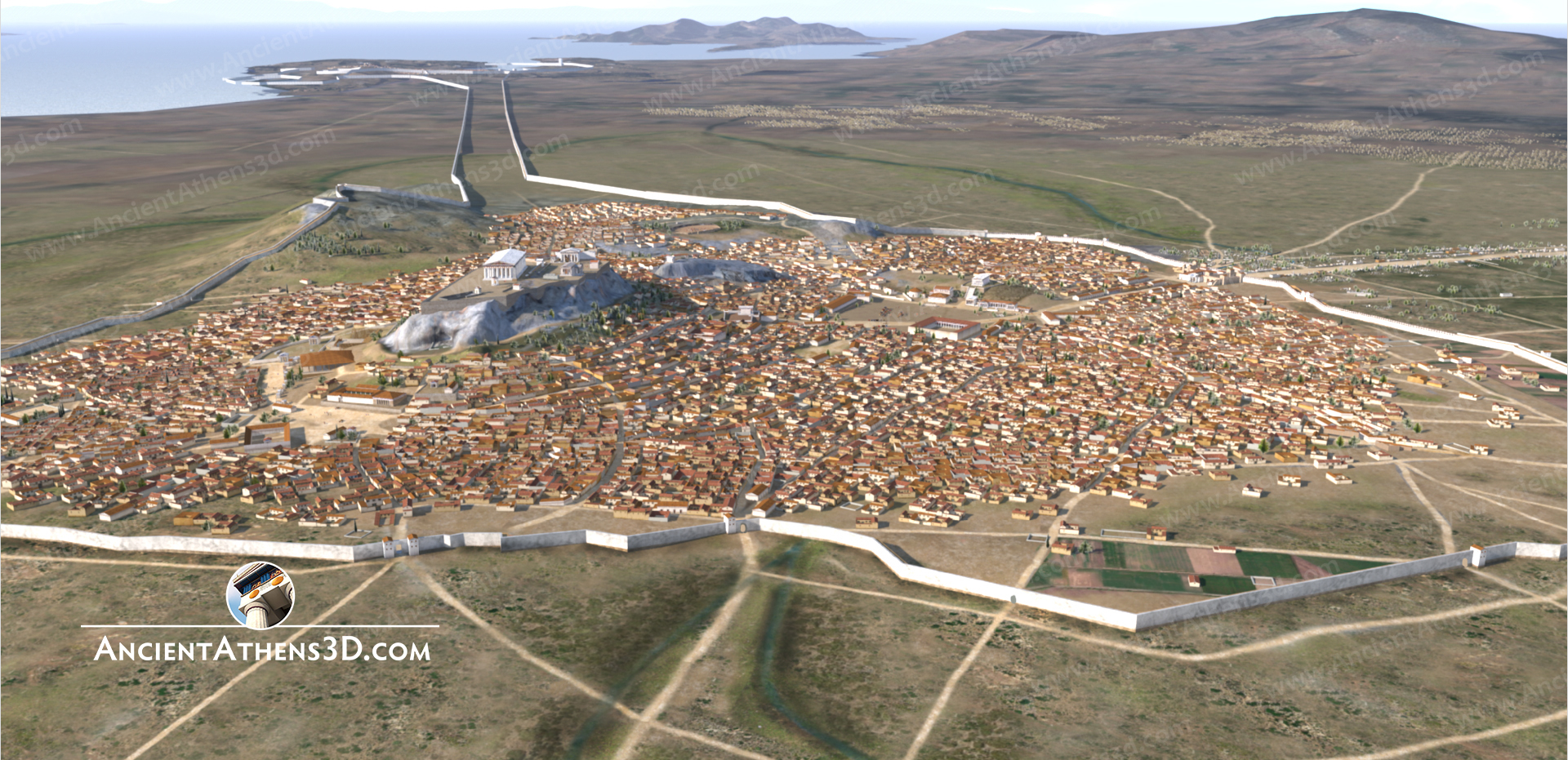
In the classical Mediterranean, a city's sovereignty was only as secure as the stone circuits that surrounded it. For ancient Athens, fortification was not merely a matter of tactical defense; it was the absolute structural guarantee of its radical democracy and maritime empire. Following the near-total destruction of the city by the Persian Empire in 480 BC, the brilliant statesman Themistocles realized that if Athens was to survive as a major power, it had to be systematically rebuilt as an impenetrable island on land.
Over the next century, the Athenians constructed a massive, interconnected fortification network—comprising the Themistoclean Wall, the Long Walls, and the Phaleric Wall. This engineering feat physically anchored the inland city of Athens to its naval ports at Piraeus, transforming the entire urban center and its maritime artery into a singular, colossal fortress. These walls allowed Athens to repeatedly defy overwhelming land forces, shape the course of the Peloponnesian War, and preserve its democratic experiment for generations against the military might of rival states.
1. The Themistoclean Wall: Rebuilding from the Ashes
The foundational ring of the Athenian defense system was constructed in a state of frantic, geopolitical panic following the defeat of the Persians at the Battle of Plataea (479 BC).
The Spartan Opposition: Recognizing that an fortified Athens would alter the balance of power in Greece, Sparta sent urgent embassies to Athens, hypocritically advising them not to rebuild their walls, arguing that fortifications would only serve as potential bases for future barbarian invaders.
The Diplomatic Delay: To buy his city time, Themistocles traveled to Sparta as an ambassador. He deliberately delayed presenting himself to the Spartan magistrates, claiming he was waiting for his fellow envoys. Meanwhile, back in Athens, the entire population—men, women, children, and slaves—worked day and night in a frantic effort to raise the walls to a defensible height.
The Epigraphic Forensic Reality: Thucydides recorded that the Athenians used whatever materials were at hand to build the wall, including tombstones, temple blocks, and fragments of statues. Modern archaeological excavations have flawlessly validated this text: the lower courses of the Themistoclean Wall systematically incorporate archaic gravestones (stelai), column drums, and carved architectural fragments from buildings destroyed during the Persian sack, preserving a real-time record of emergency civic mobilization.
2. The Long Walls: The Concept of the "Land Island"
The true stroke of Athenian strategic genius was realized in the 450s BC under Kimon and Pericles with the construction of the Long Walls (Makra Teiche).
The Dual Corridor: The Long Walls consisted of two parallel stone fortifications running roughly 4 miles (6.5 kilometers) from the edge of Athens down to the coast. The Northern Wall ran to the main naval harbor at Piraeus, while the Southern (or Phaleric) Wall ran to the older anchorage at Phaleron. Later, a third "Middle Wall" was added to create a highly secure, tight corridor explicitly safeguarding the Piraeus route.
The Periclean Strategy: This layout effectively turned Athens into an artificial island. During a land invasion, Pericles ordered the rural population of Attica to abandon their fields and retreat inside the safety of the walls. The invincible Spartan army could lay waste to the agricultural farms outside, but they could not breach the stone lines. As long as the corridor to Piraeus remained secure, the Athenian navy could continuously import food, grain, and supplies from its overseas empire, rendering traditional land sieges completely useless.
3. Engineering Mechanics: Mudbrick and Monumental Masonry
The construction of the walls required sophisticated material engineering, balancing cost, speed, and structural resilience against ancient siege engines.
[ Solid Stone Foundation Course ] ──► [ Double-Faced Ashlar Blocks ] ──► [ Packed Earth & Rubble Core ] ──► [ Sun-Dried Mudbrick Superstructure ]
The Hybrid Matrix: To construct miles of wall rapidly without bankrupting the treasury, Athenian engineers utilized a hybrid construction method. The foundation and lower courses (socle) were built out of heavy, tightly fitted ashlar stone blocks to prevent sappers from digging underneath. Atop this stone base sat a massive superstructure made of sun-dried mudbrick.
The Elastic Advantage: While mudbrick sounds fragile to modern ears, it was an ideal military material in antiquity. Unlike rigid stone, which fractures cleanly under the heavy impact of a catapult stone or battering ram, soft mudbrick absorbed the kinetic energy of missile impacts, dampening the shock waves and making the walls remarkably resilient to physical collapse.
The Protected Gallery: The top of the wall features a wooden, roofed walkway protected by crenellated battlements, allowing archers and light skirmishers to rain down missiles onto attackers while remaining completely sheltered from enemy fire.
4. The Defensive Gateways: The Dipylon and Sacred Gates
The weakest points of any wall system are its entry portals. To mitigate this risk, the main northwestern entrance to Athens—the Dipylon Gate—was engineered as a lethal tactical trap.
The Double-Gate Trap: The Dipylon (literally "Two-Gated") was not a single door, but a massive architectural courtyard enclosed by heavy stone walls. An invading army attempting to force their way through the outer gate would find themselves funnelled into a narrow, rectangular open-air stone box before they could reach the inner gate.
The Killing Zone: Once trapped inside this internal courtyard, the attackers were exposed to fire from all four sides. Athenian defenders standing on the high parapets above could unleash a catastrophic crossfire of arrows, javelins, and heavy rocks onto the congested troops below, turning the gateway into a literal slaughterhouse.
The Inner Spring: Directly adjacent sat the Sacred Gate, which allowed the Eridanos River to flow out of the city. The gate was engineered with massive iron grates embedded into the masonry, allowing water to pass through freely while preventing enemy divers from using the subterranean riverbed to infiltrate the city's internal security perimeter.
5. Geopolitical Catastrophe and Resurrection
Because the walls were the definitive symbol of Athenian imperial power, they became the primary target of political destruction when Athens finally collapsed at the end of the Peloponnesian War in 404 BC.
The Spartan Demolition: Following the total defeat of the Athenian fleet at Aegospotami, Sparta dictated brutal peace terms: Athens had to surrender its navy, dissolve its democracy, and systematically tear down the Long Walls. To maximize the humiliation, the Spartans ordered the demolition to be carried out to the joyous music of flute-players, believing that day marked the definitive liberation of Greece.
The Conon Restoration: The destruction was brief. Just a decade later, in 393 BC, the Athenian admiral Conon secured substantial financial backing from the Persian Empire—who were now eager to check Sparta's growing ambitions. Conon hired thousands of international laborers and mobilized the citizens once again to completely rebuild the Long Walls and the Piraeus fortifications, restoring Athens to its status as a major geopolitical player overnight.
The Final Evolution: In the 4th century BC, as Macedonian siege technology advanced with the invention of the torsion catapult, the Athenians updated their walls, adding large, projecting square towers equipped with artillery platforms specifically designed to house their own defensive catapults to neutralize incoming siege engines at long distance.