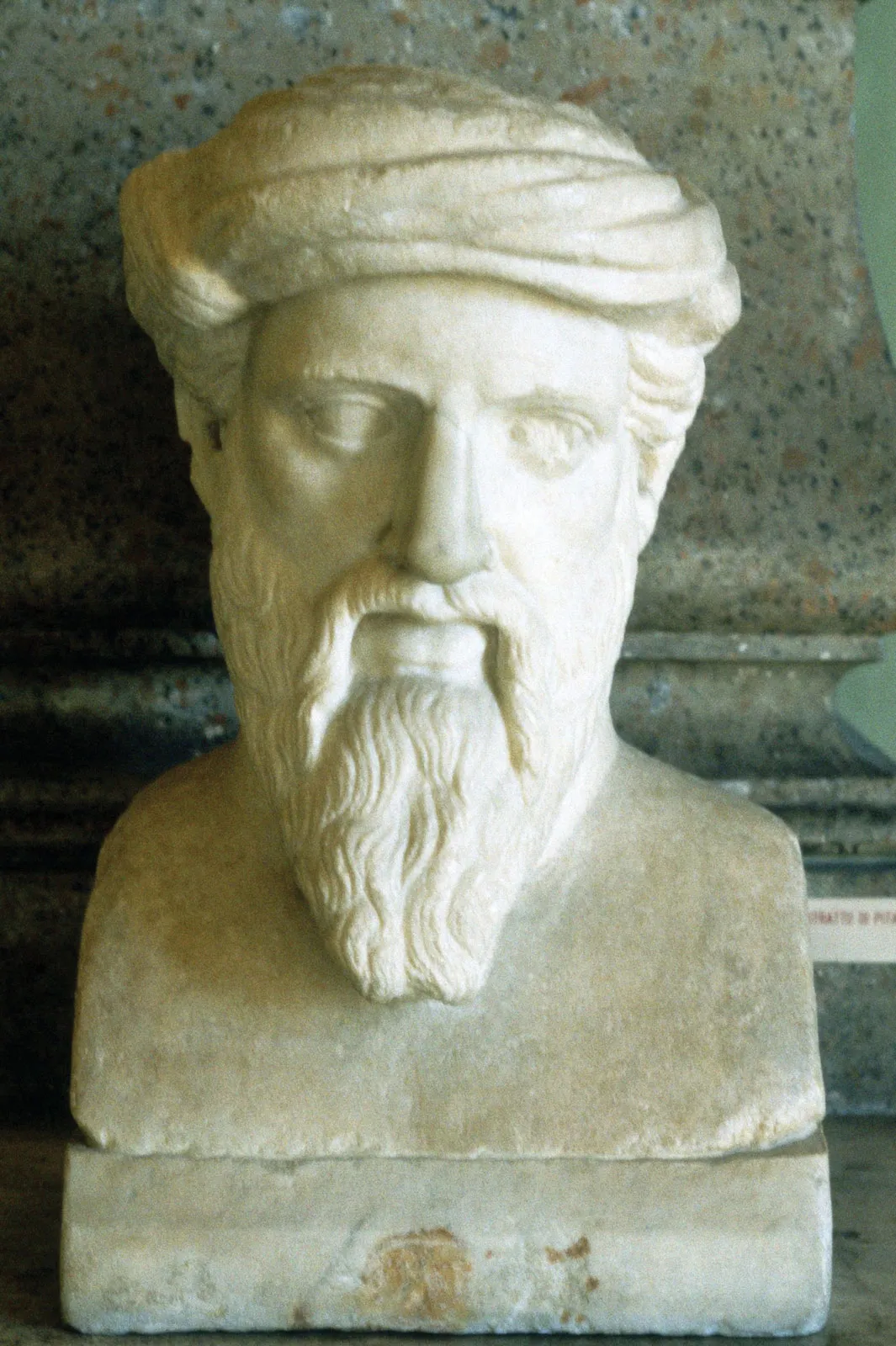
Pythagoras: More Than Just a Mathematician
Pythagoras: More Than Just a Mathematician
While Pythagoras of Samos (c. 570–c. 495 BCE) is a household name largely due to the geometric theorem that bears his name, his contributions to ancient thought extend far beyond mathematics. To the ancient world, he was primarily a religious leader, a mystic, a cosmologist, and the founder of a philosophical way of life. By shifting the focus of Greek philosophy from the material composition of the world to its abstract, mathematical order, Pythagoras laid the groundwork for both classical metaphysics and modern physics.
1. The Pythagorean Brotherhood: A Way of Life
Pythagoras migrated from Samos to Croton (in modern-day Italy) around 530 BCE and established a secretive, deeply religious community known as the Pythagorean Brotherhood.
Communal Living and Ethics: The society advocated for an ascetic lifestyle, communal property, strict ethical codes, and self-discipline.
Inclusion: In stark contrast to many other ancient Greek institutions, women were permitted to join and participate in the school as philosophers.
Metempsychosis: Central to the brotherhood’s religious beliefs was metempsychosis (the transmigration of the soul). Pythagoreans believed the soul is immortal and undergoes a cycle of rebirth, and they practiced a strict vegetarian diet (even avoiding beans, which were thought to contain human souls) to keep the spirit pure.
2. Metaphysics: "All is Number"
Where earlier Milesian philosophers like Thales and Anaximander searched for the material substance of the universe (water or the unlimited), Pythagoras asked a different question: What is the ultimate form or order of the world?
Order of the Cosmos: The Pythagoreans proposed that reality, at its deepest level, is mathematical. They observed that the universe is not a chaotic void but a cosmos—an ordered, harmonious whole.
Limited and Unlimited: Pythagoras argued that objects take their form and dimension through the imposition of limits on the unlimited. Numbers were not just abstract concepts or accounting tools to the Pythagoreans; they were the physical and metaphysical building blocks of reality.
3. The Mathematics of Music and the "Harmony of the Spheres"
Pythagoras’s most significant scientific breakthrough came when he realized that abstract numbers correspond to sensory, physical experiences—specifically, musical harmony.
String Ratios: Historical accounts credit Pythagoras with discovering that the musical intervals between notes correspond to simple numerical ratios of string lengths:
Octave: 2:1
Perfect Fifth: 3:2
Perfect Fourth: 4:3
Music of the Spheres: Reasoning that the cosmos was governed by these same mathematical harmonies, Pythagoras proposed that the planets and stars moved in accordance with exact ratios. He argued that their movement created an inaudible, celestial symphony—a concept that captivated astronomers for nearly two millennia.
4. Cosmology and the Tetraktys
The Pythagoreans used geometry and arithmetic to map the structure and creation of the physical world.
The Tetraktys: The brotherhood's most sacred symbol was the Tetraktys, a triangular figure consisting of ten dots arranged in four rows (1, 2, 3, and 4).
The first row represents a point (unity).
The second row represents a line (duality).
The third row represents a plane (harmony).
The fourth row represents a three-dimensional solid (the material world of fire, air, water, and earth).
Pythagoreans swore their most solemn oaths by the Tetraktys, seeing it as the numerical key to the universe's structure.