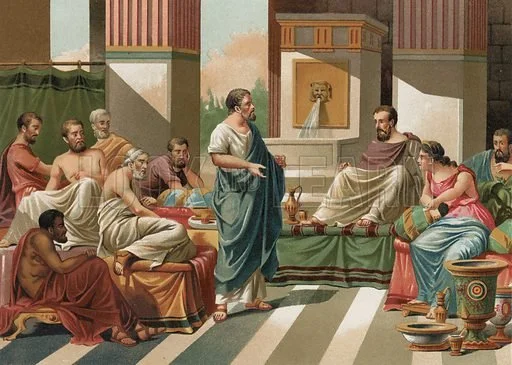
In ancient Greece, the consumption of food and drink was never merely a biological necessity; it was a highly ritualized, legally codified mechanism for establishing political alliances, reinforcing social hierarchies, and communing with the gods. The most prominent iteration of this cultural phenomenon was the symposium, which literally translates to drinking together. This was an all-male aristocratic banquet that served as the primary incubator for Greek philosophy, poetry, and political plotting. To understand Greek governance and social structures, one must understand the structural anatomy of their feasts.
A formal banquet was strictly divided into two distinct phases: the deipnon, which was the meal itself, and the symposium, which was the drinking session. The event took place in the andron, a dedicated, male-only dining hall located within the domestic home. The architectural layout of the andron was highly deliberate; the floor was often concreted or mosaiced, sloping slightly toward a central drain, and the doors were offset to accommodate an odd number of dining couches, typically ranging from seven to eleven. Guests reclined on their left elbows, two to a couch, arranged in a circular hierarchy that facilitated egalitarian conversation while maintaining clear viewlines of all participants.
The gastronomic phase featured a variety of roasted meats—such as wild boar, sacrificial beef, and thrush—accompanied by barley cakes and seasonal vegetables. However, the real engineering of social dynamics began during the second phase. Before a drop of alcohol was consumed, a symposiarch, or master of the feast, was chosen by a roll of the dice. The symposiarch held absolute legal authority over the evening, dictating the exact water-to-wine ratio to be mixed within the krater, which was a large ceramic mixing bowl. Wine was never drunk neat; doing so was considered a marker of barbarian wildness. A typical ratio was three parts water to one part wine, or five parts water to two parts wine, balancing intoxication to keep wits sharp for philosophical debate or political deliberation.
These banquets served as vital economic clearinghouses. It was during the feast that guest-friendship was formalized through the exchange of expensive silver drinking vessels and reciprocal hospitality agreements. Entertainment was highly structured, ranging from intellectual word games like kottabos, where guests flicked wine dregs at a target, to listening to hetairai, who were highly educated female companions, play musical instruments. Ultimately, the Greek banquet was a microcosm of the city-state itself—a tightly controlled environment where structural rules, calculated moderation, and ritualized excess met to forge the elite networks that directed the ancient Mediterranean world.