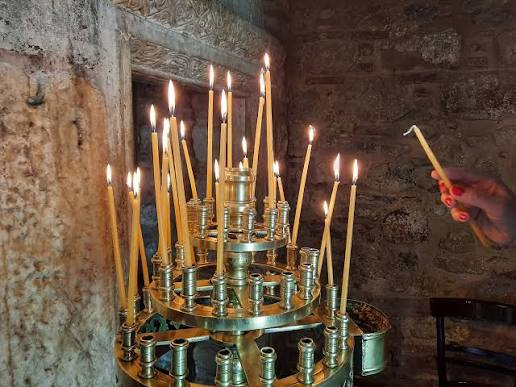
Artificial lighting played an essential role in daily life in Classical Greece, particularly after sunset, but it differed significantly from modern expectations. Contrary to the common assumption that candles were widely used, they were actually quite rare and generally considered impractical. Most candles were made from tallow, or rendered animal fat, which burned inefficiently and produced an unpleasant odor along with thick smoke and soot. These qualities made tallow candles unsuitable for indoor household use, as they could quickly fill enclosed spaces with foul-smelling fumes and leave black residue on walls, ceilings, and furnishings. As a result, candles were seldom used except in limited situations where no better alternative was available.
Instead, the primary source of artificial illumination in Greek homes, workshops, temples, and public spaces was the terracotta oil lamp, known as the lychnos. These lamps were crafted from fired clay and designed with a small reservoir to hold olive oil, the most common fuel due to its abundance and clean-burning properties. A flax or linen wick extended from a narrow spout, drawing oil through capillary action to produce a steady and relatively smokeless flame. Compared with tallow candles, oil lamps provided brighter, cleaner, and longer-lasting light while producing far less odor and smoke. Their durable and inexpensive construction also made them accessible to households across different social classes.
Terracotta oil lamps were available in a wide variety of shapes and sizes, ranging from simple undecorated forms used for everyday domestic activities to finely crafted examples adorned with geometric patterns, mythological scenes, or religious symbols. They illuminated homes during evening meals, household chores, reading, weaving, and social gatherings, while also serving important roles in religious rituals and ceremonies. In wealthier homes, multiple lamps could be placed on stands or suspended from hooks to brighten larger rooms, whereas ordinary families often relied on a single lamp to light the central living space. The widespread use of the lychnos demonstrates not only the Greeks' practical approach to everyday living but also their ability to combine functionality, craftsmanship, and artistic expression in even the most ordinary household objects.
Oil Lamps and Portable Lanterns
Fuel & Wicks: Lamps were fueled by lower-grade olive oil (often pressings from the second or third extraction) mixed with wicks twisted from flax, dried mullein leaves, or papyrus fibers.
Lanterns (Lanternai): For outdoor night travel or drafty courtyards, bronze or clay lanterns enclosed oil lamps behind thin, translucent sheets of scraped animal horn or perforated clay guards.
Societal Role: Because olive oil was a valuable commodity, burning lamps signaled household prosperity. Homes typically went to sleep at sunset, reserving artificial light for essential evening activities and ritual observances.