Abduction and Demeter's Grief
One of the most important myths in ancient Greek religion is the story of Persephone, Demeter, and Hades, which explains the origin of the seasons and the cycle of agricultural fertility. According to Greek mythology, Hades, the god and ruler of the Underworld, fell in love with Persephone, the beautiful daughter of Demeter, the goddess of agriculture, grain, and the harvest. While Persephone was gathering flowers in a meadow, the earth suddenly split open, and Hades emerged in his chariot. He abducted Persephone and carried her to the Underworld to become his queen. Her cries for help echoed across the land, but she disappeared before her mother could reach her.
When Demeter discovered that her daughter had vanished, she was overcome with overwhelming grief and despair. Refusing to accept Persephone's disappearance, Demeter wandered the earth disguised as an ordinary woman, searching tirelessly for her beloved daughter. During this long search, she neglected her divine responsibilities as goddess of agriculture and fertility. Without Demeter's care, crops ceased to grow, fields became barren, trees lost their leaves, flowers withered, and vegetation across the world began to die. The once-fertile earth became desolate, bringing about a devastating famine that threatened the survival of both humanity and the animals that depended upon the harvest. As people faced starvation and could no longer offer sacrifices to the Olympian gods, the balance between mortals and the divine was placed in serious danger.
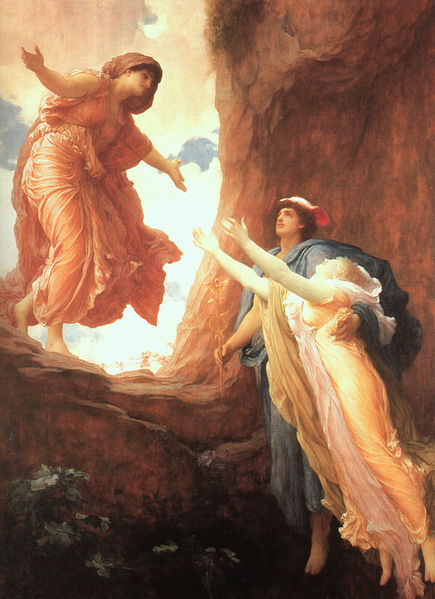
Recognizing that the continued famine endangered both the human race and the worship upon which the gods depended, Zeus, king of the Olympian gods, decided to intervene. He ordered Hades to release Persephone and allow her to return to her mother, believing that only her reunion with Demeter could restore life to the earth. Hades agreed to Zeus' command, but before Persephone departed, he devised a subtle plan to ensure that she would never leave the Underworld forever. He offered her a pomegranate (rhoa), and Persephone consumed several of its seeds. According to the sacred laws governing the Underworld, anyone who ate food in the realm of the dead became permanently connected to it. By eating the pomegranate seeds, Persephone unknowingly established an unbreakable bond with Hades' kingdom.
Because Persephone had eaten the fruit of the Underworld, she could not remain permanently among the living. A compromise was therefore arranged between Zeus, Demeter, and Hades. Persephone would spend one-third of each year in the Underworld as the queen beside Hades. During this period, Demeter mourned her daughter's absence, withdrawing her blessings from the earth. Crops stopped growing, trees became bare, and the land entered the cold, barren season associated with winter. For the remaining two-thirds of the year, Persephone would return to the world above and reunite with her mother. Filled with joy, Demeter restored fertility to the land, causing plants to flourish, flowers to bloom, and crops to grow abundantly. This joyful reunion marked the arrival of spring and summer, seasons characterized by warmth, growth, and agricultural abundance.
The myth of Persephone's annual descent into and return from the Underworld provided the ancient Greeks with an etiology, or explanatory story, for the natural cycle of the seasons and the yearly rhythm of planting and harvesting. More than simply explaining nature, the myth also expressed profound themes of life, death, loss, renewal, and hope. It formed the religious foundation of the Eleusinian Mysteries, one of the most sacred mystery cults in ancient Greece. Through secret initiation rites centered on Demeter and Persephone, participants were taught that just as Persephone returned from the darkness of the Underworld to the light of the living world each year, human beings could also hope for renewal and a blessed existence after death. Thus, the story became not only an explanation of the agricultural cycle but also one of the most influential religious narratives in the ancient Greek world.