
Introduction
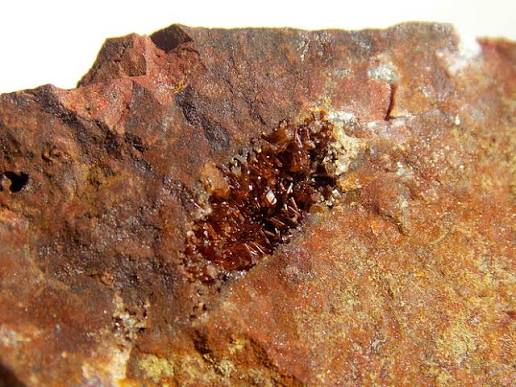
Hematite is an iron oxide mineral with the chemical formula Fe₂O₃. It commonly forms in oxidising environments and is responsible for many red, brown, and rusty colours found in soils, rocks, and mineral deposits. Its presence near springs can reveal interactions between groundwater, dissolved iron, oxygen, and surrounding geological formations.
The Othrys region of central Greece is associated with ophiolitic rocks, which are fragments of ancient oceanic lithosphere incorporated into continental geological structures. These rocks commonly include serpentinite, peridotite, and other ultramafic formations. A proposed association between hematite-rich spring deposits and Othrys ophiolites provides a useful framework for examining water-rock interaction and iron mobilisation.
Ophiolites and Groundwater Chemistry
Ophiolites are important because they preserve parts of ancient oceanic crust and upper mantle. Their rocks often contain iron- and magnesium-rich minerals that undergo chemical alteration when exposed to water and atmospheric conditions.
Serpentinisation is one particularly important process. It occurs when water reacts with ultramafic minerals, producing serpentine minerals and, under certain conditions, hydrogen and other secondary products. The resulting fluids may have unusual chemical properties, including elevated pH.
Groundwater moving through fractured ophiolitic rocks can dissolve or transport iron. When the water reaches an oxygen-rich environment, dissolved iron may oxidise and precipitate as iron oxides and hydroxides. Over time, these materials can accumulate around spring outlets and along drainage channels.
Formation of Hematite-Rich Deposits
Iron-rich spring deposits may initially contain poorly crystalline iron compounds such as ferrihydrite or goethite. With time, changes in temperature, water chemistry, and exposure to oxygen can promote mineral transformation.
Hematite may develop through several pathways, including dehydration and recrystallisation of earlier iron-bearing phases. Its red coloration can become particularly visible where mineral coatings accumulate on rocks and sediment surfaces.
Field investigations would need to distinguish natural iron precipitation from contamination caused by mining, industrial activity, or disturbed soils.
Environmental Investigation
A study of possible hematite springs near Othrys would examine:
Spring-water pH, temperature, and electrical conductivity.
Dissolved iron and manganese concentrations.
Oxidation-reduction conditions.
Mineral composition of the deposited material.
Seasonal changes in water flow.
Relationships between iron deposits and nearby rock fractures.
Water samples should be collected using appropriate protocols because the chemical composition of spring water can change rapidly after exposure to air.
Environmental Importance
Iron-rich deposits can influence aquatic ecosystems by coating streambeds and altering the availability of nutrients and trace elements. Iron precipitates may also trap phosphorus and other substances, changing local water chemistry.
These deposits are not automatically evidence of pollution. Natural iron-rich waters occur in many geological environments, but their ecological effects depend on concentration, acidity, flow conditions, and the presence of other dissolved elements.
Conclusion
Hematite-rich springs near the Othrys ophiolites would be scientifically interesting because they could reveal how groundwater interacts with ultramafic rocks. The deposits could preserve evidence of oxidation, mineral alteration, and the movement of iron through fractured geological formations. Their identification would require mineralogical confirmation and water-chemistry analysis.







