
Introduction
Melos, also known as Milos, is a volcanic island in the Aegean Sea with a diverse geological landscape and a long history of mineral resources.
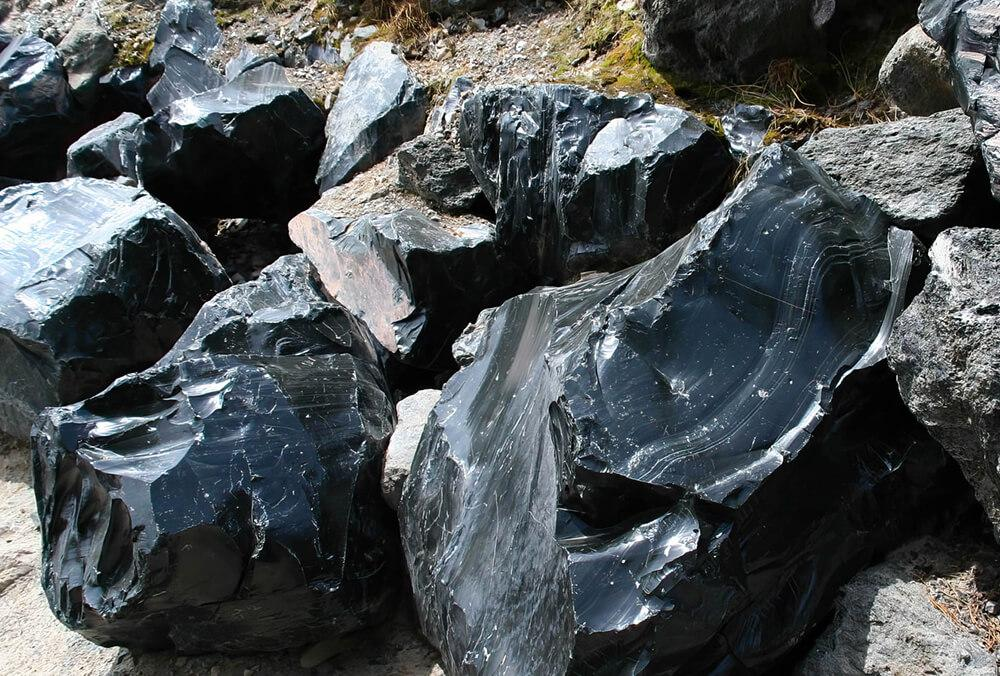
Obsidian is a naturally occurring volcanic glass formed when lava cools rapidly and does not develop extensive crystalline structure.
The title suggests obsidian domes within inner craters of Melos. The exact domes described are not verified, but the subject offers an opportunity to examine volcanic glass formation, lava behavior, and the relationship between obsidian and volcanic landforms.
Obsidian Formation
Obsidian generally forms from silica-rich lava that cools rapidly.
Because cooling occurs relatively quickly, atoms do not have enough time to organize into a regular crystal structure.
The result is volcanic glass.
Obsidian may be black, dark brown, gray, or other colors depending on its composition and inclusions.
Its characteristics include:
Glassy texture.
Conchoidal fracture.
Sharp edges when broken.
Variable chemical composition.
Limited or absent visible crystals.
Volcanic Domes
Volcanic domes develop when viscous lava accumulates around a vent.
The lava may be too thick to flow easily over long distances, allowing it to build up near the source.
Dome formation depends on lava composition, temperature, viscosity, extrusion rate, and other volcanic processes.
Some domes may contain glassy materials, but obsidian does not necessarily form a complete dome structure.
Obsidian and Melos
Melos has a significant volcanic history and is well known for geological diversity and mineral resources.
Obsidian is important archaeologically because it was used to produce sharp cutting tools.
The island's obsidian has been associated with prehistoric exchange networks in the Aegean.
Obsidian sourcing can help researchers investigate movement of raw materials, trade, navigation, and cultural connections.
Archaeological Importance
Obsidian artifacts are often studied through geochemical analysis.
The composition of obsidian can sometimes be matched to geological source areas.
This allows archaeologists to investigate whether tools were produced locally or transported from other locations.
Obsidian may have been exchanged as raw material, unfinished pieces, or completed tools.
Geological Investigation
A study of possible obsidian domes in inner craters could include:
Geological mapping.
Rock sampling.
Petrographic examination.
Chemical analysis.
Volcanic stratigraphy.
Structural mapping.
Comparison with known volcanic formations.
Researchers would need to distinguish obsidian from other glassy volcanic materials and determine whether it formed in a dome, flow, or another volcanic setting.
Conclusion
Obsidian is important both as a geological material and as an archaeological resource.
The proposed inner-crater domes of Melos would provide an interesting research subject for investigating volcanic glass formation and the geological origins of materials that supported prehistoric technology and exchange.







