Introduction
Pyrite, commonly known as fool's gold, is an iron sulfide mineral with the chemical formula FeS₂.
It is widely recognized for its metallic luster and frequent cubic crystal form. Pyrite occurs in many geological environments, including sedimentary rocks, hydrothermal veins, and metamorphic settings.
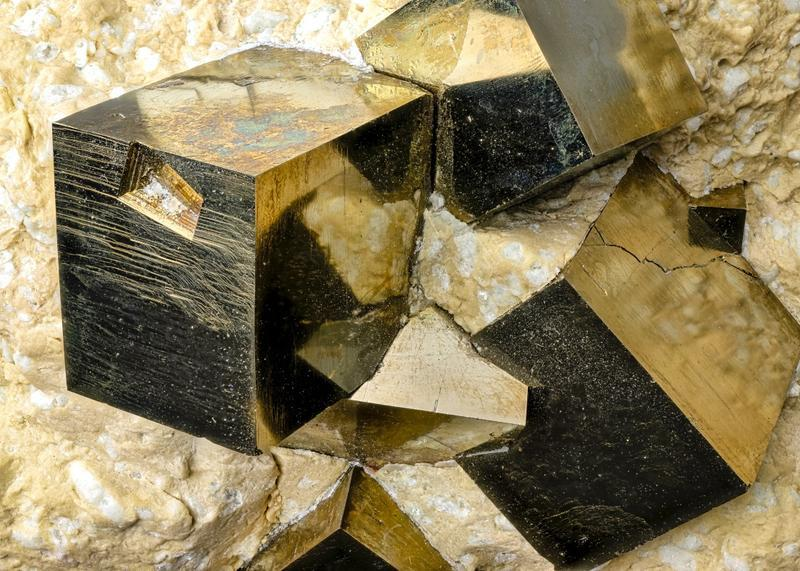
The title suggests cubic pyrite crystals associated with vein outcrops near Philippi. The specific occurrence is not verified, but the subject provides an opportunity to examine mineral formation, crystal growth, geological structures, and the relationship between sulfide minerals and host rocks.
Pyrite Properties
Pyrite is characterized by its metallic appearance and pale brass-yellow color.
Its properties include:
Chemical formula: FeS₂.
Metallic luster.
Brass-yellow color.
Relatively high density.
Cubic crystal system.
Commonly striated crystal faces.
Pyrite can resemble gold, but its physical and chemical properties are different.
Pyrite Formation
Pyrite forms under a range of geological conditions.
It may develop through reactions involving iron and sulfur in sedimentary environments or through mineral precipitation from hydrothermal fluids.
The formation process depends on:
Iron availability.
Sulfur sources.
Temperature.
Chemical conditions.
Fluid movement.
Host-rock composition.
Pyrite may occur as individual crystals, clusters, nodules, disseminated grains, or vein deposits.
Cubic Crystal Growth
Pyrite is well known for forming cubes.
Its crystal structure allows growth along directions that produce distinct cubic shapes.
When crystals grow within open spaces, they may develop relatively well-defined faces.
Growth conditions influence crystal size, shape, surface features, and the presence of defects.
Cubic crystals may form within veins or cavities where mineral-bearing fluids circulate.
Vein Outcrops
Mineral veins form when fluids move through fractures and deposit minerals.
The veins may contain multiple mineral phases, reflecting changes in fluid composition, temperature, or geological conditions.
Pyrite may occur with quartz, carbonate minerals, or other sulfides depending on the environment.
Researchers can investigate the relationship between pyrite crystals and the surrounding rock to reconstruct the mineralization process.
Geological Investigation
Possible methods include:
Geological mapping.
Mineral identification.
X-ray diffraction.
Chemical analysis.
Petrographic microscopy.
Crystal measurements.
Structural analysis of veins.
The distribution of pyrite may help identify mineralized zones and reconstruct fluid pathways.
Environmental Considerations
Pyrite can undergo oxidation when exposed to oxygen and water.
This process may produce acidity and contribute to the release of metals from surrounding materials.
The environmental consequences depend on the quantity of pyrite, the mineral assemblage, water movement, and local conditions.
Pyrite-bearing outcrops should therefore be evaluated carefully when quarrying, excavation, or environmental disturbance is considered.
Conclusion
Pyrite cubes are valuable geological indicators of mineral formation and fluid movement.
The possible occurrence of pyrite in Philippi vein outcrops would require confirmation through field mapping and mineralogical analysis.
The study could help reconstruct local geological processes and improve understanding of sulfide mineral formation.