
Introduction
Urban agriculture is becoming increasingly important as cities seek new ways to produce food closer to consumers. Population growth, limited farmland, climate pressures, and the cost of transporting fresh produce have encouraged interest in indoor farming systems.
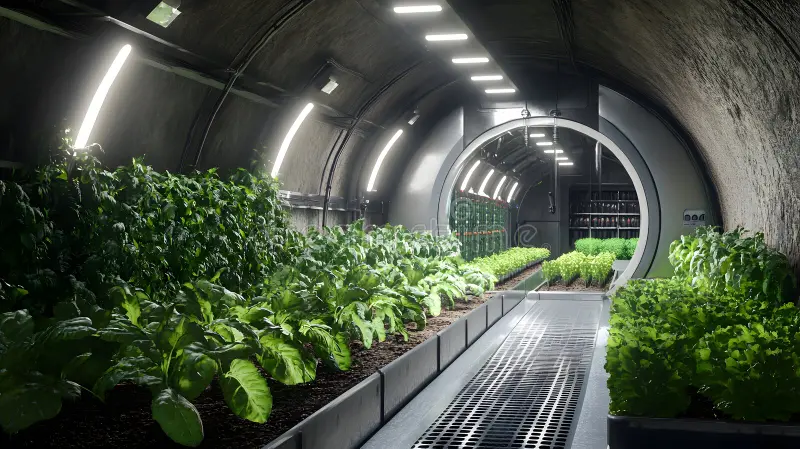
Thessaloniki, Greece's second-largest city, provides an interesting setting for examining compact agricultural facilities within dense urban environments. The proposed concept of underground hydroponic pods involves growing plants in enclosed spaces using nutrient-rich water rather than conventional soil.
Such systems could make use of adapted basements, unused commercial spaces, or purpose-built underground facilities. Their feasibility would depend on energy supply, ventilation, water quality, structural conditions, and food-production economics.
Understanding Hydroponics
Hydroponics is a cultivation method in which plants grow without traditional soil. Their roots receive water containing dissolved nutrients required for growth.
Several hydroponic systems are commonly used:
Nutrient Film Technique: A thin stream of nutrient solution flows over plant roots.
Deep Water Culture: Roots remain suspended in an oxygenated nutrient solution.
Drip Systems: Nutrient solution is delivered directly to the growing medium.
Ebb and Flow Systems: Growing trays are periodically flooded and drained.
Aeroponics: Nutrient solution is delivered as a fine mist to exposed roots.
These systems can support leafy greens, herbs, and selected fruiting crops.
Why Underground Farming?
Underground spaces can offer protection from some external weather conditions. Temperature and humidity may be more stable than in outdoor environments, although this depends on the building's construction and surrounding ground conditions.
An enclosed pod can also provide controlled access to water, nutrients, lighting, and air circulation.
The most significant challenge is lighting. Plants require photosynthetically active radiation to grow, so underground farms generally depend on artificial lighting systems, often using LED fixtures.
Designing an Underground Hydroponic Pod
A practical facility would need several integrated systems.
Growing infrastructure would include racks, trays, pumps, pipes, and nutrient reservoirs.
Lighting infrastructure would provide controlled light intensity and duration for different crops.
Environmental control would regulate temperature, humidity, airflow, and carbon dioxide.
Water management would monitor nutrient concentration, pH, dissolved oxygen, and water quality.
Food safety systems would control hygiene, pests, contamination, and harvesting conditions.
Sensors could monitor these variables continuously and alert operators when conditions move outside acceptable ranges.
Energy and Resource Efficiency
Hydroponics can use less water than some conventional agricultural methods because nutrient solutions can be recirculated. However, water savings depend on system design, leakage, cleaning, and the crops being cultivated.
Energy consumption is a major consideration for underground agriculture. Artificial lighting, pumps, air conditioning, and dehumidification can create significant electricity demand.
The use of efficient LED systems, heat recovery, renewable electricity, and carefully designed ventilation may improve operating efficiency.
Suitable Crops and Local Markets
Leafy vegetables such as lettuce, spinach, and selected herbs are common hydroponic crops because they can grow in relatively compact spaces and have short production cycles.
A Thessaloniki-based system could potentially supply restaurants, grocery stores, and food-service businesses with fresh produce.
However, not every crop is economically suitable for indoor production. Large plants, root vegetables, and crops requiring long growing periods may be more expensive to produce in controlled environments.
Challenges and Food Safety
Underground spaces must be checked for moisture intrusion, mould, chemical contamination, and structural defects before conversion.
Water quality is particularly important because contaminated water can introduce pathogens or harmful substances into the growing system.
Food safety procedures should include regular equipment cleaning, water testing, traceability, and proper handling during harvesting and packaging.
Conclusion
Underground hydroponic pods in Thessaloniki represent an innovative approach to urban food production. They could help supply selected fresh crops using controlled growing environments, but their success would depend on energy efficiency, food safety, crop selection, and market demand. The strongest applications would likely involve compact production facilities serving nearby consumers.







