
Introduction
Marble is a metamorphic rock formed when carbonate-rich rocks undergo recrystallization under elevated temperature and pressure.
It is commonly composed primarily of calcite or dolomite.
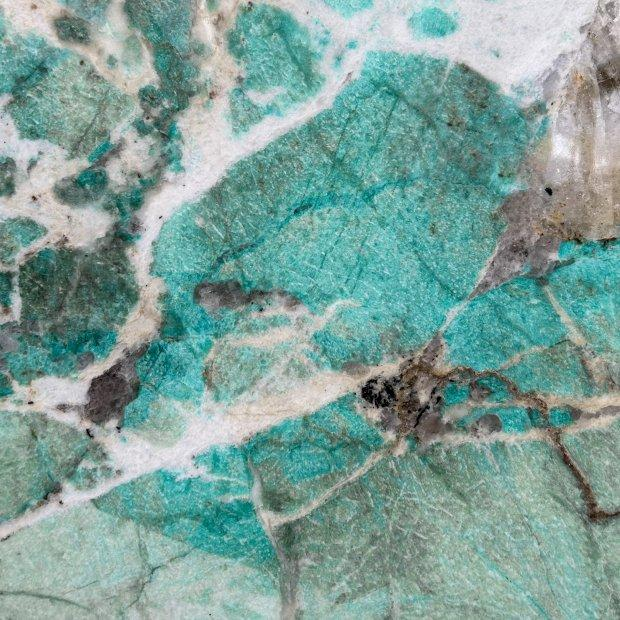
The title suggests turquoise-colored mineral flecks within marble associated with Thassos. This topic raises questions about mineral inclusions, metamorphic processes, impurities, and the identification of colored minerals in carbonate rocks.
The exact turquoise-colored inclusions described in the title are not verified. In addition, the word "turquoise" may refer to the mineral itself or simply to a blue-green color, which should not be confused with confirmed turquoise mineral identification.
Marble Formation
Marble forms through metamorphism of limestone or dolostone.
During metamorphism, the original carbonate minerals recrystallize.
This process can change:
Crystal size.
Texture.
Mineral distribution.
Structural characteristics.
Physical properties.
Pure marble may be relatively white, while impurities can produce different colors and patterns.
Mineral Inclusions
Marble may contain accessory minerals formed during metamorphism or inherited from the original rock.
Depending on the geological environment, these minerals may include silicates, oxides, sulfides, and other components.
Colored flecks may arise from:
Mineral inclusions.
Chemical impurities.
Alteration products.
Fracture fillings.
Weathering.
Surface staining.
A blue-green appearance may be produced by several different minerals, including copper-bearing compounds, but the color alone is insufficient for identification.
Turquoise and Other Blue-Green Minerals
Turquoise is a hydrated phosphate mineral containing copper and aluminum.
Its color is commonly blue to green, depending on composition and associated impurities.
Turquoise is generally associated with specific geological environments where suitable chemical components and alteration conditions occur.
Its presence within marble would require appropriate geological circumstances and should not be assumed merely from blue-green coloration.
Other minerals may produce similar visual effects, including certain copper minerals and silicate minerals.
Mineralogical Investigation
A study of colored flecks in marble could use:
Petrographic microscopy.
X-ray diffraction.
Raman spectroscopy.
Electron microscopy.
Chemical analysis.
Mineral mapping.
These methods can determine whether the flecks are mineral inclusions, alteration products, or surface contaminants.
The mineral distribution may also reveal the rock's metamorphic history.
Geological and Decorative Significance
Mineral inclusions can influence the appearance and value of marble.
They may create patterns that are attractive for architectural or decorative use.
If colored inclusions occur consistently within a marble deposit, they may also help identify the stone's geological source.
Stone provenance research is important in archaeology because marble was often transported over long distances for construction and sculpture.
Conclusion
The study of turquoise-colored flecks in marble provides an opportunity to investigate mineral inclusions, metamorphism, and stone provenance.
The Thassos location would require confirmation through mineralogical analysis and geological mapping, especially because blue-green color alone cannot identify turquoise.







