The transition of Greece from a collection of sovereign, often warring city-states to a province of the Roman Republic and later the Roman Empire was a process of "elegant decay." While the Romans deeply admired Greek culture, they had no patience for the internal squabbles and shifting leagues that had defined the Hellenistic period.
By 146 BCE, the era of the independent polis was over, and Greece became the intellectual "university" of the Roman world.
1. The Flamininus Paradox: Freedom as a Gift
The Roman takeover didn't begin with a total conquest, but with a declaration of "liberty." After defeating Macedon at the Battle of Cynoscephalae (197 BCE), the Roman general Titus Quinctius Flamininus stood before the Greeks at the Isthmian Games and declared the Greek cities free.
The Reality of "Freedom": To the Greeks, freedom meant the right to make their own foreign policy. To Rome, it meant the Greeks were now "clients" who were expected to follow Roman interests.
The Strategic Buffer: Rome initially didn't want to govern Greece directly; they wanted a stable buffer zone that wouldn't produce another Alexander or Philip V.
2. The Achaean League and the Sack of Corinth (146 BCE)
The turning point came when the Achaean League, a confederation of Greek cities, attempted to assert its independence against Roman dictates. Rome responded with overwhelming force to set a permanent example.
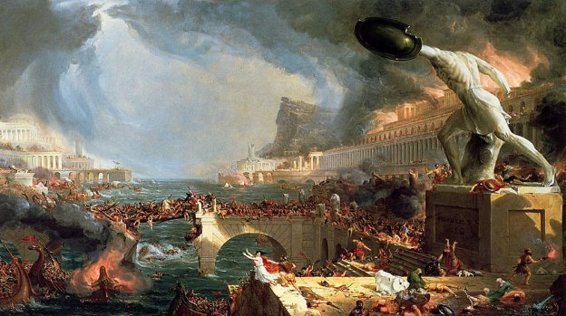
The Destruction of Corinth: The Roman general Mummius captured Corinth, a city famous for its wealth and art. He ordered the city razed to the ground, its men killed, and its women and children sold into slavery.
The Looting of Art: Thousands of Greek statues and paintings were shipped back to Rome. This moment is often cited as the birth of "Graecomania" in Rome—the start of the Roman obsession with Greek aesthetics.
3. Greece as the Province of Achaea
After 146 BCE, Greece was reorganized. While some cities like Athens and Sparta were allowed to remain "federated" (nominally independent) due to their historic prestige, most were absorbed into the province of Achaea.
Political Neutralization: The Romans dismantled the democratic institutions that sparked "rebellion." Power was shifted to local wealthy elites who were loyal to Rome.
The End of Military Power: Greek cities were forbidden from maintaining their own armies or engaging in independent diplomacy. The once-feared hoplite phalanx became a ceremonial relic.
4. The Mithridatic Wars and Sulla’s Siege (86 BCE)
The final gasp of Greek resistance occurred during the Mithridatic Wars, when Athens made the fatal mistake of siding with King Mithridates VI of Pontus against Rome.
Sulla’s Wrath: The Roman general Sulla besieged Athens, cutting down the sacred groves of the Academy and the Lyceum to build siege engines. When the city fell, the slaughter was so immense that contemporary accounts claim the blood ran out of the Dipylon Gate.
Economic Devastation: This conflict left Greece economically crippled. Massive debts to Roman moneylenders led to the abandonment of many rural areas.
5. Captive Greece Captures Her Conqueror
Despite the political and military decline, the Romans underwent a cultural "conquest" by the Greeks. As the poet Horace famously wrote: "Captive Greece took captive her savage conqueror and brought the arts to rustic Latium."
The Education Center: Athens became the "Oxford" of the Roman Empire. Every ambitious Roman youth, including Cicero and Julius Caesar, traveled to Athens to study rhetoric and philosophy.
The Philhellene Emperors: Later emperors like Nero and Hadrian poured money back into Greece. Hadrian, in particular, transformed Athens, completing the massive Temple of Olympian Zeus and building a new library and aqueduct.
6. The Demographic Shift
By the time of the High Empire (2nd century CE), mainland Greece was a quiet, somewhat depopulated backwater compared to the booming cities of Roman Asia Minor or Egypt.
Tourism and Nostalgia: Greece became a land of "heritage tourism." People visited the ruins of the Parthenon or the site of the Battle of Marathon to marvel at a past that felt increasingly distant.
The Birth of the "Graeco-Roman" Identity: The distinction between Greek and Roman eventually blurred, forming the foundation of the Byzantine Empire, where the language was Greek, the law was Roman, and the capital was Constantinople.
The decline of the Greek city-states was not a disappearance, but a transformation. They traded their military sovereignty for cultural immortality.