The Wars of the Diadochi (322–281 BCE) represent one of the most complex and blood-soaked periods in ancient history. Following the sudden death of Alexander the Great without a clear heir, his generals—known as the Diadochi (Successors)—spent over forty years tearing his empire apart to carve out kingdoms of their own.
What began as a struggle to keep the empire united under a regency quickly devolved into a "Game of Thrones" on a continental scale.
1. The Partition of Babylon (323 BCE)
Immediately after Alexander's death, the generals met in Babylon to divide the administration of the provinces.
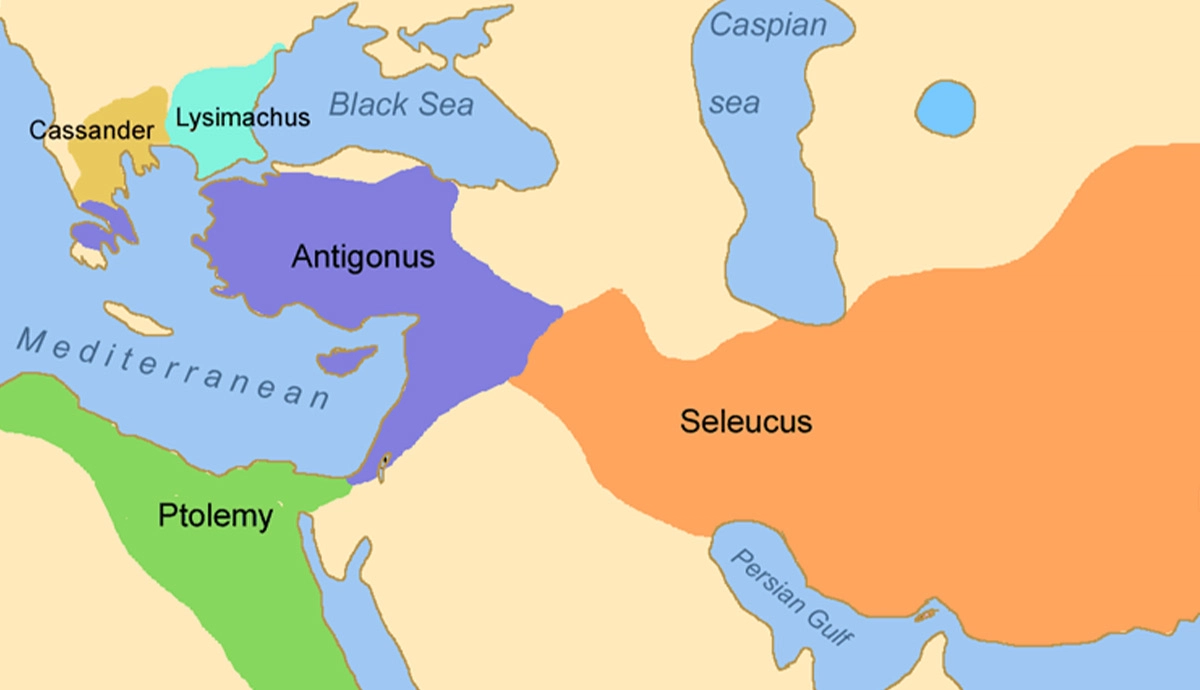
The Compromise: Since Alexander’s son (Alexander IV) wasn't yet born and his half-brother (Philip III Arrhidaeus) was mentally unfit, a regency was established. Perdiccas became the supreme regent, while other generals took key satrapies: Ptolemy took Egypt, Antigonus took Central Asia Minor, and Lysimachus took Thrace.
The First Spark: The peace lasted less than a year. Ptolemy’s hijacking of Alexander’s funeral carriage was the first open act of defiance, signaling that the generals were more interested in local power than imperial unity.
2. The Rise and Fall of the "One-Eyed" Giant
The most dominant figure of the early wars was Antigonus Monophthalmus (the One-Eyed). He was the only general who came close to reuniting Alexander’s entire empire under his own rule.
Imperial Ambition: Antigonus and his charismatic son, Demetrius the Besieger, controlled the Levant and much of Asia Minor. Their power was so great that they were the first of the successors to officially declare themselves "Kings" (Basileus) in 306 BCE.
The Battle of Ipsus (301 BCE): Fearing Antigonus’s power, a "Grand Coalition" of Seleucus, Lysimachus, and Cassander united against him. In the "Battle of the Kings" at Ipsus, Antigonus was defeated and killed at the age of 81. His defeat ensured the empire would remain permanently divided.
3. The Three Great Houses
By the end of the conflict in 281 BCE, the dust finally settled, leaving three major dynasties that would dominate the Mediterranean until the arrival of Rome:
The Ptolemies (Egypt): Ptolemy I Soter established a stable, wealthy kingdom centered in Alexandria. This dynasty would be the longest-lasting, ending only with the death of Cleopatra VII.
The Seleucids (Asia): Seleucus I Nicator claimed the vast eastern territories, from Syria to the borders of India. It was the largest and most diverse of the successor states, but also the most difficult to hold together.
The Antigonids (Macedon): After decades of instability, the descendants of Antigonus finally secured the Macedonian throne, ruling the Greek heartland until the Roman conquest.
4. Military Innovation: The War Elephants
The Diadochi wars saw the peak of "Combined Arms" warfare. While the Macedonian phalanx remained the core, the Successors obsessed over a new super-weapon: the War Elephant.
The Elephant Race: Seleucus famously traded his Indian territories to King Chandragupta Maurya for 500 war elephants. These "living tanks" were used to disrupt enemy phalanxes and terrify horses.
The Silver Shields: This era also saw the end of the Argyraspides (Silver Shields), Alexander’s elite veteran unit. After decades of undefeated service, they were eventually betrayed by their own general, Eumenes, and executed by Antigonus because they were deemed "too dangerous" to keep alive.
5. The Cultural Legacy: The Hellenistic Age
Despite the constant warfare, this period saw the birth of the Hellenistic Age. The Successors weren't just warlords; they were builders of cities.
The Spread of Greek Culture: From Ai-Khanoum in modern-day Afghanistan to Antioch in Syria, the Diadochi founded hundreds of cities that functioned as islands of Greek culture, language, and philosophy in the East.
Scientific Explosion: The competition between the kingdoms fueled a "space race" of sorts in science and art. The Library of Alexandria and the Colossus of Rhodes were products of this competitive royal patronage.
The Wars of the Diadochi transformed Alexander’s short-lived conquest into a series of stable, sophisticated kingdoms that bridged the gap between Classical Greece and the Roman Empire.