The Ptolemaic Dynasty (305–30 BCE) represents one of history's most successful cultural experiments. For nearly three centuries, a family of Macedonian Greeks ruled as the legitimate successors to the ancient Pharaohs, creating a hybrid civilization that turned Egypt into the intellectual and economic powerhouse of the Mediterranean.
While they remained culturally Greek—refusing, with the exception of Cleopatra VII, to even learn the Egyptian language—they governed through an intricate synthesis of Greek administration and Egyptian religious tradition.
1. The Foundation: Ptolemy I Soter
Ptolemy I, one of Alexander the Great’s most trusted generals and his rumored half-brother, was the architect of the dynasty. During the Partition of Babylon, he specifically requested the satrapy of Egypt, recognizing its natural defenses and immense agricultural wealth.
The Legitimacy Move: To secure his rule, Ptolemy hijacked Alexander’s funeral carriage and brought the body to Egypt. By possessing the founder’s remains, he positioned himself as the true heir to Alexander’s legacy.
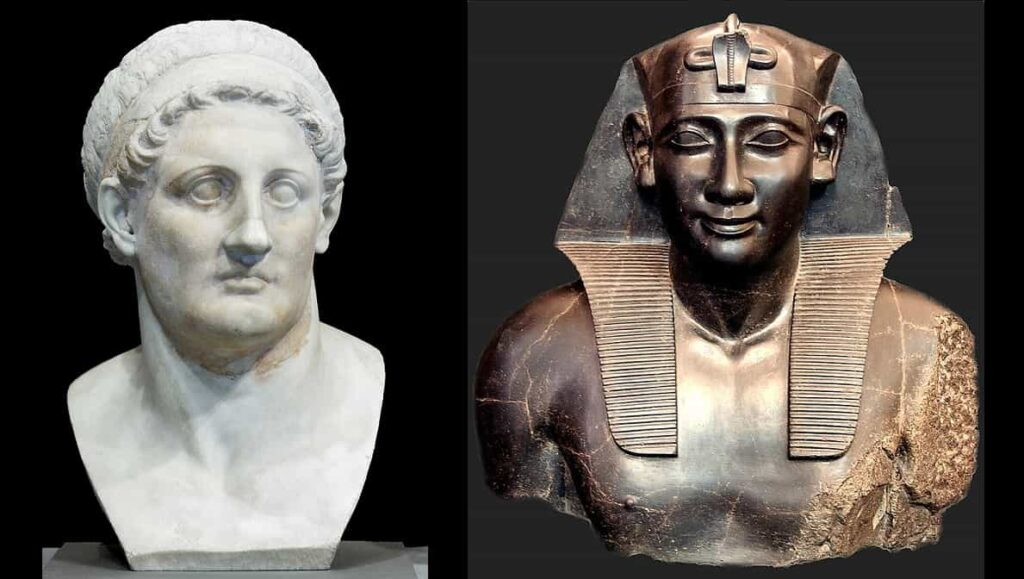
The Dual Crown: Ptolemy did not try to turn Egyptians into Greeks. Instead, he took on the titles of the Pharaohs, portraying himself in temples as a divine ruler chosen by the gods of the Nile, while ruling his Greek subjects as a Macedonian King.
2. Alexandria: The Intellectual Capital
The Ptolemies founded Alexandria on the Mediterranean coast, which quickly replaced Memphis as the capital. It was designed to be the greatest city in the world, a "hub" where the Greek and Egyptian worlds met.
The Museum and Great Library: The Ptolemies funded the Musaeum (the Temple of the Muses), a research institute that housed the Great Library. They sent agents across the known world to buy, borrow, or steal every scroll they could find, amassing a collection of roughly 500,000 texts.
The Pharos: One of the Seven Wonders of the Ancient World, the Lighthouse of Alexandria (the Pharos), stood over 100 meters tall. It symbolized the dynasty’s mastery of the sea and served as a beacon for the trade that fueled their wealth.
3. Religious Synthesis: The Creation of Serapis
The Ptolemies faced a major challenge: how to unite their Greek and Egyptian subjects in worship. Ptolemy I introduced the god Serapis to solve this.
A Hybrid God: Serapis combined the attributes of the Egyptian gods Osiris and Apis with those of the Greek gods Zeus and Hades. He was depicted as a bearded Greek deity but was associated with the Egyptian concepts of the afterlife and fertility.
The Serapeum: Massive temples were built for Serapis, most notably in Alexandria, serving as a religious bridge between the two cultures.
4. Economic Mastery and the "Nile Tax"
The Ptolemies transformed Egypt into a hyper-organized command economy. They treated the entire land of Egypt as the personal estate of the King.
Agricultural Reform: They introduced Greek farming techniques and new crops, such as "Greek wheat" and vines. They also oversaw massive irrigation projects in the Faiyum Oasis to increase arable land.
The Bureaucracy: A vast army of Greek-speaking scribes tracked every bushel of grain and every head of cattle. This efficiency made the Ptolemies the wealthiest of all the Successor kings, allowing them to maintain a massive navy and hire thousands of mercenaries.
5. The Rosetta Stone: A Window into Two Worlds
The famous Rosetta Stone was a decree issued by Ptolemy V in 196 BCE. Because the Ptolemies needed their decrees understood by all, the stone was inscribed in three scripts:
Hieroglyphic: For the powerful priestly class.
Demotic: The common script used by everyday Egyptians.
Greek: The language of the ruling administration.
This artifact eventually provided the key for modern archaeologists to crack the code of ancient Egyptian writing.
6. The End of the Line: Cleopatra VII
The dynasty ended with its most famous member, Cleopatra VII. Unlike her ancestors, she was a brilliant linguist who learned Egyptian and portrayed herself as the "New Isis."
The Roman Intervention: By the 1st century BCE, Egypt had become a "client state" of the rising Roman Republic. Cleopatra’s attempts to maintain independence through alliances with Julius Caesar and Mark Antony ultimately failed.
The Battle of Actium (31 BCE): Following her defeat by Octavian (the future Emperor Augustus), Cleopatra committed suicide. Egypt was annexed as a personal province of the Roman Emperor, ending the last of the Hellenistic kingdoms.
The Ptolemaic era was a time of immense scientific progress—where Eratosthenes calculated the circumference of the Earth and Herophilus mapped the human nervous system—all funded by the grain of the Nile.