The Kingdom of Pergamon (281–133 BCE) is one of the most fascinating success stories of the Hellenistic Age. It began not through a grand conquest, but through a colossal act of betrayal and a well-guarded treasure chest.
Rising from a single hilltop fortress to become the cultural rival of Alexandria and the most loyal ally of Rome, Pergamon was the "boutique" superpower of Asia Minor.
1. The Origin: A Treasure and a Eunuch
The kingdom’s foundation is tied to the chaos following Alexander’s death. The Macedonian general Lysimachus chose the high, naturally fortified rock of Pergamon to store his massive war chest of 9,000 talents of silver.
Philetaerus: Lysimachus entrusted this fortune to a high-ranking official named Philetaerus. In 282 BCE, sensing that Lysimachus was losing power, Philetaerus defected to the Seleucid king, taking the fortress and the 9,000 talents with him.
The Attalid Dynasty: Using that silver to hire mercenaries and "buy" the loyalty of neighboring cities, Philetaerus founded the Attalid Dynasty. Because he was a eunuch and could not have children, he adopted his nephew, Eumenes I, ensuring the throne stayed in the family.
2. The Savior of the Greeks: Defeating the Gauls
The defining moment for Pergamon’s legitimacy came under Attalus I. In the 270s BCE, Celtic tribes (the Galatians) had invaded Asia Minor, terrorizing the Greek cities.
The Victory at the Caicus River: Attalus I refused to pay tribute to the Gauls and instead met them in battle. His victory was so significant that he was hailed as "Soter" (Savior) and was the first of his line to officially take the title of King.
The Dying Gaul: To commemorate this victory, the Attalids commissioned a series of world-famous sculptures, including the Dying Gaul. These works were designed to portray the Gauls as formidable, "noble savages," which made the Pergamenian victory seem even more heroic.
3. The Cultural Rivalry: The Library of Pergamon
The Attalids were obsessed with making Pergamon the "new Athens." They poured their wealth into art, philosophy, and architecture.
The Great Library: Pergamon housed the second-largest library in the ancient world, containing roughly 200,000 scrolls. It was the only true rival to the Great Library of Alexandria.
The Invention of Parchment: Legend has it that the Ptolemies of Egypt, jealous of Pergamon’s growing library, banned the export of papyrus. In response, the Pergamenians perfected the processing of animal skins to create a new writing surface: Parchment (the word itself comes from Pergamena).
4. The Pergamon Altar: A Masterpiece of Propaganda
Built by Eumenes II, the Great Altar of Pergamon is the pinnacle of Hellenistic art. Its massive frieze depicts the Gigantomachy (the battle between the Gods and the Giants).
Political Subtext: The battle was a metaphor. The Gods represented the civilized, orderly Attalids, while the Giants represented the "barbaric" Gauls they had defeated.
The High Relief Style: Unlike the calm, balanced art of Classical Athens, the Pergamon Altar is full of "Baroque" energy—straining muscles, agonized faces, and deep shadows designed to overwhelm the viewer.
5. The "Client King" Strategy and the Roman Will
Pergamon was the first Greek power to realize that Rome was the future. By acting as Rome's primary scout and naval ally in the East, the Attalids were rewarded with massive territories taken from the Seleucids after the Battle of Magnesia (190 BCE).
The Final Act (133 BCE): The last king, Attalus III, had no heirs and was tired of the political games of the Hellenistic world. In an unprecedented move, he willed his entire kingdom to the Roman Republic upon his death.
The Province of Asia: Rome accepted the gift, transforming the wealthy kingdom into the Province of Asia, which became the financial engine of the late Roman Republic.
6. The Acropolis: A Vertical City
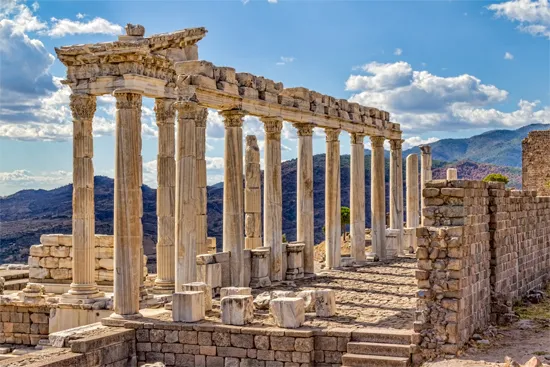
Archaeologically, Pergamon is unique because of its "theatrical" urban planning. Unlike cities on flat plains, Pergamon was built in terraces climbing up a steep mountainside.
The Steepest Theater: The theater of Pergamon is the steepest in the ancient world, built directly into the hillside with a drop so sharp it creates a dizzying view for the audience.
The Asklepion: Down in the valley, Pergamon housed one of the most famous medical centers in antiquity, where the great physician Galen practiced his craft.
The Kingdom of Pergamon proved that a small, wealthy state could dominate through "soft power"—art, diplomacy, and strategic alliances—rather than just brute military force.