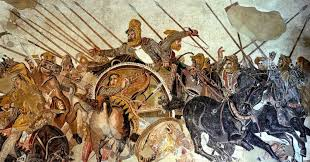
Introduction: The Clash of Kings
In November of 333 BC, the expanding horizon of the Macedonian Empire collided directly with the massed might of the Achaemenid Persian Empire on a narrow coastal plain in modern-day Turkey. This was the Battle of Issus. For the first time since Alexander the Great had crossed the Hellespont, he faced Darius III, the Great King of Persia, in person on the battlefield.
Darius held every strategic card: he had successfully maneuvered his forces behind Alexander's lines, severing his supply network, and he possessed a staggering numerical advantage. Yet, Alexander recognized that Darius’s tactical masterstroke contained a fatal flaw. By choosing a battlefield hemmed in by rugged mountains on one side and the Mediterranean Sea on the other, Darius had trapped his massive army in a bottleneck where numbers meant nothing. What followed was a masterclass in combined-arms warfare, culminating in a daring tactical gamble that broke the Persian center and sent the Great King fleeing for his life.
1. The Strategic Trap: Maneuver and Counter-Maneuver
Before the first arrow was loosed, Darius III executed a brilliant strategic march that caught the Macedonian command completely off guard.
The Severed Supply Line: While Alexander was advancing south through the Syrian Gates in pursuit of the Persian army, Darius took his main force north through a separate mountain pass known as the Amanic Gates. Darius slipped entirely behind Alexander, capturing the town of Issus and massacring the wounded Macedonian soldiers left in the hospital there.
The Imperiled Vanguard: Alexander found himself in a disastrous strategic position: his supply lines were cut, the enemy was at his rear, and the vast resources of the Persian Empire stood between him and home.
The Forced Turnback: Alexander immediately ordered his exhausted army to wheel around and march back north. He raced toward the Pinarus River, a narrow torrent flowing from the mountains to the sea, where Darius had hastily established a defensive line.
2. The Topography of the Pinarus River
The physical geography of the battlefield played a definitive role in neutralizing the Persian numbers, transforming Darius’s vast army into a congested, immobile mass.
The Narrow Funnel: The distance between the Gulf of Issus (the sea) and the jagged foothills of the Amanos Mountains was less than two miles wide.
The Persian Defensive Wall: Darius lined the northern bank of the Pinarus River. Where the river bank was not steep or muddy enough to slow a Macedonian charge, Darius constructed temporary wooden stockades, effectively turning the riverbank into a fortified wall.
The Disastrous Congestion: Darius’s army—estimated by modern historians to be between 60,000 and 100,000 troops (though ancient sources claimed far more)—was too large for the narrow space. His elite cavalry and deep lines of infantry were packed so tightly together that they lost their ability to maneuver, pivot, or deploy their full strength against the advancing Greeks.
3. The Order of Battle: Two Contrasting Doctrines
The opposing armies deployed along the riverbank, mirroring two entirely different approaches to ancient military science.
The Persian Deployment
The Right Flank (The Sea): Darius concentrated the absolute bulk of his heavy, armored cavalry on the coastal sand, where the terrain was flat enough for a massed horse charge designed to crush the Macedonian left.
The Center: Darius positioned himself in a magnificent royal chariot, surrounded by his elite royal bodyguard (The Immortals). Flanking his chariot were roughly 10,000 Greek mercenaries—hardened, heavy hoplites who fought with traditional spears and shields and possessed a deep vendetta against Macedon.
The Left Flank (The Mountains): A mixture of light infantry and skirmishers deployed along the foothills to wrap around Alexander's right side.
The Macedonian Deployment
The Left Flank (The Sea): Commanded by Alexander’s trusted, steady general Parmenio. His sole mission was defensive: hold the line against the overwhelming wave of Persian cavalry on the beach and prevent the army from being outflanked.
The Center: The heavy Macedonian Phalanx, armed with the 18-foot sarissa pikes, designed to advance slowly through the river mud to tie down the Greek mercenaries.
The Right Flank (The Mountains): Commanded by Alexander himself, leading the elite Companion Cavalry (Hetairoi) and agile Agrianian javelin-throwers.
4. Tactical Execution: The Surgical Strike
The battle unfolded not as a chaotic melee, but as a carefully timed sequence of tactical phases engineered by Alexander to exploit the rigid Persian lines.
[ Persian Cavalry Charges Beach ] ──► [ Macedonian Phalanx Fractures in Mud ] ──► [ Companion Cavalry Pierces Left-Center ] ──► [ Diagonal Charge at Darius ]
Phase 1: The Left Flank Crisis
The battle began on the beach. Darius’s massed heavy cavalry surged across the Pinarus River, slamming into Parmenio’s lines. Outnumbered and fighting on shifting sand, the Macedonian left-wing was systematically pushed back. Parmenio’s men suffered catastrophic casualties but held their shield wall together through sheer discipline, buying Alexander the precious minutes he needed on the opposite side of the field.
Phase 2: The Phalanx Fractures
In the center, the Macedonian Phalanx marched into the rushing waters of the Pinarus River. As the soldiers struggled up the steep, muddy northern bank and tried to scale Darius's wooden stockades, their tight formation began to separate. The elite Greek mercenaries fighting for Persia immediately identified these gaps, driving their spears into the fractures. The center of the Macedonian line began to buckle and stall in a brutal, localized slaughter.
Phase 3: The Companion Charge
Seeing his center in danger of total collapse, Alexander unleashed his primary strike force on the extreme right flank. Leading the Companion Cavalry at a dead gallop, he crossed the river, scattered the light Persian infantry on the mountain slopes, and violently wheeled inward.
Instead of attacking the Persian left, Alexander formed his cavalry into a tight, aggressive wedge formation and drove it directly into the exposed, blind seam between the Persian left wing and Darius’s center. The momentum of the heavy Macedonian horses shattered the Persian line, creating a deep breach.
Phase 4: The Hunt for the Great King
Alexander did not stop to roll up the Persian flank. He turned his wedge diagonally, charging directly through the blood-soaked gap straight toward Darius’s royal chariot.
A savage hand-to-hand struggle erupted around the Great King. Darius’s royal brother, Oxathres, threw his cavalry unit in front of the chariot to protect the king, and Alexander was wounded in the thigh by a sword blow. As Darius’s personal chariot drivers and horses were systematically speared down, the royal chariot became trapped among piles of bodies. Panicking, Darius leaped onto a fresh horse and fled the field, abandoning his royal bow, his chariot, and his royal cloak.
5. The Rout and the Royal Capture
The moment the Persian army saw the royal standard drop and realized Darius had fled, their morale disintegrated.
The Domino Effect: The Greek mercenaries and heavy cavalry, who had been winning their localized fights against Parmenio and the phalanx, realized they were about to be encircled from behind by Alexander's triumphant right wing. They broke formation and joined the retreat.
The Bottleneck Carnage: The retreat turned into a catastrophic slaughter. The narrow passes of the Amanic gates became jammed with thousands of fleeing horses, camels, and infantrymen. The historical chronicler Ptolemy later recorded that during the pursuit, his men crossed a deep ravine by walking over a bridge made entirely of stacked Persian corpses.
The Ultimate Trophy: While Darius escaped into the eastern provinces, Alexander captured the ultimate political prize: the Persian royal baggage train. Inside the captured tents at Issus were Darius’s mother (Sisygambis), his wife (Stateira I), and his young children. In a famous display of magnanimity designed to validate his claim as the legitimate new King of Asia, Alexander treated the royal family with absolute imperial dignity, refusing to harm them and maintaining their royal status.
6. Historical Consequences: The Path to Empire
The Battle of Issus was the psychological turning point of Alexander's entire campaign, shattering the illusion of Persian invincibility and permanently altering the geopolitical landscape of the ancient world.
The Rejection of Diplomacy: Following his escape, a desperate Darius sent a letter to Alexander offering a massive ransom for his family, a formal alliance, and the ceding of all Persian territories west of the Euphrates River. Alexander famously rejected the offer, replying that he was now the supreme lord of Asia, and that if Darius wished to contest it, he must stand and fight like a man.
The Mediterranean Strategy: By winning at Issus, Alexander completely neutralized the powerful Persian navy operating in the Aegean Sea. Deprived of their coastal land bases, ports, and funding cities in Phoenicia, the Persian fleet systematically dissolved without Alexander ever having to fight a major sea battle.
The Open Road: Issus cleared the path for the Macedonian army to march south down the Levant, conquer Egypt, and ultimately cross into the heart of Mesopotamia, setting the stage for the final, terminal clash of the Achaemenid Empire at Gaugamela two years later.